Al Saikhan Lamia, Alobaida Muath, Bhuva Anish, Chaturvedi Nish, Heasman John, Hughes Alun D, Jones Siana, Eastwood Sophie, Manisty Charlotte, March Katherine, Ghosh Arjun K, Mayet Jamil, Oguntade Ayodipupo, Tillin Therese, Williams Suzanne, Wright Andrew, Park Chloe
Department of Cardiac Technology, College of Applied Medical Sciences, Imam Abdulrahman Bin Faisal University, Dammam, Saudi Arabia.
MRC Unit for Lifelong Health and Ageing, Department of Population Science & Experimental Medicine, UCL Institute of Cardiovascular Science, University College London, London, United Kingdom.
Front Cardiovasc Med. 2020 Nov 13;7:591946. doi: 10.3389/fcvm.2020.591946. eCollection 2020.
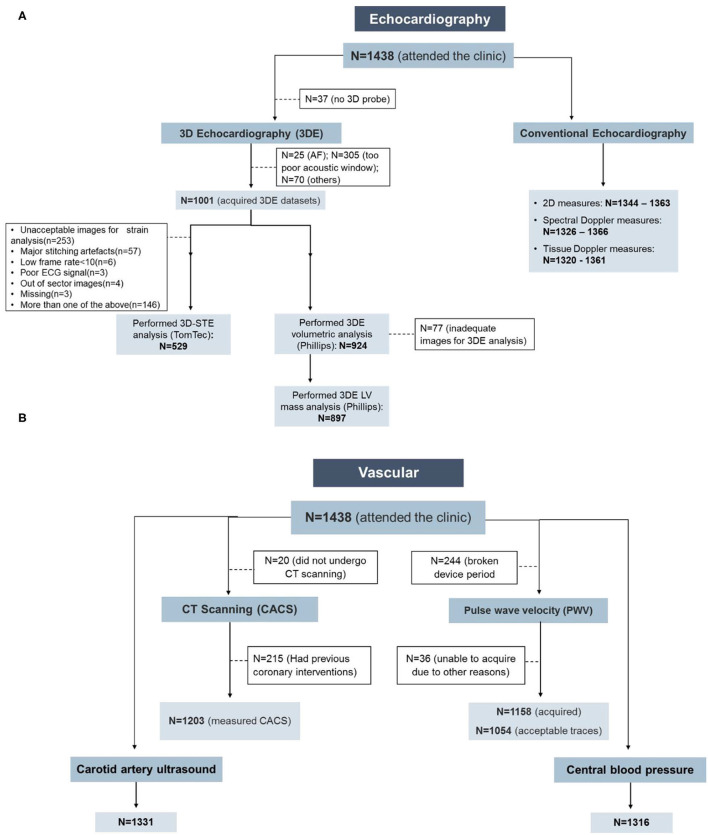
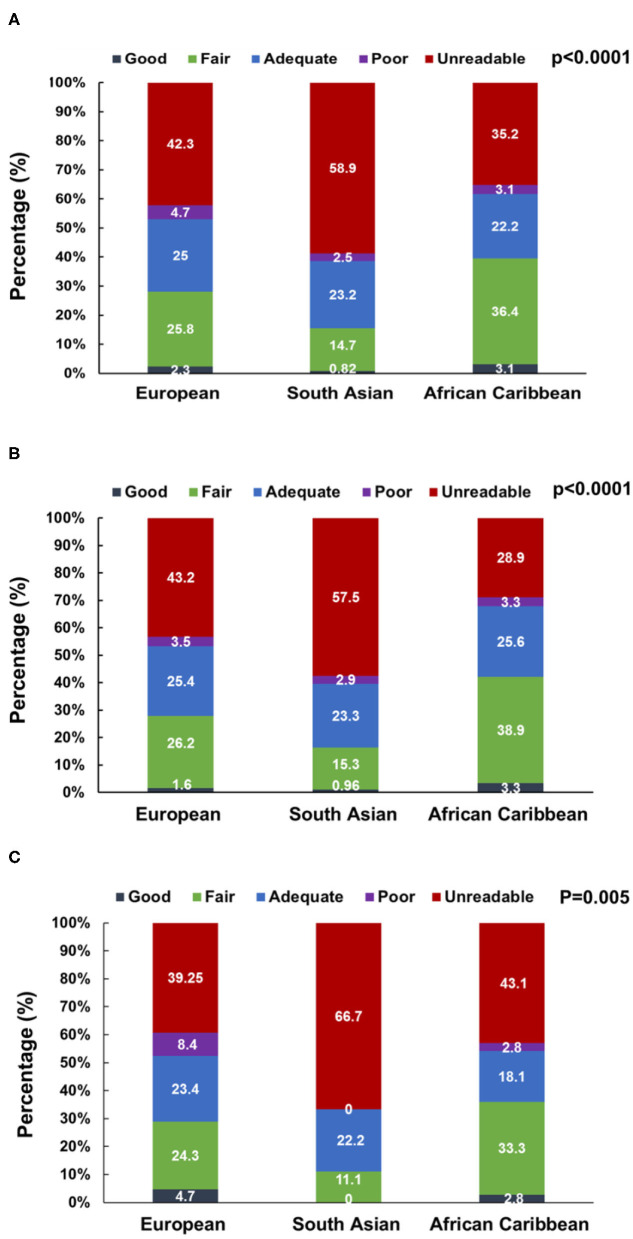
People of South Asian and African Caribbean ethnicities living in UK have a high risk of cardiometabolic disease. Limited data exist regarding detailed cardiometabolic phenotyping in this population. Methods enabling this are widely available, but the practical aspects of undertaking such studies in large and diverse samples are seldom reported. The Southall and Brent Revisited (SABRE) study is the UK's largest tri-ethnic longitudinal cohort. Over 1,400 surviving participants (58-85 years) attended the 2nd study visit (2008-2011); during which, comprehensive cardiovascular phenotyping, including 3D-echocardiography [3D-speckle-tracking (3D-STE)], computed tomography, coronary artery calcium scoring, pulse wave velocity, central blood pressure, carotid artery ultrasound, and retinal imaging, were performed. We describe the methods used with the aim of providing a guide to their feasibility and reproducibility in a large tri-ethnic population-based study of older people. Conventional echocardiography and all vascular measurements showed high feasibility (>90% analyzable of clinic attendees), but 3D-echocardiography (3DE) and 3D-STE were less feasible (76% 3DE acquisition feasibility and 38% 3D-STE feasibility of clinic attendees). 3D-STE feasibility differed by ethnicity, being lowest in South Asian participants and highest in African Caribbean participants ( < 0.0001). Similar trends were observed in men ( < 0.0001) and women ( = 0.005); however, in South Asians, there were more women with unreadable 3D-images compared to men (67 vs. 58%). Intra- and inter-observer variabilities were excellent for most of conventional and advanced echocardiographic measures. The test-retest reproducibility was good-excellent and fair-good for conventional and advanced echocardiographic measures, respectively, but lower than when re-reading the same images. All vascular measures demonstrated excellent or fair-good reproducibility. We describe the feasibility and reproducibility of detailed cardiovascular phenotyping in an ethnically diverse population. The data collected will lead to a better understanding of why people of South Asian and African Caribbean ancestry are at elevated risk of cardiometabolic diseases.
生活在英国的南亚和非洲加勒比裔人群患心脏代谢疾病的风险很高。关于该人群详细心脏代谢表型的现有数据有限。实现这一点的方法广泛可用,但在大型多样样本中进行此类研究的实际情况却鲜有报道。“再访索撒尔和布伦特”(SABRE)研究是英国最大的三族裔纵向队列研究。超过1400名存活参与者(58 - 85岁)参加了第二次研究访视(2008 - 2011年);在此期间,进行了全面的心血管表型分析,包括三维超声心动图[三维斑点追踪(3D - STE)]、计算机断层扫描、冠状动脉钙化评分、脉搏波速度、中心血压、颈动脉超声和视网膜成像。我们描述所使用的方法,旨在为其在一项基于三族裔老年人群的大型研究中的可行性和可重复性提供指导。传统超声心动图和所有血管测量显示出高可行性(诊所参与者中>90%可分析),但三维超声心动图(3DE)和3D - STE的可行性较低(诊所参与者中3DE采集可行性为76%,3D - STE可行性为38%)。3D - STE可行性因种族而异,在南亚参与者中最低,在非洲加勒比参与者中最高(<0.0001)。在男性(<0.0001)和女性(=0.005)中观察到类似趋势;然而,在南亚人中,与男性相比,有更多女性的三维图像不可读(67%对58%)。对于大多数传统和先进的超声心动图测量,观察者内和观察者间的变异性都非常好。重测可重复性对于传统超声心动图测量为良好 - 优秀,对于先进超声心动图测量为中等 - 良好,但低于重新读取相同图像时的情况。所有血管测量均显示出优秀或中等 - 良好的可重复性。我们描述了在一个种族多样化人群中详细心血管表型分析的可行性和可重复性。所收集的数据将有助于更好地理解为什么南亚和非洲加勒比血统的人患心脏代谢疾病的风险较高。