Department of Gastroenterology, Liv Hospital, Samsun, Turkey
Department of Gastroenterology, Hitit University Erol Olçok Training and Research Hospital, Çorum, Turkey
Turk J Med Sci. 2021 Apr 30;51(2):813-818. doi: 10.3906/sag-2010-64.
BACKGROUND/AIM: Familial Mediterranean fever (FMF) is a disease that is mainly diagnosed with clinical features. Several well- known inflammatory markers increase in FMF. However, there is still a need for diagnostic tests for specifying FMF and monitoring inflammatory activity. CXCL16 is a chemokine produced by inflammatory cells that demonstrate efficacy in the acute phase response. In this study, we aimed to investigate the relationship between CXCL16 levels and FMF disease and to evaluate CXCL16 levels as a novel biomarker for FMF.
Fifty-three male patients diagnosed with FMF and sixty healthy individuals were included in this cross- sectional study. Blood samples were taken in the first 24 h of the attack periods. Serum soluble CXCL16 was evaluated by enzyme-linked immunosorbent assay (ELISA) method.
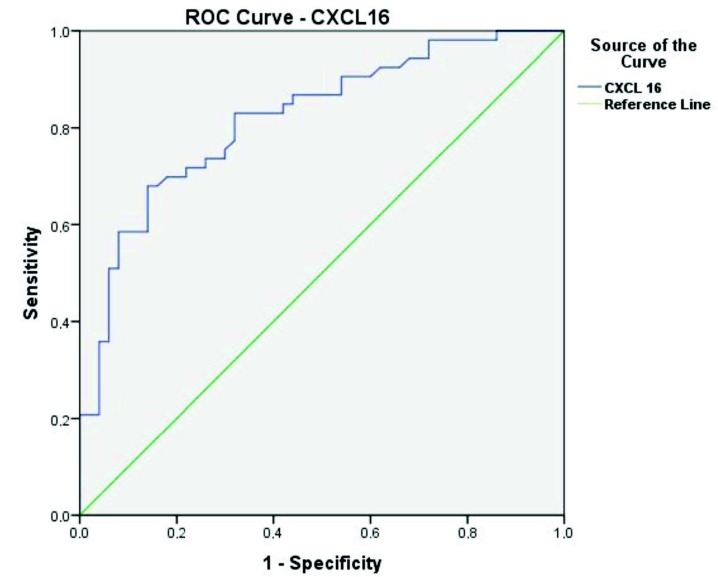
CXCL16 (P < 0.001), erythrocyte sedimentation rate (P < 0.001), C-reactive protein (P < 0.001), and fibrinogen (P = 0.005) were significantly higher in FMF group than in control group. Receiver operating characteristic (ROC) curve analysis revealed a cut off value of CXCL16 as 2.68 ng/ml with 83% sensitivity and 68% specificity (P < 0.001). Logistic regression analysis indicated that high CXCL16 and erythrocyte sedimentation rate levels were predictive parameters for FMF disease (OR 8.31; 95% CI 2.59-26.62; p <0.001) (OR 1.27; 95% CI 1.12-1.44; P < 0.001). There was no correlation between CXCL16 levels and attack frequency and disease duration (P = 0.395, P = 0.956).
To the best of our knowledge, this is the first study evaluating serum soluble CXCL16 levels as a biomarker for FMF. CXCL16 levels were significantly higher and were predictive for monitoring inflammatory activity in patients with FMF. CXCL16 may be a promising biomarker for FMF diagnosis.
背景/目的:家族性地中海热(FMF)主要通过临床特征进行诊断,几种知名的炎症标志物在 FMF 中增加。然而,仍然需要用于指定 FMF 和监测炎症活动的诊断测试。CXCL16 是一种由炎症细胞产生的趋化因子,在急性期反应中显示出疗效。在这项研究中,我们旨在研究 CXCL16 水平与 FMF 疾病之间的关系,并评估 CXCL16 水平作为 FMF 的新型生物标志物。
这项横断面研究纳入了 53 名男性 FMF 患者和 60 名健康个体。在发作期的前 24 小时内采集血液样本。通过酶联免疫吸附试验(ELISA)方法评估血清可溶性 CXCL16。
FMF 组的 CXCL16(P < 0.001)、红细胞沉降率(P < 0.001)、C 反应蛋白(P < 0.001)和纤维蛋白原(P = 0.005)显著高于对照组。接收者操作特征(ROC)曲线分析显示,CXCL16 的截断值为 2.68ng/ml,具有 83%的敏感性和 68%的特异性(P < 0.001)。逻辑回归分析表明,高 CXCL16 和红细胞沉降率水平是 FMF 疾病的预测参数(OR 8.31;95%CI 2.59-26.62;p <0.001)(OR 1.27;95%CI 1.12-1.44;P < 0.001)。CXCL16 水平与发作频率和疾病持续时间之间无相关性(P = 0.395,P = 0.956)。
据我们所知,这是首次评估血清可溶性 CXCL16 水平作为 FMF 生物标志物的研究。CXCL16 水平显著升高,可预测 FMF 患者的炎症活动监测。CXCL16 可能是 FMF 诊断的有前途的生物标志物。