Centre for Clinical Brain Sciences, University of Edinburgh, Edinburgh, UK.
UK Dementia Research Institute, University of Edinburgh, Edinburgh, UK.
Lupus. 2021 Feb;30(2):285-298. doi: 10.1177/0961203320979045. Epub 2020 Dec 13.
This work investigates network organisation of brain structural connectivity in systemic lupus erythematosus (SLE) relative to healthy controls and its putative association with lesion distribution and disease indicators.
White matter hyperintensity (WMH) segmentation and connectomics were performed in 47 patients with SLE and 47 healthy age-matched controls from structural and diffusion MRI data. Network nodes were divided into hierarchical tiers based on numbers of connections. Results were compared between patients and controls to assess for differences in brain network organisation. Voxel-based analyses of the spatial distribution of WMH in relation to network measures and SLE disease indicators were conducted.
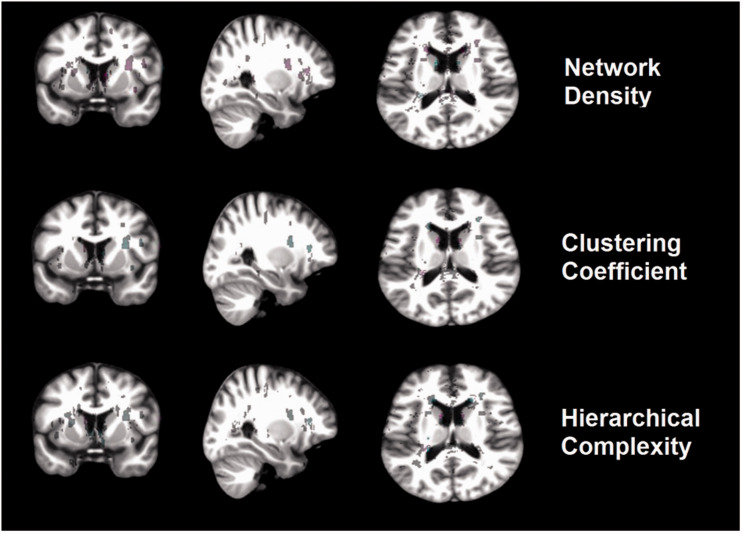
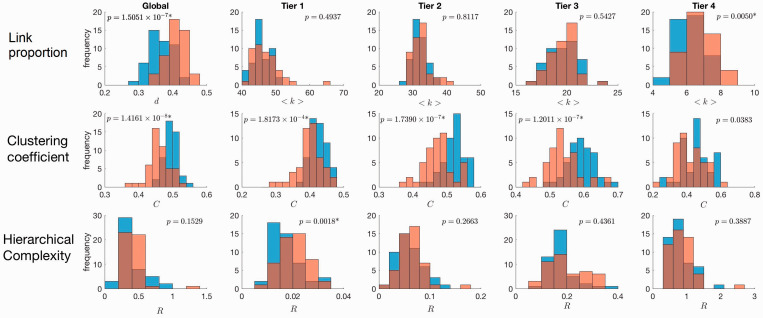
Despite inter-individual differences in brain network organization observed across the study sample, the connectome networks of SLE patients had larger proportion of connections in the peripheral nodes. SLE patients had statistically larger numbers of links in their networks with generally larger fractional anisotropy weights (i.e. a measure of white matter integrity) and less tendency to aggregate than those of healthy controls. The voxels exhibiting connectomic differences were coincident with WMH clusters, particularly the left hemisphere's intersection between the anterior limb of the internal and external capsules. Moreover, these voxels also associated more strongly with disease indicators.
Our results indicate network differences reflective of compensatory reorganization of the neural circuits, reflecting adaptive or extended neuroplasticity in SLE.
本研究旨在探讨系统性红斑狼疮(SLE)患者脑结构连接的网络组织与健康对照者的差异,及其与病变分布和疾病指标的潜在关联。
对 47 例 SLE 患者和 47 例年龄匹配的健康对照者的结构和弥散 MRI 数据进行了脑白质高信号(WMH)分割和连接组学分析。根据连接数量将网络节点分为层次级别。比较患者和对照组之间的脑网络组织差异。对 WMH 在空间分布与网络测量和 SLE 疾病指标之间的关系进行了体素基分析。
尽管在整个研究样本中观察到个体间脑网络组织存在差异,但 SLE 患者的连接组网络具有更大比例的外围节点连接。SLE 患者的网络中存在统计学上更多的连接,且它们的网络具有更大的分数各向异性权重(即衡量白质完整性的指标),且比健康对照组的连接更不容易聚集。表现出连接组差异的体素与 WMH 簇重合,特别是左半球内囊前肢与外囊之间的交点。此外,这些体素与疾病指标的关联也更强。
我们的结果表明,网络差异反映了神经网络的代偿性重组,反映了 SLE 中适应性或扩展的神经可塑性。