Infectious Disease Department, Hospital del Niño Dr José Renán Esquivel, Panama City, Panama; Sistema Nacional de Investigación, Senacyt, Panama.
Bill & Melinda Gates Foundation, Seattle, WA, USA.
Lancet. 2021 Jan 2;397(10268):27-38. doi: 10.1016/S0140-6736(20)32540-X. Epub 2020 Dec 9.
Continued emergence and spread of circulating vaccine-derived type 2 polioviruses and vaccine-associated paralytic poliomyelitis from Sabin oral poliovirus vaccines (OPVs) has stimulated development of two novel type 2 OPV candidates (OPV2-c1 and OPV2-c2) designed to have similar immunogenicity, improved genetic stability, and less potential to reacquire neurovirulence. We aimed to assess safety and immunogenicity of the two novel OPV candidates compared with a monovalent Sabin OPV in children and infants.
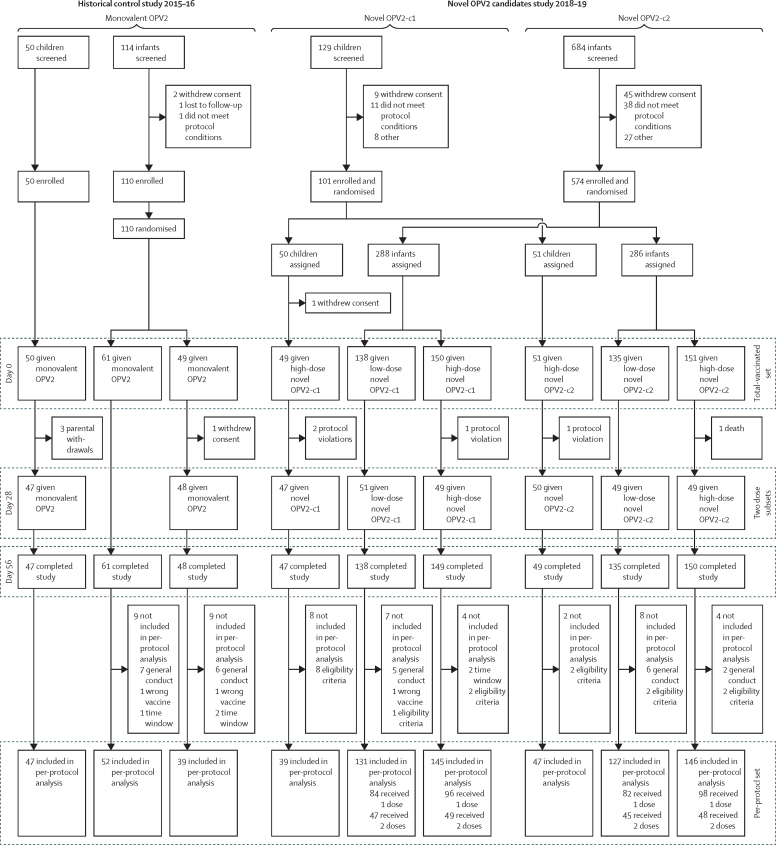
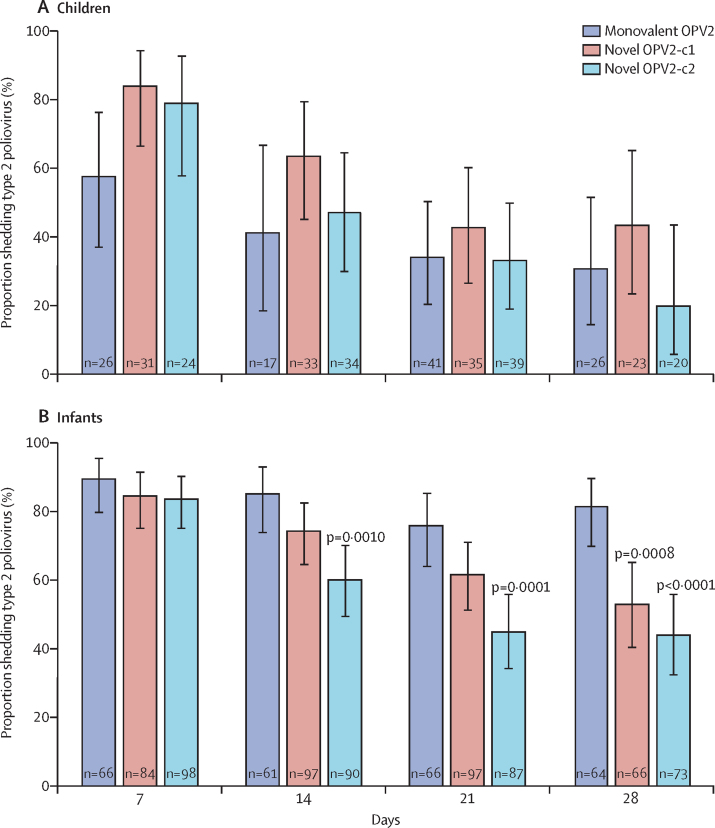
We did two single-centre, multi-site, partly-masked, randomised trials in healthy cohorts of children (aged 1-4 years) and infants (aged 18-22 weeks) in Panama: a control phase 4 study with monovalent Sabin OPV2 before global cessation of monovalent OPV2 use, and a phase 2 study with low and high doses of two novel OPV2 candidates. All participants received one OPV2 vaccination and subsets received two doses 28 days apart. Parents reported solicited and unsolicited adverse events. Type 2 poliovirus neutralising antibodies were measured at days 0, 7, 28, and 56, and stool viral shedding was assessed up to 28 days post-vaccination. Primary objectives were to assess safety in all participants and non-inferiority of novel OPV2 day 28 seroprotection versus monovalent OPV2 in infants (non-inferiority margin 10%). These studies were registered with ClinicalTrials.gov, NCT02521974 and NCT03554798.
The control study took place between Oct 23, 2015, and April 29, 2016, and the subsequent phase 2 study between Sept 19, 2018, and Sept 30, 2019. 150 children (50 in the control study and 100 of 129 assessed for eligibility in the novel OPV2 study) and 684 infants (110 of 114 assessed for eligibility in the control study and 574 of 684 assessed for eligibility in the novel OPV2 study) were enrolled and received at least one study vaccination. Vaccinations were safe and well tolerated with no causally associated serious adverse events or important medical events in any group. Solicited and unsolicited adverse events were overwhelmingly mild or moderate irrespective of vaccine or dose. Nearly all children were seroprotected at baseline, indicating high baseline immunity. In children, the seroprotection rate 28 days after one dose was 100% for monovalent OPV2 and both novel OPV2 candidates. In infants at day 28, 91 (94% [95% CI 87-98]) of 97 were seroprotected after receiving monovalent OPV2, 134 (94% [88-97]) of 143 after high-dose novel OPV2-c1, 122 (93% [87-97]) of 131 after low-dose novel OPV2-c1, 138 (95% [90-98]) of 146 after high-dose novel OPV2-c2, and 115 (91% [84-95]) of 127 after low-dose novel OPV2-c2. Non-inferiority was shown for low-dose and high-dose novel OPV2-c1 and high-dose novel OPV2-c2 despite monovalent OPV2 recipients having higher baseline immunity.
Both novel OPV2 candidates were safe, well tolerated, and immunogenic in children and infants. Novel OPV2 could be an important addition to our resources against poliovirus given the current epidemiological situation.
Fighting Infectious Diseases in Emerging Countries and Bill & Melinda Gates Foundation.
循环疫苗衍生型 2 脊灰病毒和由萨宾口服脊髓灰质炎疫苗(OPV)引起的疫苗相关麻痹性脊髓灰质炎的持续出现和传播,刺激了两种新型 2 型 OPV 候选物(OPV2-c1 和 OPV2-c2)的开发,旨在具有相似的免疫原性、提高遗传稳定性和降低恢复神经毒性的潜力。我们旨在评估与单价萨宾 OPV 相比,两种新型 OPV 候选物在儿童和婴儿中的安全性和免疫原性。
我们在巴拿马的健康儿童(1-4 岁)和婴儿(18-22 周)队列中进行了两项单中心、多地点、部分盲法、随机试验:一项有控制的 4 期研究,在全球停止使用单价 OPV2 之前使用单价萨宾 OPV2,以及一项使用两种新型 OPV2 候选物的低剂量和高剂量的 2 期研究。所有参与者均接受了一次 OPV2 接种,部分参与者接受了 28 天间隔的两次接种。父母报告了征求和未征求的不良事件。在第 0、7、28 和 56 天测量 2 型脊灰病毒中和抗体,并在接种后 28 天内评估粪便病毒脱落情况。主要目标是评估所有参与者的安全性和新型 OPV2 第 28 天的血清保护率与婴儿的单价 OPV2 相比是否具有非劣效性(非劣效性边界 10%)。这些研究在 ClinicalTrials.gov 上注册,NCT02521974 和 NCT03554798。
对照研究于 2015 年 10 月 23 日至 2016 年 4 月 29 日进行,随后的 2 期研究于 2018 年 9 月 19 日至 2019 年 9 月 30 日进行。共有 150 名儿童(对照组 50 名,新型 OPV2 研究 129 名中有 100 名符合入选条件)和 684 名婴儿(对照组 110 名,新型 OPV2 研究 684 名中有 574 名符合入选条件)入组并接受了至少一次研究接种。接种疫苗安全且耐受性良好,任何组均无因果相关的严重不良事件或重要医疗事件。征求和未征求的不良事件绝大多数为轻度或中度,与疫苗或剂量无关。几乎所有儿童在基线时均具有血清保护作用,表明基线免疫水平较高。在儿童中,一剂后 28 天的血清保护率为 100%,单价 OPV2 和两种新型 OPV2 候选物均为 100%。在婴儿中,第 28 天接受单价 OPV2 后,97 名中有 91 名(94%[95%CI 87-98%]),高剂量新型 OPV2-c1 后 143 名中有 134 名(94%[88-97%]),低剂量新型 OPV2-c1 后 131 名中有 122 名(93%[87-97%]),高剂量新型 OPV2-c2 后 146 名中有 138 名(95%[90-98%]),低剂量新型 OPV2-c2 后 127 名中有 115 名(91%[84-95%])。尽管单价 OPV2 受种者具有更高的基线免疫,但新型 OPV2-c1 低剂量和高剂量以及新型 OPV2-c2 高剂量的非劣效性均得到了证明。
两种新型 OPV2 候选物在儿童和婴儿中均安全、耐受且具有免疫原性。鉴于当前的流行病学情况,新型 OPV2 可能是对抗脊灰病毒的重要资源。
抗击传染病新兴国家和比尔及梅琳达盖茨基金会。