Department of Social and Administrative Pharmacy, Faculty of Pharmaceutical Sciences, Chulalongkorn University, Bangkok, Thailand.
Department of Emergency Medicine, Chancellor Tuanku Muhriz Hospital, Universiti Kebangsaan Malaysia Medical Centre, Kuala Lumpur, Malaysia.
J Glob Health. 2020 Dec;10(2):020415. doi: 10.7189/jogh.10.020415.
Snakebite envenoming, a high priority Neglected Tropical Disease categorized by the World Health Organization (WHO), has been considered as a poverty-related disease that requires greater global awareness and collaboration to establish strategies that effectively decrease economic burdens. This prompts the need for a comprehensive review of the global literature that summarizes the global economic burden and a description of methodology details and their variation. This study aimed to systematically identify studies on cost of illness and economic evaluation associated with snakebites, summarize study findings, and evaluate their methods to provide recommendations for future studies.
We searched PubMed, EMBASE, Cochrane library, and Econlit for articles published from inception to 31 July 2019. Original articles reporting costs or full economic evaluation related with snakebites were included. The methods and reporting quality were assessed. Costs were presented in US dollars (US$) in 2018.
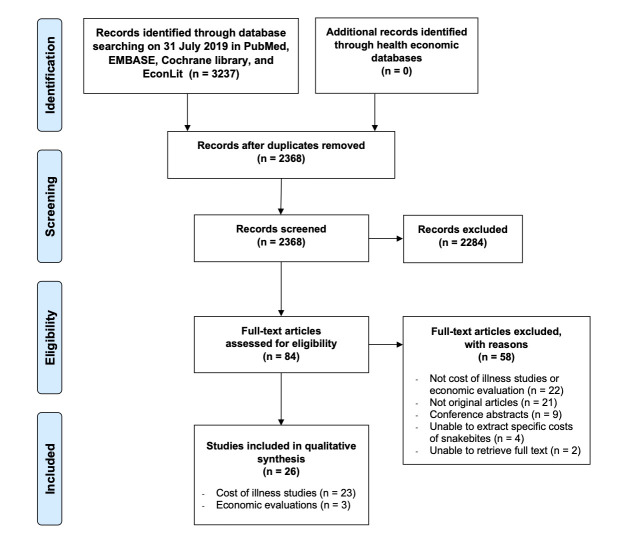
Twenty-three cost of illness studies and three economic evaluation studies related to snakebites were included. Majority of studies (18/23, 78.26%) were conducted in Low- and Middle-income countries. Most cost of illness studies (82.61%) were done using hospital-based data of snakebite patients. While, four studies (17.39%) estimated costs of snakebites in communities. Five studies (21.74%) used societal perspective estimating both direct and indirect costs. Only one study (4.35%) undertook incidence-based approach to estimate lifetime costs. Only three studies (13.04%) estimated annual national economic burdens of snakebite which varied drastically from US$126 319 in Burkina Faso to US$13 802 550 in Sri Lanka. Quality of the cost of illness studies were varied and substantially under-reported. All three economic evaluation studies were cost-effectiveness analysis using decision tree model. Two of them assessed cost-effectiveness of having full access to antivenom and reported cost-effective findings.
Economic burdens of snakebite were underestimated and not extensively studied. To accurately capture the economic burdens of snakebites at both the global and local level, hospital data should be collected along with community survey and economic burdens of snakebites should be estimated both in short-term and long-term period to incorporate the lifetime costs and productivity loss due to premature death, disability, and consequences of snakebites.
蛇伤中毒,一种由世界卫生组织(WHO)列为高度优先的被忽视热带病,被认为是一种与贫困相关的疾病,需要加强全球意识和合作,制定有效减轻经济负担的策略。这促使我们需要对全球文献进行全面综述,总结全球经济负担,并描述方法细节及其变化。本研究旨在系统地确定与蛇伤相关的疾病经济负担和经济评估研究,总结研究结果,并评估其方法,为未来的研究提供建议。
我们检索了 PubMed、EMBASE、Cochrane 图书馆和 Econlit 数据库,以获取从成立到 2019 年 7 月 31 日发表的文章。纳入了报告与蛇伤相关的成本或全经济评估的原始文章。评估了方法和报告质量。成本以 2018 年的美元(US$)表示。
纳入了 23 项与蛇伤相关的疾病经济负担研究和 3 项经济评估研究。大多数研究(18/23,78.26%)在中低收入国家进行。大多数疾病经济负担研究(82.61%)使用了基于医院的蛇伤患者数据。而四项研究(17.39%)则在社区中估算了蛇伤的成本。五项研究(21.74%)采用了社会视角来估算直接和间接成本。仅有一项研究(4.35%)采用基于发病率的方法来估算终生成本。仅有三项研究(13.04%)估算了蛇伤的年度国家经济负担,差异巨大,从布基纳法索的 126319 美元到斯里兰卡的 13802550 美元不等。疾病经济负担研究的质量差异很大,且大量信息未报告。所有三项经济评估研究均为采用决策树模型的成本效益分析。其中两项评估了充分获得抗蛇毒血清的成本效益,并报告了成本效益发现。
对蛇伤的经济负担估计不足,且研究不充分。为了准确地在全球和地方层面捕捉蛇伤的经济负担,应同时收集医院数据和社区调查,并在短期和长期内估算蛇伤的经济负担,以纳入因过早死亡、残疾和蛇伤后果而导致的终生成本和生产力损失。