• 文献检索
  • 文档翻译
  • 深度研究
  • 学术资讯
  • Suppr Zotero 插件Zotero 插件
  • 邀请有礼
  • 套餐&价格
  • 历史记录
应用&插件
Suppr Zotero 插件Zotero 插件浏览器插件Mac 客户端Windows 客户端微信小程序
定价
高级版会员购买积分包购买API积分包
服务
文献检索文档翻译深度研究API 文档MCP 服务
关于我们
关于 Suppr公司介绍联系我们用户协议隐私条款
关注我们

Suppr 超能文献

核心技术专利:CN118964589B侵权必究
粤ICP备2023148730 号-1Suppr @ 2026

文献检索

告别复杂PubMed语法,用中文像聊天一样搜索,搜遍4000万医学文献。AI智能推荐,让科研检索更轻松。

立即免费搜索

文件翻译

保留排版,准确专业,支持PDF/Word/PPT等文件格式,支持 12+语言互译。

免费翻译文档

深度研究

AI帮你快速写综述,25分钟生成高质量综述,智能提取关键信息,辅助科研写作。

立即免费体验

利用2015年至2019年乌干达卫生管理信息系统(HMIS)数据分析疟疾发病率的时空模式

Spatial-temporal patterns of malaria incidence in Uganda using HMIS data from 2015 to 2019.

作者信息

Kigozi Simon P, Kigozi Ruth N, Sebuguzi Catherine M, Cano Jorge, Rutazaana Damian, Opigo Jimmy, Bousema Teun, Yeka Adoke, Gasasira Anne, Sartorius Benn, Pullan Rachel L

机构信息

Department of Disease Control, London School of Hygiene & Tropical Medicine, Keppel Street, London, WC1E 7HT, UK.

Infectious Diseases Research Collaboration, PO Box 7475, Kampala, Uganda.

出版信息

BMC Public Health. 2020 Dec 14;20(1):1913. doi: 10.1186/s12889-020-10007-w.

DOI:10.1186/s12889-020-10007-w
PMID:33317487
原文链接:https://pmc.ncbi.nlm.nih.gov/articles/PMC7737387/
Abstract

BACKGROUND

As global progress to reduce malaria transmission continues, it is increasingly important to track changes in malaria incidence rather than prevalence. Risk estimates for Africa have largely underutilized available health management information systems (HMIS) data to monitor trends. This study uses national HMIS data, together with environmental and geographical data, to assess spatial-temporal patterns of malaria incidence at facility catchment level in Uganda, over a recent 5-year period.

METHODS

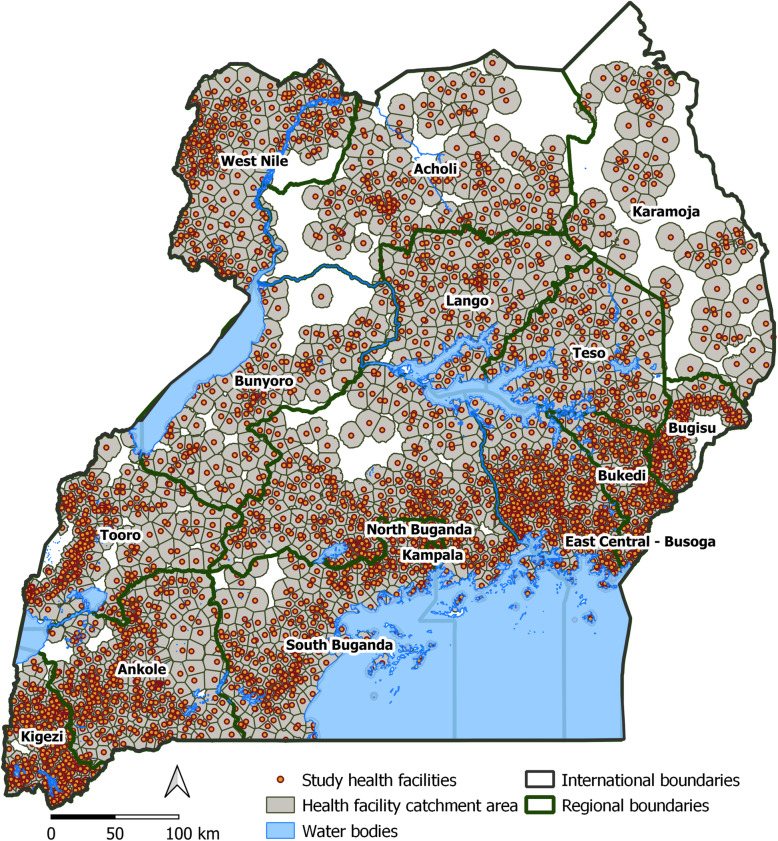
Data reported by 3446 health facilities in Uganda, between July 2015 and September 2019, was analysed. To assess the geographic accessibility of the health facilities network, AccessMod was employed to determine a three-hour cost-distance catchment around each facility. Using confirmed malaria cases and total catchment population by facility, an ecological Bayesian conditional autoregressive spatial-temporal Poisson model was fitted to generate monthly posterior incidence rate estimates, adjusted for caregiver education, rainfall, land surface temperature, night-time light (an indicator of urbanicity), and vegetation index.

RESULTS

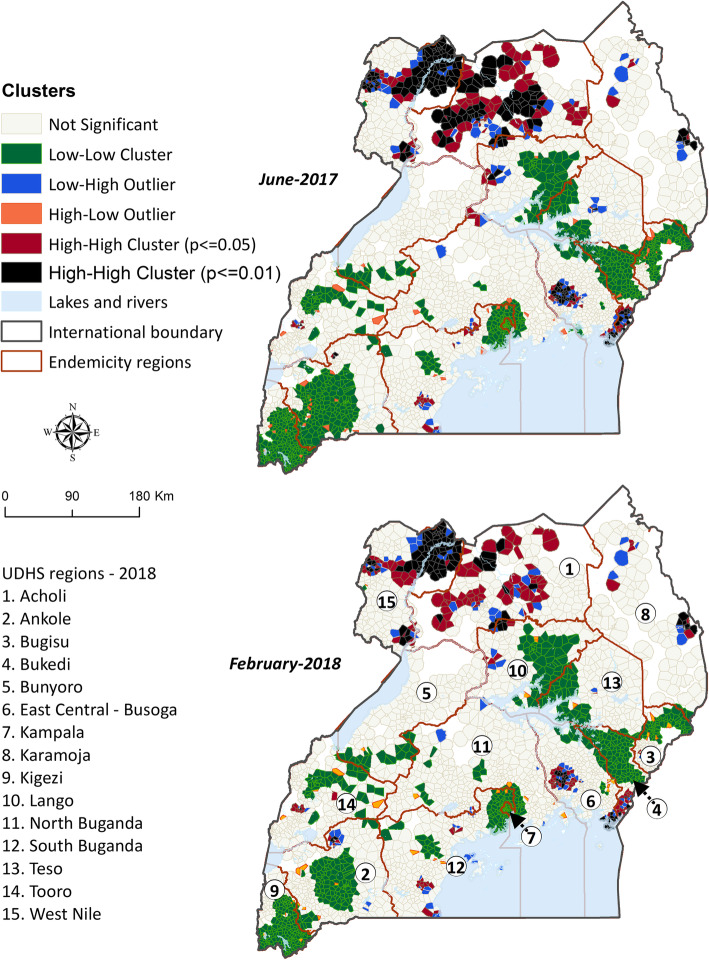
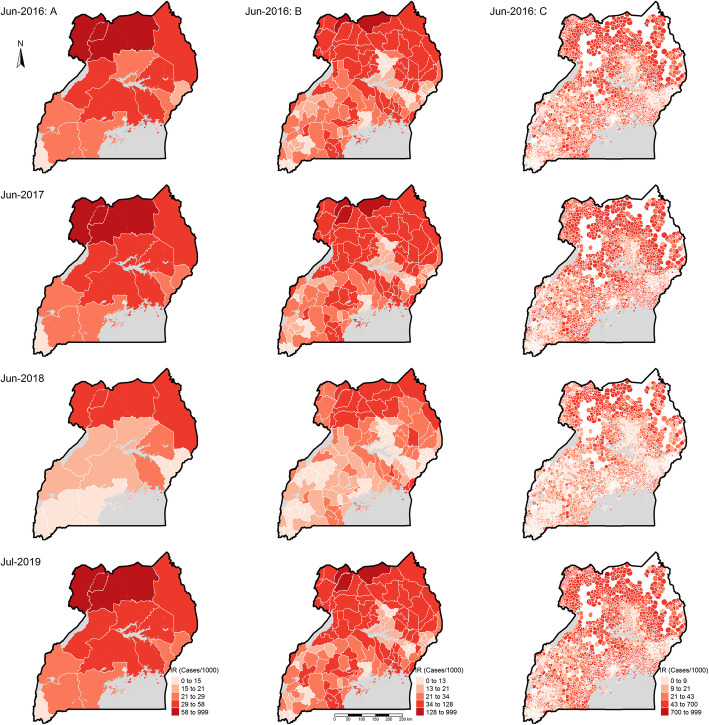
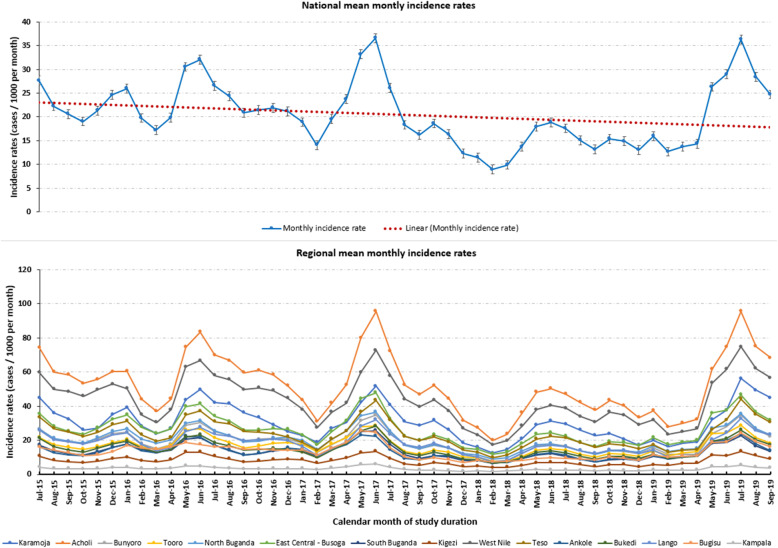
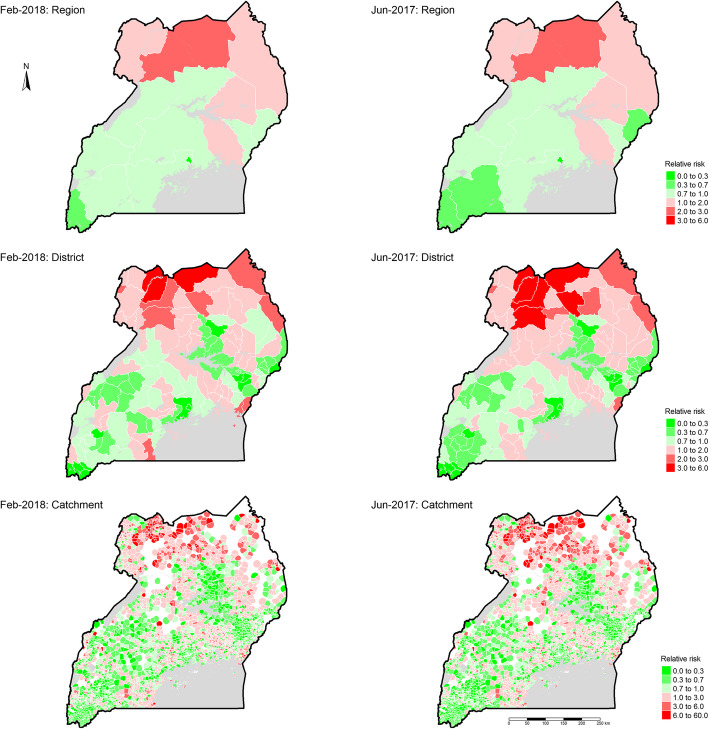
An estimated 38.8 million (95% Credible Interval [CI]: 37.9-40.9) confirmed cases of malaria occurred over the period, with a national mean monthly incidence rate of 20.4 (95% CI: 19.9-21.5) cases per 1000, ranging from 8.9 (95% CI: 8.7-9.4) to 36.6 (95% CI: 35.7-38.5) across the study period. Strong seasonality was observed, with June-July experiencing highest peaks and February-March the lowest peaks. There was also considerable geographic heterogeneity in incidence, with health facility catchment relative risk during peak transmission months ranging from 0 to 50.5 (95% CI: 49.0-50.8) times higher than national average. Both districts and health facility catchments showed significant positive spatial autocorrelation; health facility catchments had global Moran's I = 0.3 (p < 0.001) and districts Moran's I = 0.4 (p < 0.001). Notably, significant clusters of high-risk health facility catchments were concentrated in Acholi, West Nile, Karamoja, and East Central - Busoga regions.

CONCLUSION

Findings showed clear countrywide spatial-temporal patterns with clustering of malaria risk across districts and health facility catchments within high risk regions, which can facilitate targeting of interventions to those areas at highest risk. Moreover, despite high and perennial transmission, seasonality for malaria incidence highlights the potential for optimal and timely implementation of targeted interventions.

摘要

背景

随着全球在减少疟疾传播方面不断取得进展,追踪疟疾发病率而非患病率的变化变得越来越重要。非洲的风险评估在很大程度上未充分利用现有的卫生管理信息系统(HMIS)数据来监测趋势。本研究使用国家HMIS数据以及环境和地理数据,评估乌干达最近5年期间医疗机构集水区层面疟疾发病率的时空模式。

方法

分析了乌干达3446家医疗机构在2015年7月至2019年9月期间报告的数据。为了评估医疗机构网络的地理可达性,使用AccessMod确定每个医疗机构周围三小时成本距离的集水区。利用各医疗机构确诊的疟疾病例和集水区总人口,拟合了一个生态贝叶斯条件自回归时空泊松模型,以生成每月的后验发病率估计值,并根据照顾者教育程度、降雨量、地表温度、夜间灯光(城市化指标)和植被指数进行调整。

结果

在此期间,估计发生了3880万例(95%可信区间[CI]:3790 - 4090万)确诊疟疾病例,全国平均每月发病率为每1000人20.4例(95%CI:19.9 - 21.5),在整个研究期间从8.9例(95%CI:8.7 - 9.4)到36.6例(95%CI:35.7 - 38.5)不等。观察到强烈的季节性,6月至7月出现最高峰,2月至3月出现最低峰。发病率在地理上也存在相当大的异质性,在传播高峰期,医疗机构集水区的相对风险比全国平均水平高0至50.5倍(95%CI:49.0 - 50.8)。地区和医疗机构集水区均显示出显著的正空间自相关性;医疗机构集水区的全局莫兰指数I = 0.3(p < 0.001),地区莫兰指数I = 0.4(p < 0.001)。值得注意的是,高风险医疗机构集水区的显著聚集集中在阿乔利、西尼罗河、卡拉莫贾和东中部 - 布索加地区。

结论

研究结果显示出全国范围内清晰的时空模式,疟疾风险在各地区以及高风险地区内的医疗机构集水区存在聚集现象,这有助于将干预措施针对那些风险最高的地区。此外,尽管疟疾传播率高且常年存在,但发病率的季节性突出了针对性干预措施最佳和及时实施的潜力。
https://cdn.ncbi.nlm.nih.gov/pmc/blobs/6329/7737387/8f9b3a960af3/12889_2020_10007_Fig5_HTML.jpg
https://cdn.ncbi.nlm.nih.gov/pmc/blobs/6329/7737387/0cc5eb122278/12889_2020_10007_Fig1_HTML.jpg
https://cdn.ncbi.nlm.nih.gov/pmc/blobs/6329/7737387/a943a4e6bf63/12889_2020_10007_Fig2_HTML.jpg
https://cdn.ncbi.nlm.nih.gov/pmc/blobs/6329/7737387/6d03dcceacd3/12889_2020_10007_Fig3_HTML.jpg
https://cdn.ncbi.nlm.nih.gov/pmc/blobs/6329/7737387/d3e3fbec5b1a/12889_2020_10007_Fig4_HTML.jpg
https://cdn.ncbi.nlm.nih.gov/pmc/blobs/6329/7737387/8f9b3a960af3/12889_2020_10007_Fig5_HTML.jpg
https://cdn.ncbi.nlm.nih.gov/pmc/blobs/6329/7737387/0cc5eb122278/12889_2020_10007_Fig1_HTML.jpg
https://cdn.ncbi.nlm.nih.gov/pmc/blobs/6329/7737387/a943a4e6bf63/12889_2020_10007_Fig2_HTML.jpg
https://cdn.ncbi.nlm.nih.gov/pmc/blobs/6329/7737387/6d03dcceacd3/12889_2020_10007_Fig3_HTML.jpg
https://cdn.ncbi.nlm.nih.gov/pmc/blobs/6329/7737387/d3e3fbec5b1a/12889_2020_10007_Fig4_HTML.jpg
https://cdn.ncbi.nlm.nih.gov/pmc/blobs/6329/7737387/8f9b3a960af3/12889_2020_10007_Fig5_HTML.jpg

相似文献

1
Spatial-temporal patterns of malaria incidence in Uganda using HMIS data from 2015 to 2019.利用2015年至2019年乌干达卫生管理信息系统(HMIS)数据分析疟疾发病率的时空模式
BMC Public Health. 2020 Dec 14;20(1):1913. doi: 10.1186/s12889-020-10007-w.
2
Estimating malaria incidence from routine health facility-based surveillance data in Uganda.利用乌干达常规卫生机构监测数据估算疟疾发病率。
Malar J. 2020 Dec 2;19(1):445. doi: 10.1186/s12936-020-03514-z.
3
Mapping malaria incidence using routine health facility surveillance data in Uganda.利用乌干达常规卫生机构监测数据绘制疟疾发病率图。
BMJ Glob Health. 2023 May;8(5). doi: 10.1136/bmjgh-2022-011137.
4
The effect of case management and vector-control interventions on space-time patterns of malaria incidence in Uganda.病例管理和病媒控制干预措施对乌干达疟疾发病率时空模式的影响。
Malar J. 2018 Apr 12;17(1):162. doi: 10.1186/s12936-018-2312-7.
5
Mapping malaria seasonality in Madagascar using health facility data.利用医疗机构数据绘制马达加斯加疟疾季节性分布地图。
BMC Med. 2020 Feb 10;18(1):26. doi: 10.1186/s12916-019-1486-3.
6
Folic acid supplementation and malaria susceptibility and severity among people taking antifolate antimalarial drugs in endemic areas.在流行地区,服用抗叶酸抗疟药物的人群中,叶酸补充剂与疟疾易感性和严重程度的关系。
Cochrane Database Syst Rev. 2022 Feb 1;2(2022):CD014217. doi: 10.1002/14651858.CD014217.
7
Estimation of malaria incidence in northern Namibia in 2009 using Bayesian conditional-autoregressive spatial-temporal models.2009年在纳米比亚北部运用贝叶斯条件自回归时空模型估算疟疾发病率。
Spat Spatiotemporal Epidemiol. 2013 Dec;7:25-36. doi: 10.1016/j.sste.2013.09.001. Epub 2013 Sep 17.
8
Childhood malaria case incidence in Malawi between 2004 and 2017: spatio-temporal modelling of climate and non-climate factors.2004 年至 2017 年马拉维儿童疟疾发病情况:气候和非气候因素的时空建模。
Malar J. 2020 Jan 6;19(1):5. doi: 10.1186/s12936-019-3097-z.
9
Geostatistical modelling of malaria indicator survey data to assess the effects of interventions on the geographical distribution of malaria prevalence in children less than 5 years in Uganda.乌干达5岁以下儿童疟疾指标调查数据的地质统计学建模,以评估干预措施对疟疾流行率地理分布的影响
PLoS One. 2017 Apr 4;12(4):e0174948. doi: 10.1371/journal.pone.0174948. eCollection 2017.
10
Practical Implications of a Relationship between Health Management Information System and Community Cohort-Based Malaria Incidence Rates.健康管理信息系统与基于社区队列的疟疾发病率之间关系的实际意义。
Am J Trop Med Hyg. 2020 Jul;103(1):404-414. doi: 10.4269/ajtmh.19-0950. Epub 2020 Apr 2.

引用本文的文献

1
Epidemiological Profile and Risk Factors for Malaria in Rural Communities Before the Operationalization of the Singrobo-Ahouaty Dam, Southern Côte d'Ivoire.科特迪瓦南部辛罗博-阿瓦蒂大坝运行前农村社区疟疾的流行病学概况及危险因素
Trop Med Infect Dis. 2025 Jul 15;10(7):197. doi: 10.3390/tropicalmed10070197.
2
Sibling species composition and feeding pattern of malaria vectors in indoor-sprayed and non-sprayed districts of Lira and Kole, northern Uganda.乌干达北部利拉和科莱室内喷洒区和未喷洒区疟疾媒介的同胞物种组成及摄食模式
Malar J. 2025 Jul 1;24(1):202. doi: 10.1186/s12936-025-05460-0.
3
Using a quality improvement approach to improve reporting of malaria deaths in Namutumba District, Eastern Uganda, 2022-2023.

本文引用的文献

1
Rapid shifts in the age-specific burden of malaria following successful control interventions in four regions of Uganda.疟疾在乌干达四个地区成功控制干预措施后,特定年龄段负担的迅速变化。
Malar J. 2020 Mar 30;19(1):128. doi: 10.1186/s12936-020-03196-7.
2
Mapping routine malaria incidence at village level for targeted control in Papua New Guinea.绘制巴布亚新几内亚村庄层面的常规疟疾发病率,以进行针对性防控。
Geospat Health. 2019 Nov 7;14(2). doi: 10.4081/gh.2019.798.
3
Effects and factors associated with indoor residual spraying with Actellic 300 CS on malaria morbidity in Lira District, Northern Uganda.
2022 - 2023年,采用质量改进方法改善乌干达东部纳穆通巴区疟疾死亡报告情况。
PLOS Glob Public Health. 2025 Jun 2;5(6):e0003324. doi: 10.1371/journal.pgph.0003324. eCollection 2025.
4
Impact of indoor residual spraying on malaria incidence in Ugandan prisons: an interrupted time series analysis.室内滞留喷洒对乌干达监狱疟疾发病率的影响:一项中断时间序列分析
Malar J. 2025 May 25;24(1):163. doi: 10.1186/s12936-025-05422-6.
5
Evaluating malaria burden in children under-five and intervention outcomes in Tarkwa-Nsuaem municipality.评估塔夸-恩苏埃姆市五岁以下儿童的疟疾负担及干预效果。
BMC Infect Dis. 2025 Feb 28;25(1):294. doi: 10.1186/s12879-025-10705-z.
6
Assessing the resilience of child immunisation programmes using geospatial modelling and interrupted time series analysis in Ethiopia and Kenya amidst the COVID-19 pandemic: tracking coverage and identifying key challenges.在埃塞俄比亚和肯尼亚新冠疫情期间,利用地理空间建模和中断时间序列分析评估儿童免疫规划的恢复力:追踪覆盖率并识别关键挑战
BMJ Public Health. 2024 Jul 26;2(1):e000857. doi: 10.1136/bmjph-2023-000857. eCollection 2024 Jun.
7
Safety and Efficacy of Incorporating Actellic 300 CS into Soil Wall Plaster for Control of Malaria Vectors in Rural Northeastern Uganda.将阿克泰300 CS混入乌干达东北部农村土墙灰泥中用于控制疟疾媒介的安全性和有效性。
Trop Med Infect Dis. 2024 Dec 24;10(1):4. doi: 10.3390/tropicalmed10010004.
8
Malaria among febrile patients suspected of Yellow fever during an outbreak in Ghana.加纳疫情期间疑似感染黄热病的发热患者中的疟疾情况。
Res Sq. 2024 Dec 30:rs.3.rs-5684092. doi: 10.21203/rs.3.rs-5684092/v1.
9
Temporal changes in Plasmodium falciparum genetic diversity and multiplicity of infection across three areas of varying malaria transmission intensities in Uganda.乌干达三个疟疾传播强度不同地区恶性疟原虫遗传多样性和感染多虫性的时间变化
Trop Med Health. 2024 Dec 30;52(1):103. doi: 10.1186/s41182-024-00672-7.
10
Effect of seasonal malaria chemoprevention on incidence of malaria among children under five years in Kotido and Moroto Districts, Uganda, 2021: time series analysis.2021年乌干达科蒂多和莫罗托地区季节性疟疾化学预防对五岁以下儿童疟疾发病率的影响:时间序列分析
Malar J. 2024 Dec 18;23(1):389. doi: 10.1186/s12936-024-05220-6.
在乌干达北部利拉区,使用 Actellic 300 CS 室内滞留喷洒对疟疾发病率的影响及相关因素。
Malar J. 2019 Feb 21;18(1):44. doi: 10.1186/s12936-019-2681-6.
4
Innovation to impact in spatial epidemiology.创新对空间流行病学的影响。
BMC Med. 2018 Nov 14;16(1):209. doi: 10.1186/s12916-018-1205-5.
5
Influence of Climatic Factors on Malaria Epidemic in Gulu District, Northern Uganda: A 10-Year Retrospective Study.气候因素对乌干达北部古卢区疟疾流行的影响:一项10年回顾性研究
Malar Res Treat. 2018 Aug 13;2018:5482136. doi: 10.1155/2018/5482136. eCollection 2018.
6
Mapping local variation in educational attainment across Africa.绘制非洲各地教育程度的地域差异图。
Nature. 2018 Feb 28;555(7694):48-53. doi: 10.1038/nature25761.
7
Access to emergency hospital care provided by the public sector in sub-Saharan Africa in 2015: a geocoded inventory and spatial analysis.2015 年撒哈拉以南非洲地区公立部门提供的紧急医院护理服务可及性:地理编码清单和空间分析。
Lancet Glob Health. 2018 Mar;6(3):e342-e350. doi: 10.1016/S2214-109X(17)30488-6. Epub 2018 Jan 26.
8
Spatiotemporal Modeling for Fine-Scale Maps of Regional Malaria Endemicity and Its Implications for Transitional Complexities in a Routine Surveillance Network in Western Cambodia.柬埔寨西部常规监测网络中区域疟疾流行程度精细尺度地图的时空建模及其对过渡复杂性的影响
Front Public Health. 2017 Sep 26;5:262. doi: 10.3389/fpubh.2017.00262. eCollection 2017.
9
Fine scale mapping of malaria infection clusters by using routinely collected health facility data in urban Dar es Salaam, Tanzania.利用坦桑尼亚达累斯萨拉姆市常规收集的卫生设施数据对疟疾感染聚集区进行精细尺度绘图。
Geospat Health. 2017 May 11;12(1):494. doi: 10.4081/gh.2017.494.
10
The impact of urbanization and population density on childhood Plasmodium falciparum parasite prevalence rates in Africa.城市化和人口密度对非洲儿童恶性疟原虫寄生虫感染率的影响。
Malar J. 2017 Jan 26;16(1):49. doi: 10.1186/s12936-017-1694-2.