Dept. of Clinical Sciences, Clinical Research Center, Lund University, Malmö, Sweden.
Dept. of Cardiology, Skåne University Hospital, Lund/Malmö, Sweden.
Cardiovasc Diabetol. 2020 Dec 14;19(1):214. doi: 10.1186/s12933-020-01189-z.
Type 2 diabetes (T2D) patients are at a greater risk of cardiovascular events due to aggravated atherosclerosis. Oxidized LDL (oxLDL) has been shown to be increased in T2D plaques and suggested to contribute to plaque ruptures. Despite intensified statin treatment during the last decade the higher risk for events remains. Here, we explored if intensified statin treatment was associated with reduced oxLDL in T2D plaques and if oxLDL predicts cardiovascular events, to elucidate whether further plaque oxLDL reduction would be a promising therapeutic target.
Carotid plaque OxLDL levels and plasma lipoproteins were assessed in 200 patients. Plaque oxLDL was located by immunohistochemistry. Plaque cytokines, cells and scavenger receptor gene expression were quantified by Luminex, immunohistochemistry and RNA sequencing, respectively. Clinical information and events during follow-up were obtained from national registers.
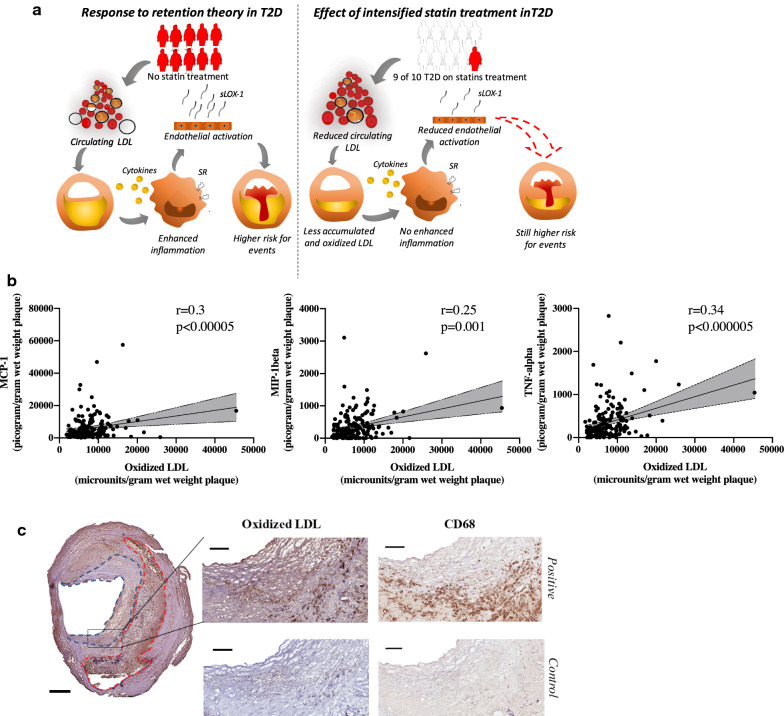
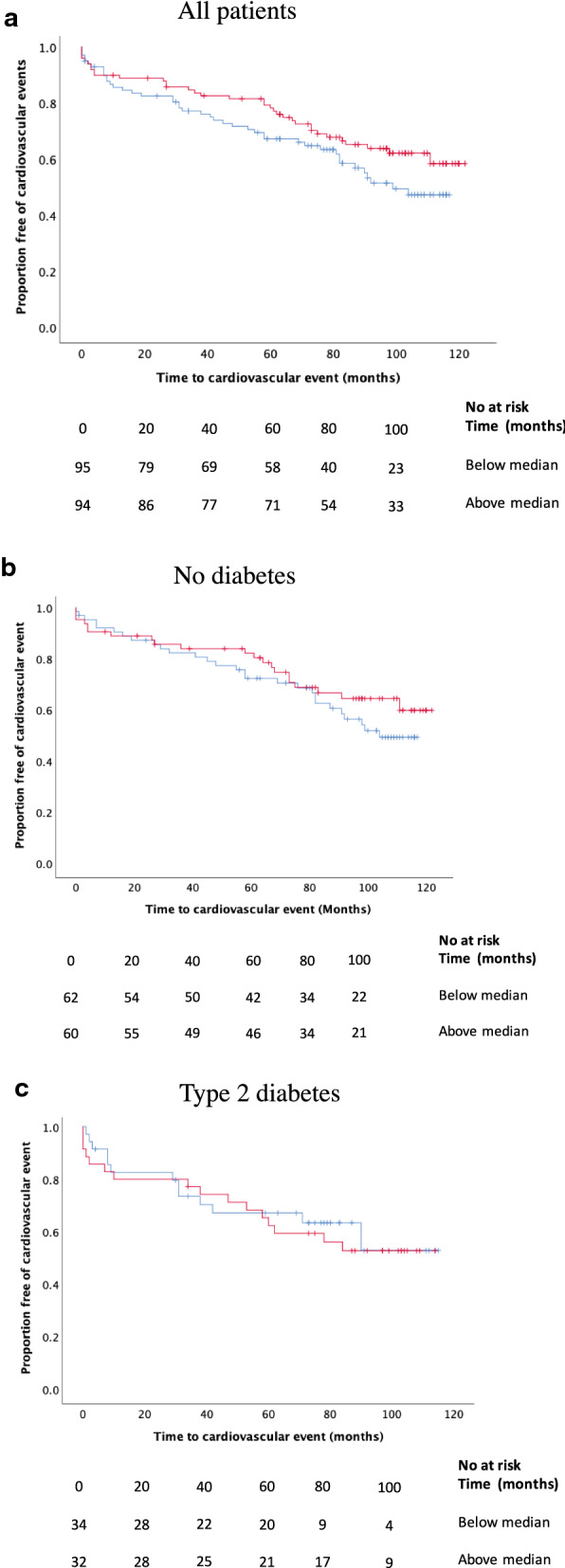
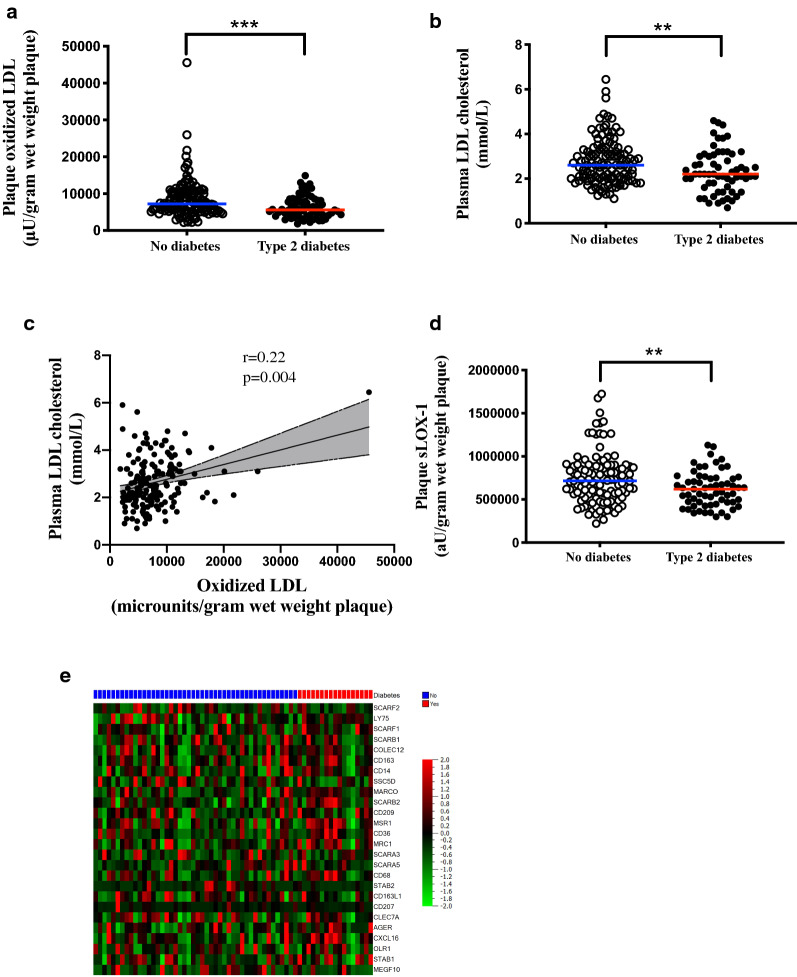
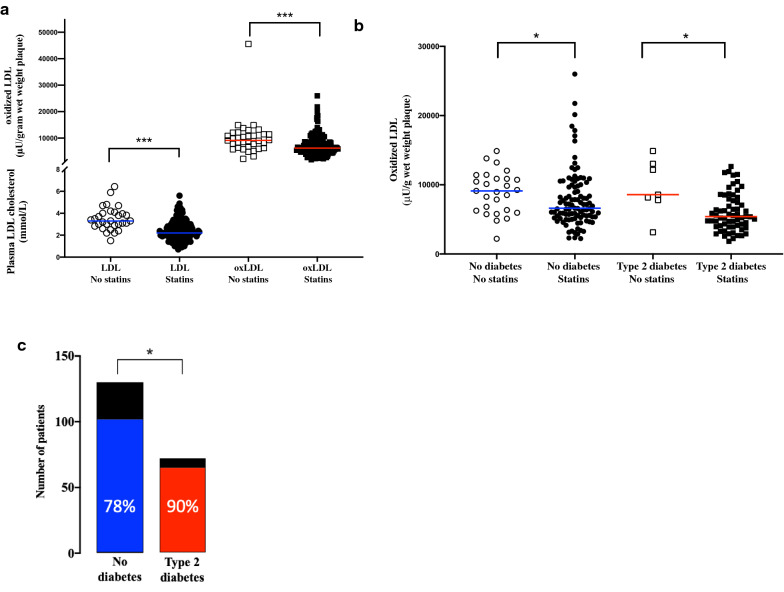
Plaque oxLDL levels correlated with markers of inflammatory activity, endothelial activation and plasma LDL cholesterol (r = 0.22-0.32 and p ≤ 0.01 for all). T2D individuals exhibited lower plaque levels of oxLDL, sLOX-1(a marker of endothelial activation) and plasma LDL cholesterol (p = 0.001, p = 0.006 and p = 0.009). No increased gene expression of scavenger receptors was identified in T2D plaques. The lower oxLDL content in T2D plaques was associated with a greater statin usage (p = 0.026). Supporting this, a linear regression model showed that statin treatment was the factor with the strongest association to plaque oxLDL and plasma LDL cholesterol (p < 0.001 for both). However, patients with T2D more frequently suffered from symptoms and yet plaque levels of oxLDL did not predict cardiovascular events in T2D (findings are summarized in Fig. 1a).
This study points out the importance of statin treatment in affecting plaque biology in T2D. It also implies that other biological components, beyond oxLDL, need to be identified and targeted to further reduce the risk of events among T2D patients receiving statin treatment.
2 型糖尿病(T2D)患者由于动脉粥样硬化加重,发生心血管事件的风险更高。已经证实,T2D 斑块中的氧化型低密度脂蛋白(oxLDL)增加,并认为其导致斑块破裂。尽管在过去十年中强化他汀类药物治疗,但事件风险仍然较高。在这里,我们探讨了强化他汀类药物治疗是否与 T2D 斑块中 oxLDL 的减少相关,以及 oxLDL 是否可以预测心血管事件,以阐明进一步降低斑块 oxLDL 是否是一个有前途的治疗靶点。
在 200 名患者中评估颈动脉斑块 oxLDL 水平和血浆脂蛋白。通过免疫组织化学定位斑块 oxLDL。通过 Luminex、免疫组织化学和 RNA 测序分别定量斑块细胞因子、细胞和清道夫受体基因表达。从国家登记处获得临床信息和随访期间的事件。
斑块 oxLDL 水平与炎症活动、内皮激活和血浆 LDL 胆固醇的标志物相关(r=0.22-0.32,p≤0.01)。T2D 个体的斑块 oxLDL、sLOX-1(内皮激活标志物)和血浆 LDL 胆固醇水平较低(p=0.001,p=0.006 和 p=0.009)。在 T2D 斑块中未发现清道夫受体基因表达增加。T2D 斑块中 oxLDL 含量较低与他汀类药物使用率较高相关(p=0.026)。支持这一点,线性回归模型显示,他汀类药物治疗是与斑块 oxLDL 和血浆 LDL 胆固醇相关性最强的因素(p<0.001)。然而,T2D 患者更频繁地出现症状,但 oxLDL 水平并未预测 T2D 患者的心血管事件(总结如图 1a)。
本研究指出了他汀类药物治疗在影响 T2D 斑块生物学方面的重要性。它还暗示,需要确定并靶向其他生物成分,除了 oxLDL 之外,以进一步降低接受他汀类药物治疗的 T2D 患者的事件风险。