Simurda Tomas, Vilar Rui, Zolkova Jana, Ceznerova Eliska, Kolkova Zuzana, Loderer Dusan, Neerman-Arbez Marguerite, Casini Alessandro, Brunclikova Monika, Skornova Ingrid, Dobrotova Miroslava, Grendar Marian, Stasko Jan, Kubisz Peter
National Centre of Hemostasis and Thrombosis, Department of Hematology and Transfusiology Comenius University in Bratislava, Jessenius Faculty of Medicine in Martin and University Hospital in Martin, 03601 Martin, Slovakia.
Department of Genetic Medicine and Development, University Medical School of Geneva, 1211 Geneva, Switzerland.
Biomedicines. 2020 Dec 13;8(12):605. doi: 10.3390/biomedicines8120605.
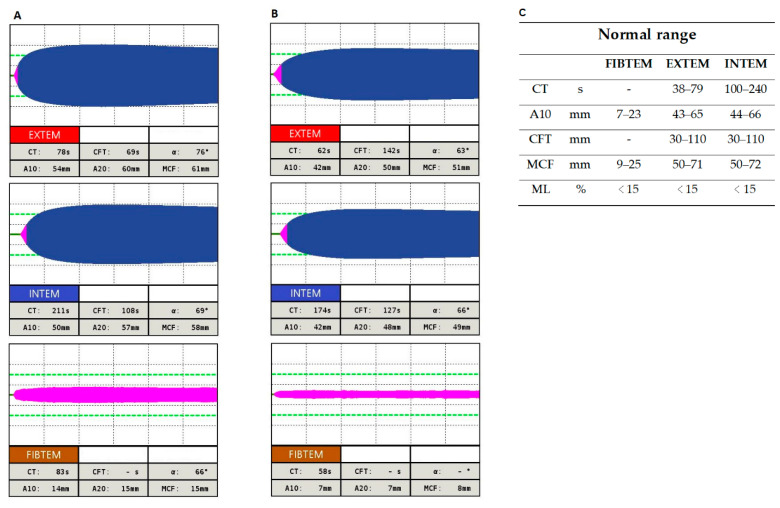
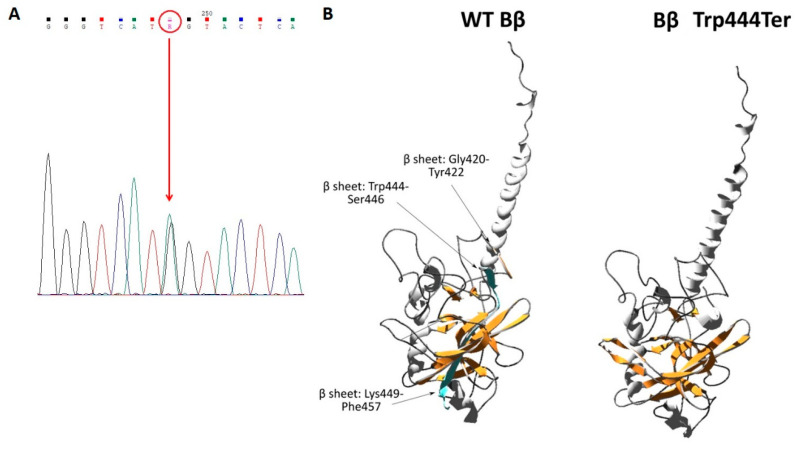
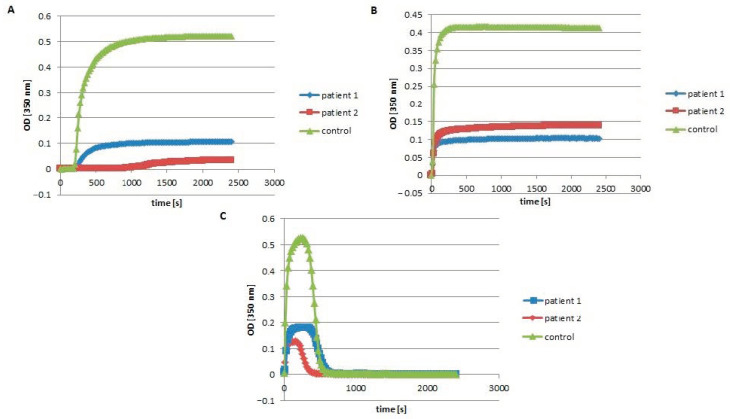
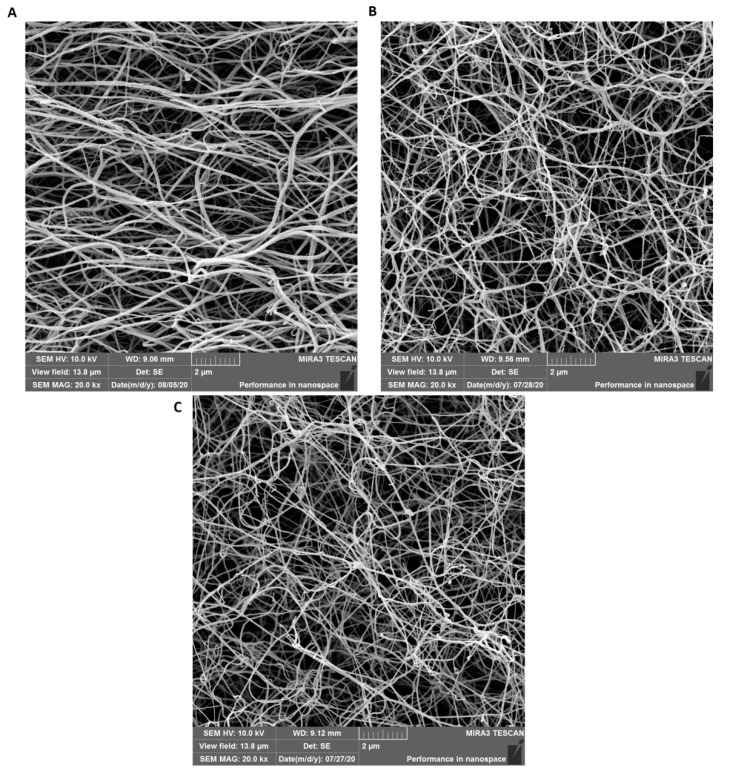
Congenital hypofibrinogenemia is a rare bleeding disorder characterized by a proportional decrease of functional and antigenic fibrinogen levels. Hypofibrinogenemia can be considered the phenotypic expression of heterozygous loss of function mutations occurring within one of the three fibrinogen genes (, , and ). Clinical manifestations are highly variable; most patients are usually asymptomatic, but may appear with mild to severe bleeding or thrombotic complications. We have sequenced all exons of the , , and genes using the DNA isolated from the peripheral blood in two unrelated probands with mild hypofibrinogenemia. Coagulation screening, global hemostasis, and functional analysis tests were performed. Molecular modeling was used to predict the defect of synthesis and structural changes of the identified mutation. DNA sequencing revealed a novel heterozygous variant c.1421G>A in exon 8 of the gene encoding a Bβ chain (p.Trp474Ter) in both patients. Clinical data from patients showed bleeding episodes. Protein modelling confirmed changes in the secondary structure of the molecule, with the loss of three β sheet arrangements. As expected by the low fibrinogen levels, turbidity analyses showed a reduced fibrin polymerisation and imaging difference in thickness fibrin fibers. We have to emphasize that our patients have a quantitative fibrinogen disorder; therefore, the reduced function is due to the reduced concentration of fibrinogen, since the Bβ chains carrying the mutation predicted to be retained inside the cell. The study of fibrinogen molecules using protein modelling may help us to understand causality and effect of novel genetic mutations.
先天性低纤维蛋白原血症是一种罕见的出血性疾病,其特征是功能性和抗原性纤维蛋白原水平成比例下降。低纤维蛋白原血症可被视为三个纤维蛋白原基因(FGA、FGB和FGG)之一发生杂合性功能丧失突变的表型表达。临床表现高度可变;大多数患者通常无症状,但可能出现轻度至重度出血或血栓形成并发症。我们使用从两名患有轻度低纤维蛋白原血症的无关先证者外周血中分离的DNA,对FGA、FGB和FGG基因的所有外显子进行了测序。进行了凝血筛查、整体止血和功能分析测试。分子建模用于预测已识别突变的合成缺陷和结构变化。DNA测序显示,两名患者中编码Bβ链的FGB基因外显子8中存在一个新的杂合变体c.1421G>A(p.Trp474Ter)。患者的临床数据显示有出血发作。蛋白质建模证实了分子二级结构的变化,失去了三个β折叠排列。正如低纤维蛋白原水平所预期的那样,浊度分析显示纤维蛋白聚合减少,纤维蛋白纤维厚度的成像差异。我们必须强调,我们的患者患有定量纤维蛋白原疾病;因此,功能降低是由于纤维蛋白原浓度降低,因为携带预测将保留在细胞内的突变的Bβ链。使用蛋白质建模对纤维蛋白原分子进行研究可能有助于我们理解新基因突变的因果关系和影响。