Hartnett Erin G, Knight Julia, Radolec Mackenzy, Buckanovich Ronald J, Edwards Robert P, Vlad Anda M
Department of Obstetrics and Gynecology and Reproductive Sciences, Magee-Womens Research Institute and Foundation and Magee-Womens Hospital of UPMC, School of Medicine, University of Pittsburgh, Pittsburgh, PA 15213, USA.
School of Medicine, University of Pittsburgh, Pittsburgh, PA 15213, USA.
Cancers (Basel). 2020 Dec 11;12(12):3733. doi: 10.3390/cancers12123733.
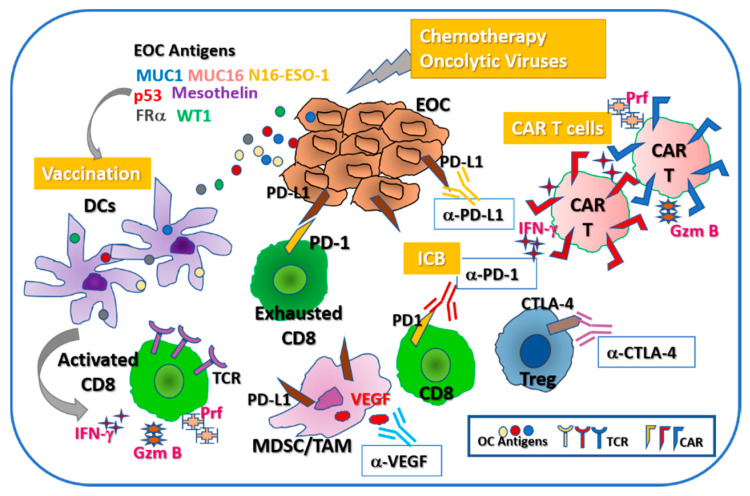
New treatment modalities are needed in order to improve the prognosis of women diagnosed with epithelial ovarian cancer (EOC), the most aggressive gynecologic cancer type. Most ovarian tumors are infiltrated by immune effector cells, providing the rationale for targeted approaches that boost the existing or trigger new anti-tumor immune mechanisms. The field of immuno-oncology has experienced remarkable progress in recent years, although the results seen with single agent immunotherapies in several categories of solid tumors have yet to extend to ovarian cancer. The challenge remains to determine what treatment combinations are most suitable for this disease and which patients are likely to benefit and to identify how immunotherapy should be incorporated into EOC standard of care. We review here some of the most promising immune therapies for EOC and focus on those currently tested in clinical trials.
为了改善被诊断为上皮性卵巢癌(EOC,最具侵袭性的妇科癌症类型)的女性患者的预后,需要新的治疗方式。大多数卵巢肿瘤都有免疫效应细胞浸润,这为增强现有或触发新的抗肿瘤免疫机制的靶向治疗方法提供了理论依据。近年来,免疫肿瘤学领域取得了显著进展,尽管在几类实体瘤中使用单药免疫疗法的结果尚未扩展到卵巢癌。挑战仍然在于确定哪些治疗组合最适合这种疾病,哪些患者可能从中受益,并确定如何将免疫疗法纳入EOC的标准治疗方案。我们在此回顾一些最有前景的EOC免疫疗法,并重点关注目前正在临床试验中测试的疗法。