Argudo Ramírez Ana, Martín Nalda Andrea, Marín Soria José Luis, López Galera Rosa María, González de Aledo Castillo José Manuel, Pajares García Sonia, Rivière Jacques G, Martínez Gallo Mónica, Colobran Roger, Parra Martínez Alba, Ribes Rubio Antonia, Fernández Bardon Rosa María, Asso Ministral Laia, Prats Viedma Blanca, García Villoria Judit, Soler Palacín Pere
Sección de Errores Congénitos del Metabolismo-IBC. Servicio de Bioquímica y Genética Molecular. Centro de Diagnóstico Biomédico. Hospital Clínic. Barcelona. España.
Unidad de Patología Infecciosa e Inmunodeficiencias de Pediatría. Hospital Universitari Vall d'Hebron. Institut de Recerca Vall d'Hebron. Centro Jeffrey Modell para el diagnóstico e investigación en inmunodeficiencias primarias. Universitat Autónoma de Barcelona. Barcelona. España.
Rev Esp Salud Publica. 2020 Dec 16;94:e202012153.
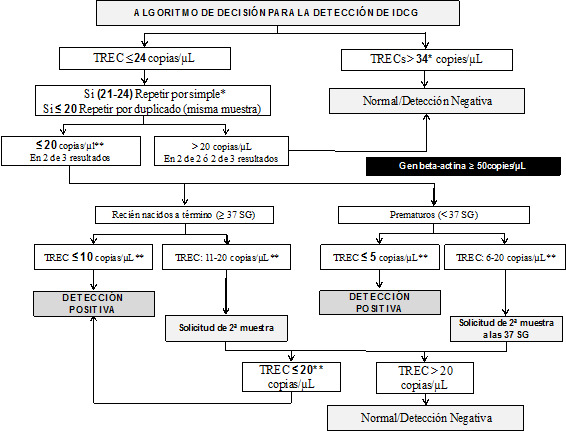
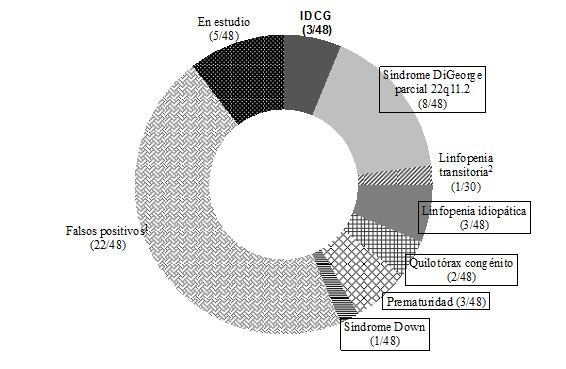
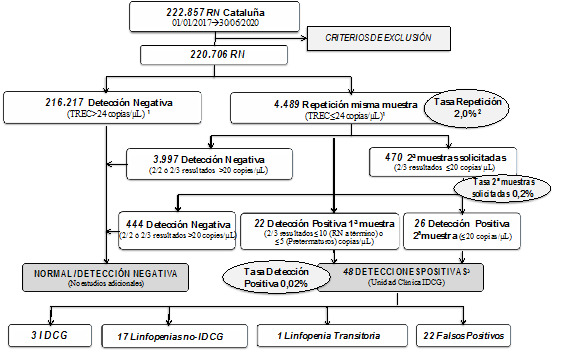
Severe combined immunodeficiency (SCID), the most severe form of T-cell immunodeficiency, can be screened at birth by quantifying T-cell receptor excision circles (TREC) in dried blood spot (DBS) samples. Early detection of this condition speeds up the establishment of appropriate treatment and increases the patient's life expectancy. Newborn screening for SCID started in January 2017 in Catalonia, the first Spanish and European region to universally include this testing. The results obtained in the first three years and a half of experience (January 2017 - June 2020) are shown here, using EnLite Neonatal TREC kit (Perkin Elmer) with 20 copies/µL as TREC detection cutoff. Of 222,857 newborns screened, 48 tested positive: three patients were diagnosed with SCID (incidence 1:74,285); 17 patients had clinically significant T-cell lymphopenia (non-SCID) with an incidence of 1 in 13,109 newborns; twenty two patients were considered false-positive cases because of an initially normal lymphocyte count with normalization of TREC between 3 and 6 months of life; one case had transient lymphopenia due to an initially low lymphocyte count with recovery in the following months; and five patients are still under study. The results obtained provide further evidence of the benefits of including this disease in newborn screening programs. Even longer follow-up could be necessary to define the exact incidence of SCID in Catalonia.
严重联合免疫缺陷病(SCID)是最严重的T细胞免疫缺陷形式,可通过对干血斑(DBS)样本中的T细胞受体切除环(TREC)进行定量分析在出生时进行筛查。早期发现这种疾病可加快适当治疗方案的确定,并延长患者的预期寿命。2017年1月,加泰罗尼亚开始对SCID进行新生儿筛查,加泰罗尼亚是西班牙和欧洲首个全面开展此项检测的地区。本文展示了头三年半(2017年1月至2020年6月)使用EnLite新生儿TREC试剂盒(珀金埃尔默公司)、以20拷贝/微升作为TREC检测临界值所获得的结果。在222857名接受筛查新生儿中,48例检测呈阳性:3例患者被诊断为SCID(发病率1:74285);17例患者患有具有临床意义的T细胞淋巴细胞减少症(非SCID),新生儿发病率为1/13109;22例患者被视为假阳性病例,原因是其淋巴细胞计数最初正常,且在3至6个月大时TREC恢复正常;1例患者因最初淋巴细胞计数较低且在随后几个月恢复而出现短暂性淋巴细胞减少症;5例患者仍在研究中。所获得的结果进一步证明了将这种疾病纳入新生儿筛查项目的益处。可能需要更长时间的随访才能确定加泰罗尼亚SCID的确切发病率。