Ghosh Sujal, Albert Michael H, Hauck Fabian, Hönig Manfred, Schütz Catharina, Schulz Ansgar, Speckmann Carsten
Klinik für Kinder-Onkologie, -Hämatologie und Klinische Immunologie, Zentrum für Kinder- und Jugendmedizin, Universitätsklinikum Düsseldorf, Düsseldorf, Deutschland.
Klinik für Kinder-Onkologie, -Hämatologie und Klinische Immunologie, Zentrum für Kinder- und Jugendmedizin, Universitätsklinikum Düsseldorf, Moorenstr. 5, 40225, Düsseldorf, Deutschland.
Bundesgesundheitsblatt Gesundheitsforschung Gesundheitsschutz. 2023 Nov;66(11):1222-1231. doi: 10.1007/s00103-023-03773-6. Epub 2023 Sep 19.
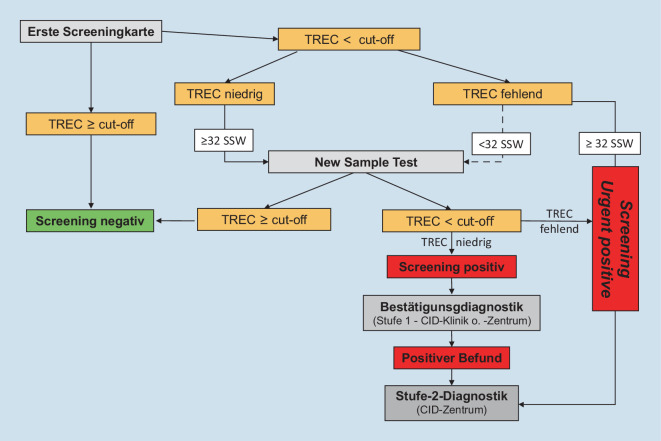
Patients with a severe combined immunodeficiency (SCID) harbor genetic mutations disrupting T cell immunity and hence suffer severe, life-threatening infections or manifestations of immune dysregulation within the first months of their life. The only cure is to correct their immune system, usually by means of hematopoietic stem cell transplantation (HSCT). Pilot studies and national programs in the United States and in European countries have shown that patients can be identified at an early asymptomatic stage through newborn screening. This allows treatment before the occurrence of severe complications, which improves the outcome of curative strategies like HSCT.After assessment by the Federal Joint Committee (G-BA), the SCID screening was implemented into newborn screening in Germany in 2019. The first results of the screening (dry blood spot cards from around 2 million newborns between August 2019 and February 2022) were recently published. As expected, in addition to classic SCID diseases (incidence 1:54,000), infants with syndromic disorders and T cell lymphopenia were also identified. All patients with classic SCID were scheduled for curative treatment. Of the 25 patients with classic SCID, 21 were already transplanted at the time of data analysis. Only one of 21 transplanted patients died due to pre-existing infections. A comparison of the recent screening data with historical data suggests that SCID newborn screening has been successfully implemented in Germany. Patients with SCID are routinely identified very early and scheduled for curative therapy.
患有严重联合免疫缺陷(SCID)的患者存在破坏T细胞免疫的基因突变,因此在出生后的头几个月会遭受严重的、危及生命的感染或免疫失调表现。唯一的治疗方法是纠正他们的免疫系统,通常通过造血干细胞移植(HSCT)来实现。美国和欧洲国家的试点研究及国家项目表明,通过新生儿筛查可以在早期无症状阶段识别患者。这使得在严重并发症发生之前就能进行治疗,从而改善了HSCT等治愈性策略的治疗效果。经联邦联合委员会(G-BA)评估后,SCID筛查于2019年在德国纳入新生儿筛查。最近公布了筛查的首批结果(2019年8月至2022年2月期间约200万新生儿的干血斑卡片)。正如预期的那样,除了经典的SCID疾病(发病率1:54,000)外,还识别出了患有综合征性疾病和T细胞淋巴细胞减少症的婴儿。所有经典SCID患者都被安排进行治愈性治疗。在25例经典SCID患者中,21例在数据分析时已经接受了移植。21例移植患者中只有1例因既往感染死亡。将近期筛查数据与历史数据进行比较表明,SCID新生儿筛查已在德国成功实施。SCID患者通常能在很早的时候被识别出来,并被安排进行治愈性治疗。