
嗅觉识别能力与β-淀粉样蛋白和tau蛋白负荷的关联:一项系统评价和荟萃分析。
Association of Odor Identification Ability With Amyloid-β and Tau Burden: A Systematic Review and Meta-Analysis.
作者信息
Tu Lihui, Lv Xiaozhen, Fan Zili, Zhang Ming, Wang Huali, Yu Xin
机构信息
Dementia Care and Research Center, Clinical Research Division, Peking University Institute of Mental Health (Sixth Hospital), Beijing, China.
Beijing Dementia Key Lab, National Clinical Research Center for Mental Disorders, Key Laboratory of Mental Health, Ministry of Health Peking University, Beijing, China.
出版信息
Front Neurosci. 2020 Nov 26;14:586330. doi: 10.3389/fnins.2020.586330. eCollection 2020.
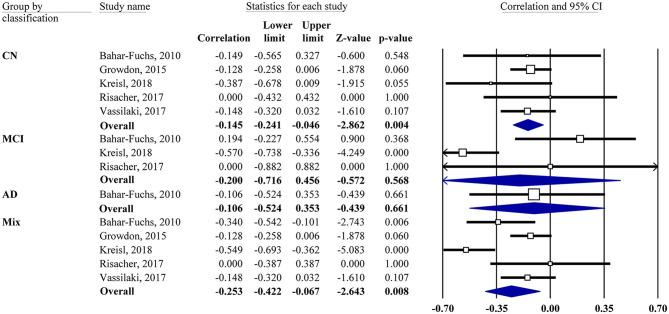
The associations between olfactory identification (OI) ability and the Alzheimer's disease biomarkers were not clear. This meta-analysis aimed to examine the associations between OI and Aβ and tau burden. Electronic databases (PubMed, Embase, PsycINFO, and Google Scholar) were searched until June 2019 to identify studies that reported correlation coefficients or regression coefficients between OI and Aβ or tau levels measured by positron emission tomography (PET) or cerebrospinal fluid (CSF). Pooled Pearson correlation coefficients were computed for the PET imaging and CSF biomarkers, with subgroup analysis for subjects classified into different groups. Nine studies met the inclusion criteria. Of these, five studies ( = 494) involved Aβ PET, one involved tau PET ( = 26), and four involved CSF Aβ or tau ( = 345). OI was negatively associated with Aβ PET in the mixed ( = -0.25, = 0.008) and cognitively normal groups ( = -0.15, = 0.004) but not in the mild cognitive impairment group. A similar association with CSF total tau in the mixed group was also observed. No association was found between OI and CSF phosphorylated tau or Aβ in the subgroup analysis of the CSF biomarkers. Due to a lack of data, no pooled value could be computed for the association between the OI and tau PET. The associations between OI ability and Aβ and CSF tau burden in older adults are negligible. While current evidence does not support the association, further studies using PET tau imaging are warranted.
嗅觉识别(OI)能力与阿尔茨海默病生物标志物之间的关联尚不清楚。本荟萃分析旨在研究OI与Aβ和tau蛋白负荷之间的关联。检索了电子数据库(PubMed、Embase、PsycINFO和谷歌学术)直至2019年6月,以识别报告了通过正电子发射断层扫描(PET)或脑脊液(CSF)测量的OI与Aβ或tau水平之间相关系数或回归系数的研究。计算了PET成像和CSF生物标志物的合并Pearson相关系数,并对分类为不同组别的受试者进行了亚组分析。九项研究符合纳入标准。其中,五项研究(n = 494)涉及Aβ PET,一项涉及tau PET(n = 26),四项涉及CSF Aβ或tau(n = 345)。在混合组(r = -0.25,p = 0.008)和认知正常组(r = -0.15,p = 0.004)中,OI与Aβ PET呈负相关,但在轻度认知障碍组中无此关联。在混合组中也观察到OI与CSF总tau有类似关联。在CSF生物标志物的亚组分析中,未发现OI与CSF磷酸化tau或Aβ之间存在关联。由于缺乏数据,无法计算OI与tau PET之间关联的合并p值。老年人的OI能力与Aβ和CSF tau蛋白负荷之间的关联可忽略不计。虽然目前的证据不支持这种关联,但仍有必要使用PET tau成像进行进一步研究。


 Zotero 插件