Kucera Jiri, Lochman Jan, Bouchal Pavel, Pakostova Eva, Mikulasek Kamil, Hedrich Sabrina, Janiczek Oldrich, Mandl Martin, Johnson D Barrie
Department of Biochemistry, Faculty of Science, Masaryk University, Brno, Czechia.
School of Biological Sciences, College of Natural Sciences, Bangor University, Bangor, United Kingdom.
Front Microbiol. 2020 Nov 30;11:610836. doi: 10.3389/fmicb.2020.610836. eCollection 2020.
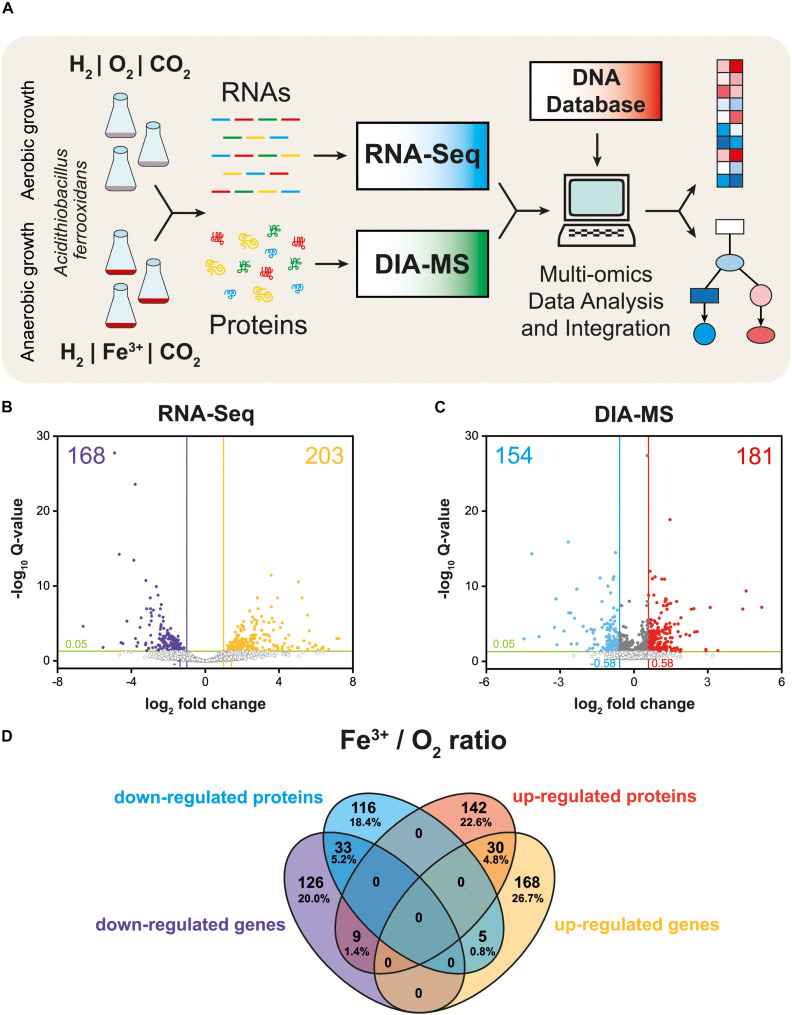
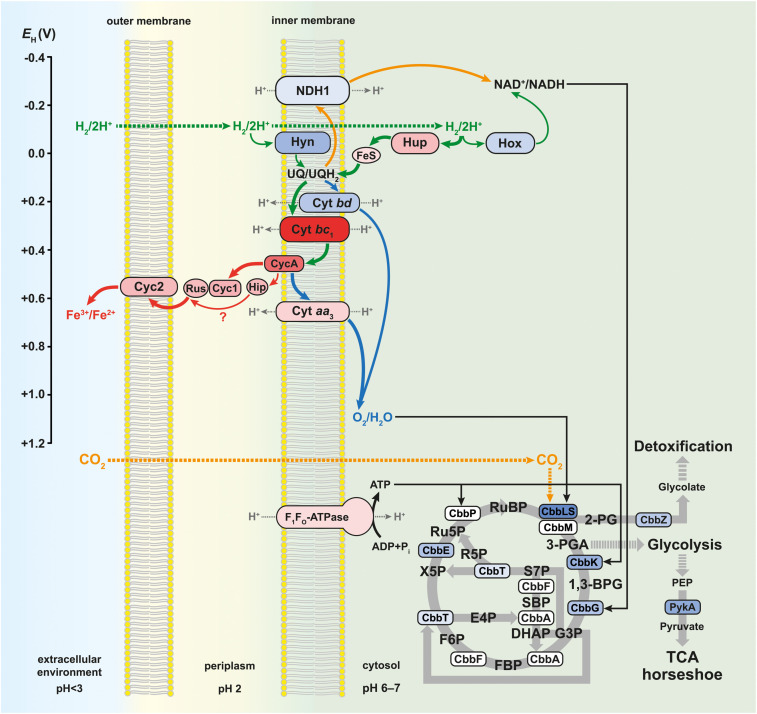
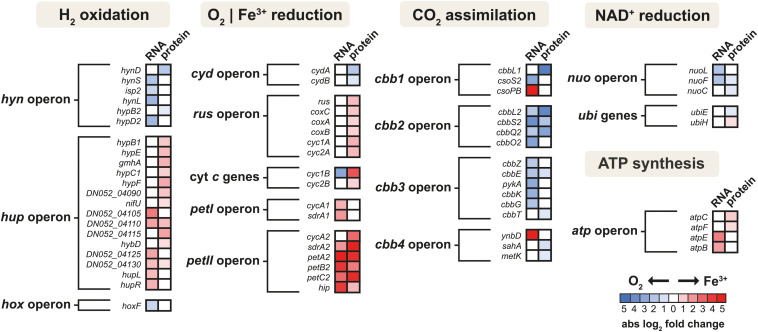
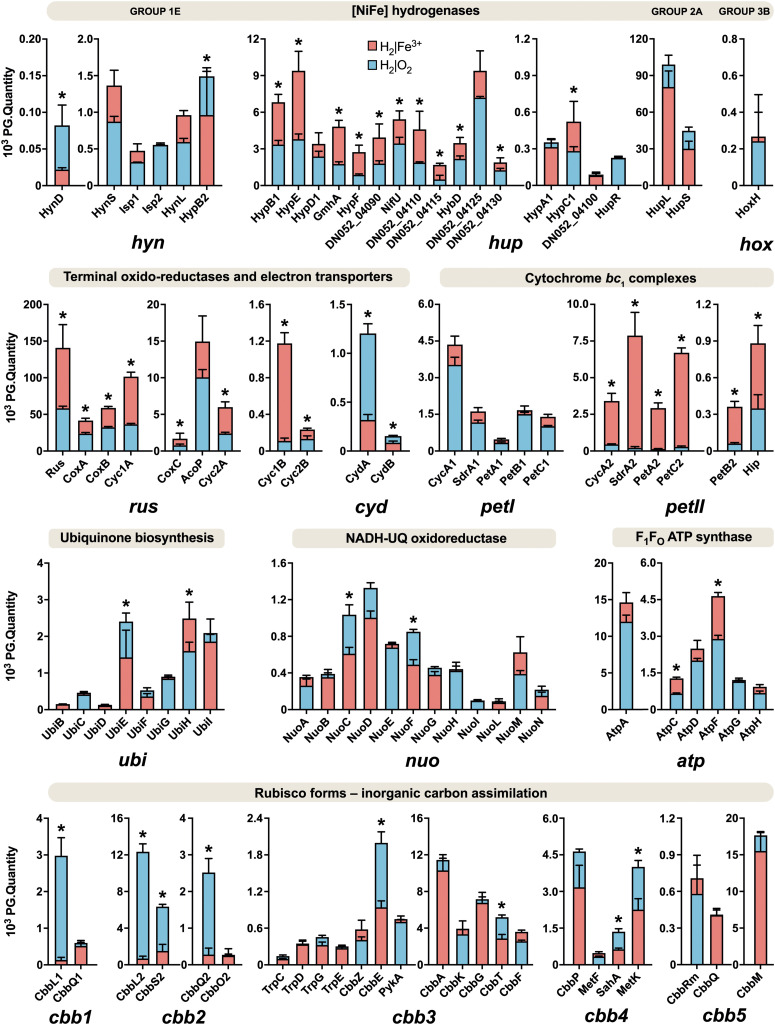
Hydrogen can serve as an electron donor for chemolithotrophic acidophiles, especially in the deep terrestrial subsurface and geothermal ecosystems. Nevertheless, the current knowledge of hydrogen utilization by mesophilic acidophiles is minimal. A multi-omics analysis was applied on growing on hydrogen, and a respiratory model was proposed. In the model, [NiFe] hydrogenases oxidize hydrogen to two protons and two electrons. The electrons are used to reduce membrane-soluble ubiquinone to ubiquinol. Genetically associated iron-sulfur proteins mediate electron relay from the hydrogenases to the ubiquinone pool. Under aerobic conditions, reduced ubiquinol transfers electrons to either cytochrome oxidase via cytochrome complex and cytochrome or the alternate directly to cytochrome oxidase, resulting in proton efflux and reduction of oxygen. Under anaerobic conditions, reduced ubiquinol transfers electrons to outer membrane cytochrome (ferrireductase) via cytochrome complex and a cascade of electron transporters (cytochrome , cytochrome , rusticyanin, and high potential iron-sulfur protein), resulting in proton efflux and reduction of ferric iron. The proton gradient generated by hydrogen oxidation maintains the membrane potential and allows the generation of ATP and NADH. These results further clarify the role of extremophiles in biogeochemical processes and their impact on the composition of the deep terrestrial subsurface.
氢气可以作为化能自养嗜酸菌的电子供体,特别是在陆地深部地下和地热生态系统中。然而,目前关于嗜温嗜酸菌利用氢气的知识非常有限。对以氢气为生长底物的嗜酸菌进行了多组学分析,并提出了一个呼吸模型。在该模型中,[NiFe]氢化酶将氢气氧化为两个质子和两个电子。电子用于将膜溶性泛醌还原为泛醇。与基因相关的铁硫蛋白介导电子从氢化酶传递到泛醌池。在有氧条件下,还原型泛醇通过细胞色素复合物和细胞色素将电子传递给细胞色素氧化酶,或者直接将电子传递给细胞色素氧化酶,导致质子外流和氧气还原。在厌氧条件下,还原型泛醇通过细胞色素复合物和一系列电子转运蛋白(细胞色素、细胞色素、锈铁蛋白和高电位铁硫蛋白)将电子传递给外膜细胞色素(铁还原酶),导致质子外流和三价铁还原。氢气氧化产生的质子梯度维持膜电位,并允许生成ATP和NADH。这些结果进一步阐明了嗜极微生物在生物地球化学过程中的作用及其对陆地深部地下成分的影响。