Fayyad Nour, Kobaisi Farah, Beal David, Mahfouf Walid, Ged Cécile, Morice-Picard Fanny, Fayyad-Kazan Mohammad, Fayyad-Kazan Hussein, Badran Bassam, Rezvani Hamid R, Rachidi Walid
University Grenoble Alpes, SyMMES/CIBEST UMR 5819 UGA-CNRS-CEA, Grenoble, France.
Laboratory of Cancer Biology and Molecular Immunology, Faculty of Sciences I, Lebanese University, Hadath, Lebanon.
Front Genet. 2020 Nov 27;11:561687. doi: 10.3389/fgene.2020.561687. eCollection 2020.
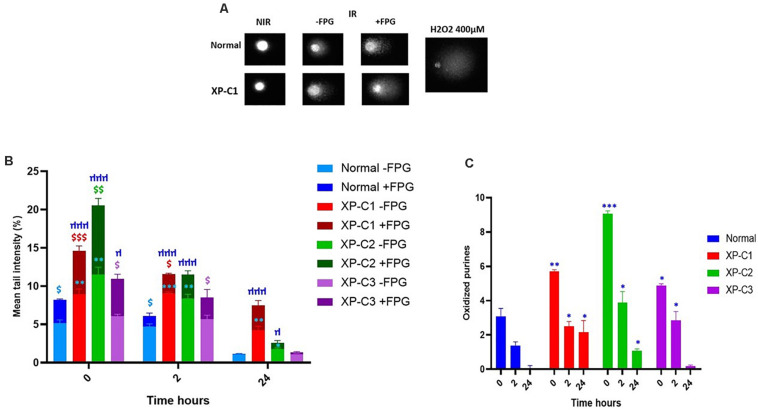
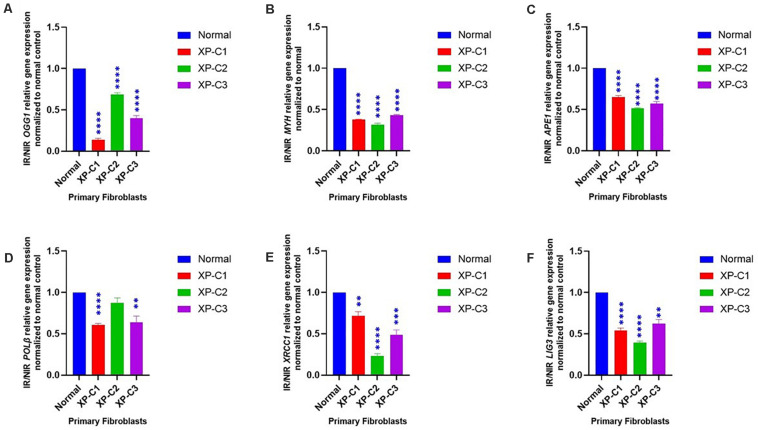
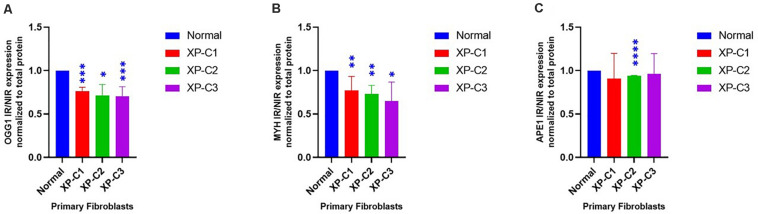
Xeroderma Pigmentosum C (XPC) is a multi-functional protein that is involved not only in the repair of bulky lesions, post-irradiation, via nucleotide excision repair (NER) but also in oxidative DNA damage mending. Since base excision repair (BER) is the primary regulator of oxidative DNA damage, we characterized, post-Ultraviolet B-rays (UVB)-irradiation, the detailed effect of three different XPC mutations in primary fibroblasts derived from XP-C patients on mRNA, protein expression and activity of different BER factors. We found that XP-C fibroblasts are characterized by downregulated expression of different BER factors including , , , , , and β. Such a downregulation was also observed at OGG1, MYH, and APE1 protein levels. This was accompanied with an increase in DNA oxidative lesions, as evidenced by 8-oxoguanine levels, immediately post-UVB-irradiation. Unlike in normal control cells, these oxidative lesions persisted over time in XP-C cells having lower excision repair capacities. Taken together, our results indicated that an impaired BER pathway in XP-C fibroblasts leads to longer persistence and delayed repair of oxidative DNA damage. This might explain the diverse clinical phenotypes in XP-C patients suffering from cancer in both photo-protected and photo-exposed areas. Therapeutic strategies based on reinforcement of BER pathway might therefore represent an innovative path for limiting the drawbacks of NER-based diseases, as in XP-C case.
着色性干皮病C(XPC)是一种多功能蛋白,不仅通过核苷酸切除修复(NER)参与辐射后大片段损伤的修复,还参与氧化性DNA损伤的修复。由于碱基切除修复(BER)是氧化性DNA损伤的主要调节因子,我们在紫外线B(UVB)照射后,对来自着色性干皮病C型(XP-C)患者的原代成纤维细胞中三种不同XPC突变对不同BER因子的mRNA、蛋白质表达和活性的详细影响进行了表征。我们发现,XP-C成纤维细胞的特征是不同BER因子的表达下调,包括、、、、、和β。在OGG1、MYH和APE1蛋白水平也观察到这种下调。这伴随着DNA氧化损伤的增加,如UVB照射后立即检测到的8-氧鸟嘌呤水平所示。与正常对照细胞不同,这些氧化损伤在切除修复能力较低的XP-C细胞中随时间持续存在。综上所述,我们的结果表明,XP-C成纤维细胞中BER途径受损导致氧化性DNA损伤的持续时间延长和修复延迟。这可能解释了XP-C患者在光保护和光暴露区域患癌症的不同临床表型。因此,基于增强BER途径的治疗策略可能代表了一条创新途径,用于限制如XP-C病例中基于NER疾病的缺点。