
利用表面化学实现高性能摩擦纳米发电机
Leverage Surface Chemistry for High-Performance Triboelectric Nanogenerators.
作者信息
Xu Jing, Zou Yongjiu, Nashalian Ardo, Chen Jun
机构信息
Department of Bioengineering, University of California, Los Angeles, Los Angeles, CA, United States.
出版信息
Front Chem. 2020 Nov 20;8:577327. doi: 10.3389/fchem.2020.577327. eCollection 2020.
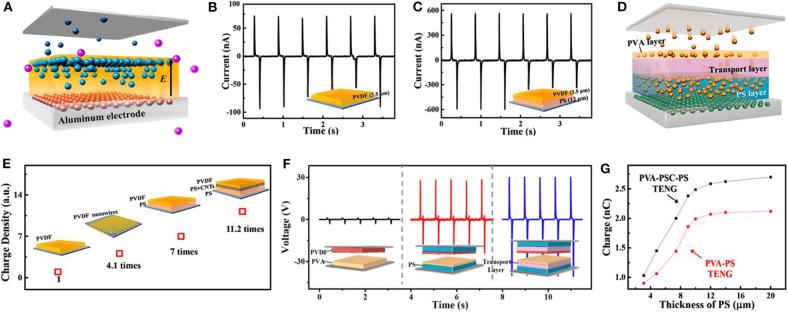
Triboelectric Nanogenerators (TENGs) are a highly efficient approach for mechanical-to-electrical energy conversion based on the coupling effects of contact electrification and electrostatic induction. TENGs have been intensively applied as both sustainable power sources and self-powered active sensors with a collection of compelling features, including lightweight, low cost, flexible structures, extensive material selections, and high performances at low operating frequencies. The output performance of TENGs is largely determined by the surface triboelectric charges density. Thus, manipulating the surface chemical properties via appropriate modification methods is one of the most fundamental strategies to improve the output performances of TENGs. This article systematically reviews the recently reported chemical modification methods for building up high-performance TENGs from four aspects: functional groups modification, ion implantation and decoration, dielectric property engineering, and functional sublayers insertion. This review will highlight the contribution of surface chemistry to the field of triboelectric nanogenerators by assessing the problems that are in desperate need of solving and discussing the field's future directions.
摩擦纳米发电机(TENGs)是一种基于接触起电和静电感应耦合效应的高效机械能-电能转换方法。TENGs作为可持续电源和自供电有源传感器得到了广泛应用,具有一系列引人注目的特性,包括重量轻、成本低、结构灵活、材料选择广泛以及在低工作频率下具有高性能。TENGs的输出性能在很大程度上取决于表面摩擦电荷密度。因此,通过适当的改性方法操纵表面化学性质是提高TENGs输出性能的最基本策略之一。本文从官能团改性、离子注入与修饰、介电性能工程和功能子层插入四个方面系统地综述了最近报道的用于构建高性能TENGs的化学改性方法。本综述将通过评估亟待解决的问题并讨论该领域的未来方向,突出表面化学对摩擦纳米发电机领域的贡献。


 Zotero 插件