School of Electrical & Electronic Engineering, North China Electric Power University, Beijing 102206, China.
Department of Bioengineering, University of California, Los Angeles, Los Angeles, CA 90095, USA.
Biosensors (Basel). 2021 Jul 23;11(8):245. doi: 10.3390/bios11080245.
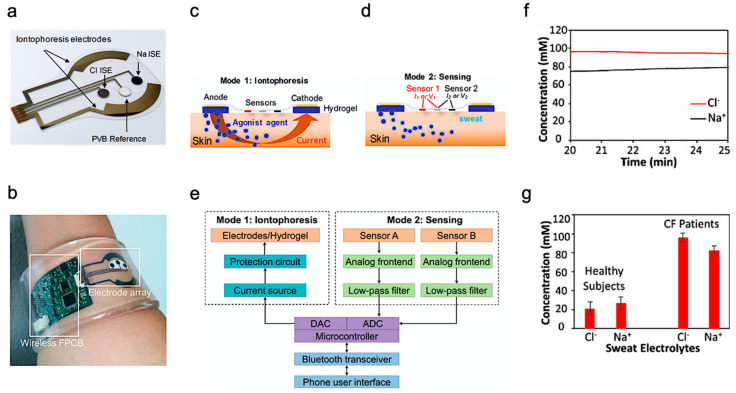
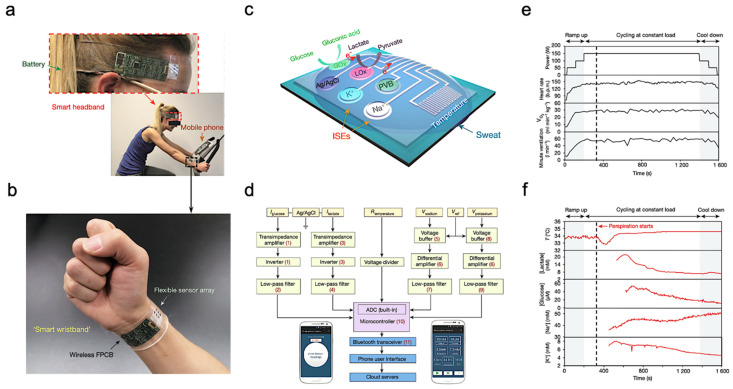
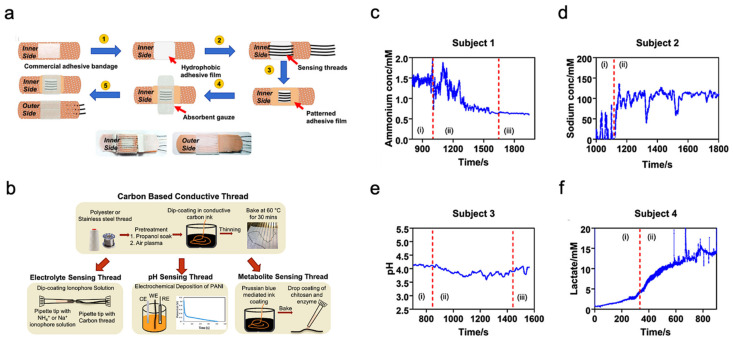
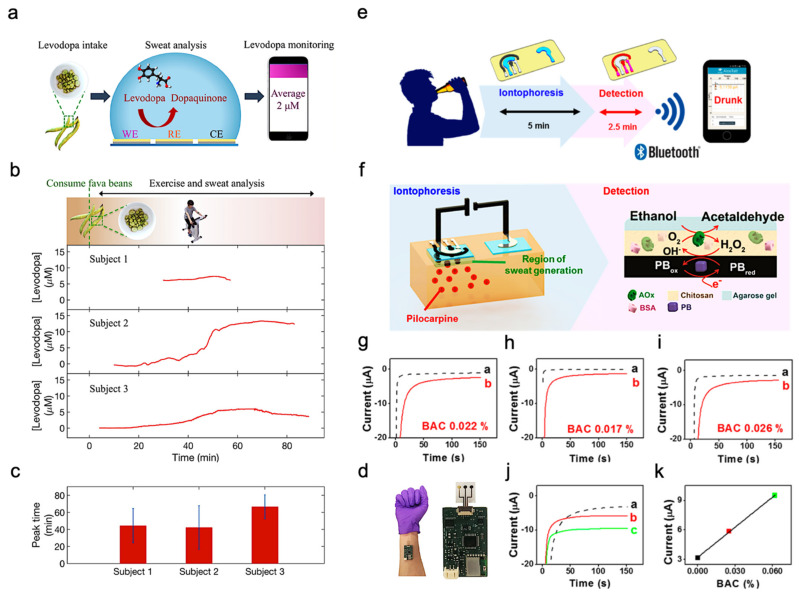
Recent advances in microfluidics, microelectronics, and electrochemical sensing methods have steered the way for the development of novel and potential wearable biosensors for healthcare monitoring. Wearable bioelectronics has received tremendous attention worldwide due to its great a potential for predictive medical modeling and allowing for personalized point-of-care-testing (POCT). They possess many appealing characteristics, for example, lightweight, flexibility, good stretchability, conformability, and low cost. These characteristics make wearable bioelectronics a promising platform for personalized devices. In this paper, we review recent progress in flexible and wearable sensors for non-invasive biomonitoring using sweat as the bio-fluid. Real-time and molecular-level monitoring of personal health states can be achieved with sweat-based or perspiration-based wearable biosensors. The suitability of sweat and its potential in healthcare monitoring, sweat extraction, and the challenges encountered in sweat-based analysis are summarized. The paper also discusses challenges that still hinder the full-fledged development of sweat-based wearables and presents the areas of future research.
近年来,微流控、微电子学和电化学传感方法的进步为新型潜在的可穿戴生物传感器的医疗保健监测开辟了道路。可穿戴式生物电子学因其在预测性医学建模方面的巨大潜力以及实现个性化即时护理测试(POCT)而受到全球的广泛关注。它们具有许多吸引人的特点,例如重量轻、灵活性好、良好的拉伸性、适应性和低成本。这些特点使可穿戴生物电子学成为个性化设备的有前途的平台。在本文中,我们综述了使用汗液作为生物流体的无创生物监测用柔性和可穿戴传感器的最新进展。基于汗液或出汗的可穿戴生物传感器可实现实时和分子级别的个人健康状态监测。本文总结了汗液的适用性及其在医疗保健监测、汗液提取方面的潜力以及基于汗液分析所遇到的挑战。此外,本文还讨论了仍然阻碍汗液型可穿戴设备全面发展的挑战,并提出了未来研究的领域。