Departments of Pediatrics and Pathology, University of Michigan Medical School, Ann Arbor, MI, USA.
University of Washington, Seattle, WA, USA.
J Thromb Haemost. 2021 Jan;19 Suppl 1(Suppl 1):21-31. doi: 10.1111/jth.15186.
Despite recent therapeutic advances, life expectancy in persons with congenital hemophilia A (PwcHA) remains below that of the non-HA population. As new therapies are introduced, a uniform approach to the assessment of mortality is required for comprehensive evaluation of risk-benefit profiles, timely identification of emerging safety signals, and comparisons between treatments.
Develop and test a framework for consistent reporting and analysis of mortality across past, current, and future therapies.
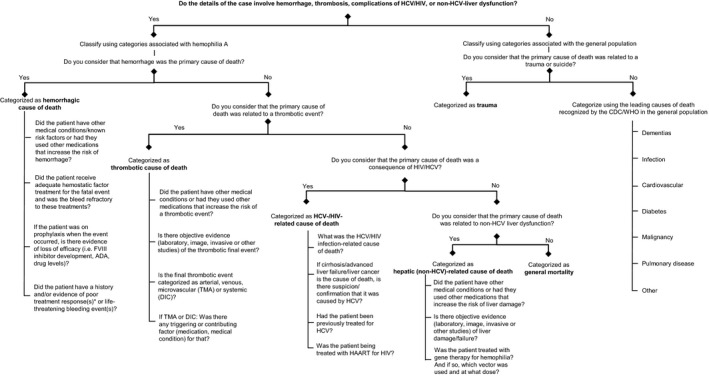
PATIENTS/METHODS: We identified known causes of mortality in PwcHA through literature review, analysis of the US Food and Drug Administration Adverse Event Reporting System (FAERS) database, and expert insights. Leading causes of death in general populations are those recognized by the Centers for Disease Control and Prevention and the World Health Organization. We developed an algorithm for assessing fatalities in PwcHA and used this to categorize FAERS data as a proof of concept.
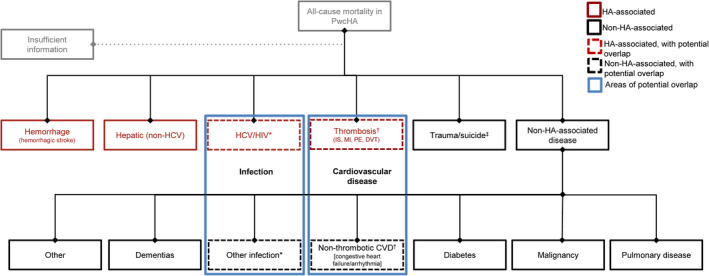
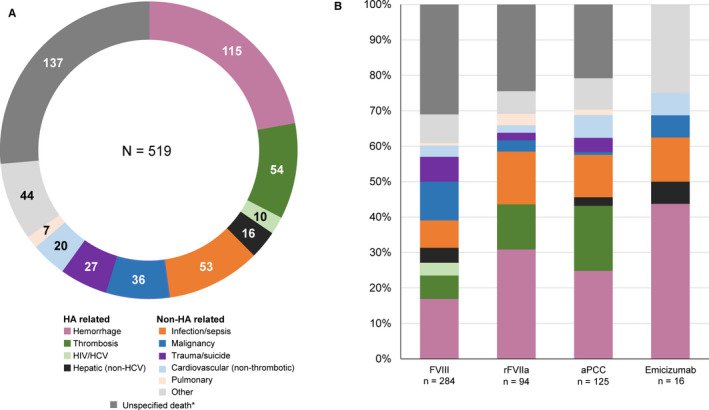
PwcHA share mortality causes with the non-HA population including cardiovascular disease, malignancy, infections, pulmonary disease, dementias, and trauma/suicide. Causes associated with HA include hemorrhage, thrombosis, human immunodeficiency virus, hepatitis C virus, and liver dysfunction. We propose an algorithm employing these classes to categorize fatalities and use it to classify FAERS fatality data between 01/01/2000 and 03/31/2020; the most common causes were hemorrhage (22.2%) and thrombosis (10.4%).
A conceptual framework for examining mortality in PwcHA receiving any hemophilia therapy is proposed to analyze and interpret fatalities, enabling consistent and objective assessment. Application of the framework using FAERS data suggests a generally consistent pattern of reported mortality across HA treatments, supporting the utility of this unified approach.
尽管最近有了治疗上的进展,但先天性血友病 A(PwcHA)患者的预期寿命仍低于非血友病 A 人群。随着新疗法的引入,需要采用统一的方法来评估死亡率,以便全面评估风险效益比、及时发现新的安全信号,并对不同治疗方法进行比较。
制定并测试一个适用于既往、当前和未来治疗方法的死亡率一致报告和分析框架。
患者/方法:我们通过文献回顾、美国食品和药物管理局不良事件报告系统(FAERS)数据库分析以及专家意见,确定了 PwcHA 患者死亡的已知原因。一般人群的主要死亡原因是由疾病控制与预防中心和世界卫生组织认定的原因。我们开发了一种用于评估 PwcHA 患者死亡的算法,并将其用于 FAERS 数据分类以验证概念。
PwcHA 与非血友病 A 人群的死亡率原因相同,包括心血管疾病、恶性肿瘤、感染、肺部疾病、痴呆和创伤/自杀。与血友病 A 相关的原因包括出血、血栓形成、人类免疫缺陷病毒、丙型肝炎病毒和肝功能障碍。我们提出了一种使用这些类别对死亡进行分类的算法,并使用它来对 2000 年 1 月 1 日至 2020 年 3 月 31 日期间 FAERS 死亡数据进行分类;最常见的原因是出血(22.2%)和血栓形成(10.4%)。
提出了一个用于检查接受任何血友病治疗的 PwcHA 患者死亡率的概念性框架,以分析和解释死亡事件,从而能够进行一致和客观的评估。使用 FAERS 数据应用该框架表明,HA 治疗的报告死亡率存在一致的模式,支持这种统一方法的实用性。