Hassan Shermarke, Monahan Rory C, Mauser-Bunschoten Evelien P, van Vulpen Lize F D, Eikenboom Jeroen, Beckers Erik A M, Hooimeijer Louise, Ypma Paula F, Nieuwenhuizen Laurens, Coppens Michiel, Schols Saskia E M, Leebeek Frank W G, Smit Cees, Driessens Mariëtte H, le Cessie Saskia, van Balen Erna C, Rosendaal Frits R, van der Bom Johanna G, Gouw Samantha C
Department of Clinical Epidemiology, Leiden University Medical Center, Leiden, the Netherlands.
Van Creveldkliniek, University Medical Center Utrecht, Utrecht University, Utrecht, the Netherlands.
J Thromb Haemost. 2021 Mar;19(3):645-653. doi: 10.1111/jth.15182. Epub 2020 Dec 18.
Treatment of patients with hemophilia has advanced over the past decades, but it is unknown whether this has resulted in a normal life expectancy in the Netherlands.
This observational cohort study aimed to assess all-cause and cause-specific mortality in patients with hemophilia in the Netherlands between 2001 and 2018 and to compare mortality and life expectancy with previous survival assessments from 1973 onward.
PATIENTS/METHODS: All 1066 patients with hemophilia who participated in a nationwide survey in 2001 were followed until July 2018.
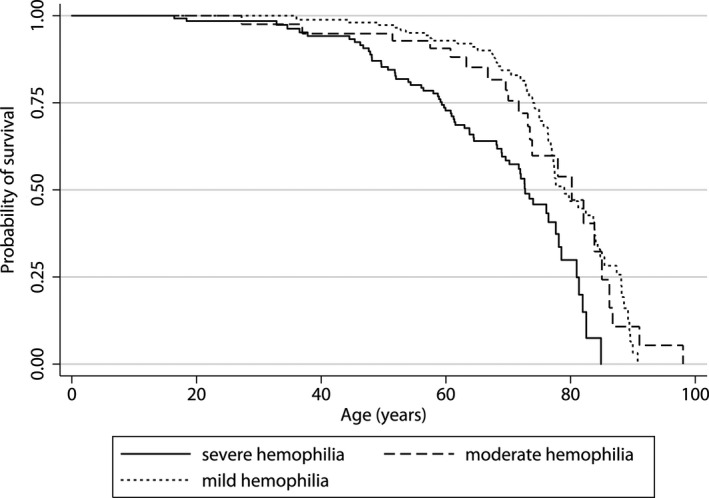
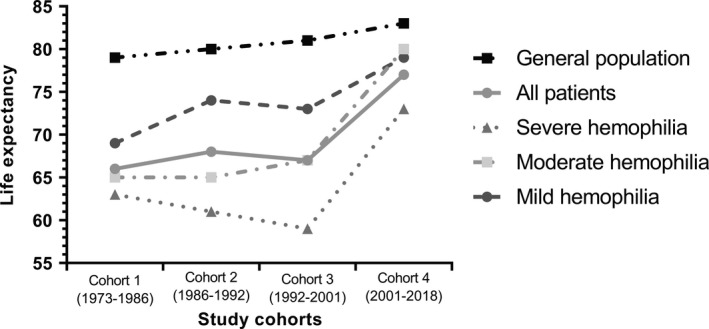
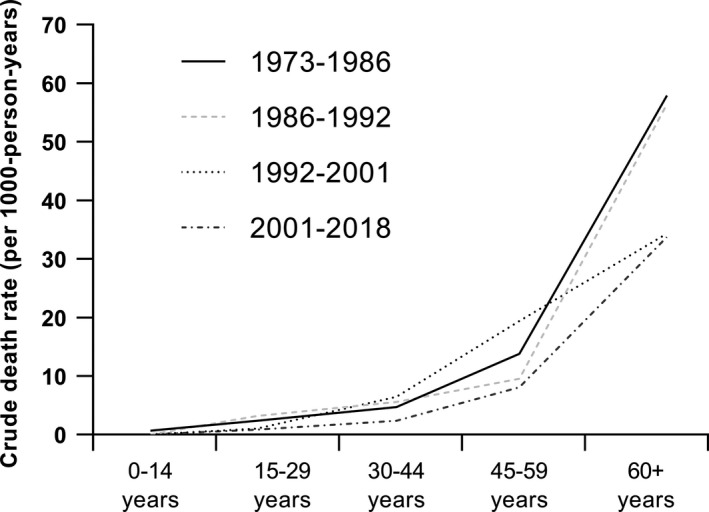
Information on 1031 individuals (97%) was available, of whom 142 (14%) deceased during follow-up. Compared with the general Dutch male population, mortality of patients with hemophilia was still increased (standardized mortality ratio: 1.4, 95% confidence interval: 1.2-1.7). Intracranial bleeding and malignancies were the most common causes of death. Estimated median life expectancy of patients with hemophilia was 77 years, 6 years lower than the median life expectancy of the general Dutch male population (83 years). Over the past 45 years, death rates of patients with hemophilia have consistently decreased, approaching the survival experience of the general population. Over the past decades, mortality due to human immunodeficiency virus and hepatitis C virus infections has decreased, death due to intracranial hemorrhages has increased, and death due to ischemic heart disease has remained consistently low over time.
Survival in patients with hemophilia in the Netherlands has improved over time but is still lower than that of the general population.
在过去几十年中,血友病患者的治疗取得了进展,但在荷兰,这是否已带来正常的预期寿命尚不清楚。
这项观察性队列研究旨在评估2001年至2018年荷兰血友病患者的全因死亡率和特定病因死亡率,并将死亡率和预期寿命与1973年以来的先前生存评估进行比较。
患者/方法:对2001年参加全国性调查的所有1066例血友病患者进行随访,直至2018年7月。
获得了1031例个体(97%)的信息,其中142例(14%)在随访期间死亡。与荷兰男性普通人群相比,血友病患者的死亡率仍然较高(标准化死亡率:1.4,95%置信区间:1.2 - 1.7)。颅内出血和恶性肿瘤是最常见的死亡原因。血友病患者的估计中位预期寿命为77岁,比荷兰男性普通人群的中位预期寿命(83岁)低6岁。在过去45年中,血友病患者的死亡率持续下降,接近普通人群的生存情况。在过去几十年中,因人类免疫缺陷病毒和丙型肝炎病毒感染导致的死亡率下降,因颅内出血导致的死亡增加,因缺血性心脏病导致的死亡长期保持在较低水平。
荷兰血友病患者的生存率随时间有所提高,但仍低于普通人群。