Universidade Federal de Minas Gerais. Faculdade de Farmácia. Programa de Pós-Graduação em Medicamentos e Assistência Farmacêutica. Belo Horizonte, MG, Brasil.
Universidade Federal de Minas Gerais. Faculdade de Farmácia. Departamento de Farmácia Social. Belo Horizonte, MG, Brasil.
Rev Saude Publica. 2020 Dec 16;54:146. doi: 10.11606/s1518-8787.2020054001920. eCollection 2020.
To assess longitudinally the change in quality of life in people living with HIV initiating antiretroviral therapy in three public reference services specialized in HIV care in Belo Horizonte, Brazil.
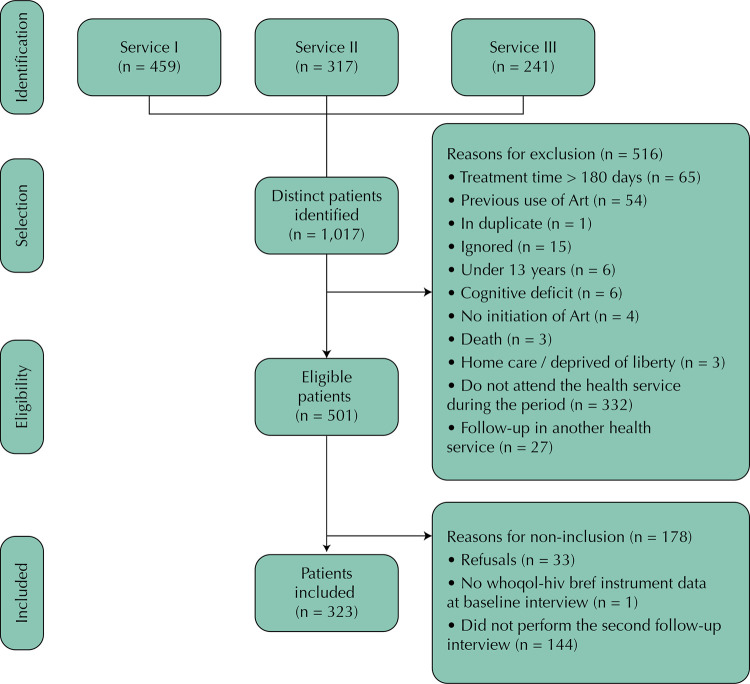
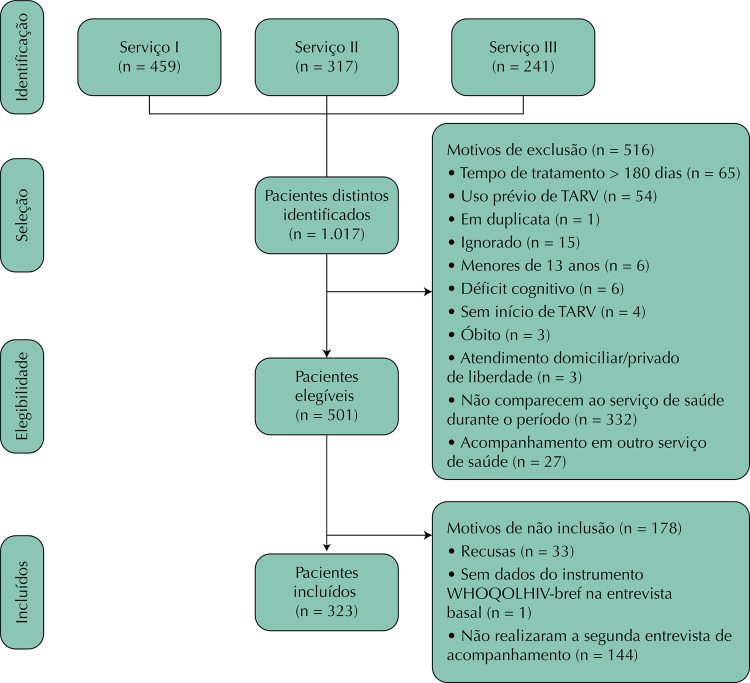
Prospective cohort study among people living with HIV, aged 18 years or older, and initiating antiretroviral therapy. We obtained sociodemographic, behavioral, clinical data related to pharmacological treatment and to the service by face-to-face interviews, and supplemented these data with information from clinical records and Information Systems of the Brazilian HIV/AIDS Program. We measured the quality of life using the WHOQOL-HIV bref instrument, with a minimum interval of six months between the baseline and the follow-up interviews. We used paired t-test to assess the mean change in quality of life between the two interviewsand evaluated factors associated with this outcome using multiple linear regression.
The overall quality of life, as well as the physical, psychological, level of independence, environment and spiritual quality of life domains were statistically higher in people living with HIV using antiretroviral therapy at the end of the follow-up. Factors independently associated with the increase in quality of life were having religious belief and living with other people. Having signs or symptoms of anxiety and depression and the number of adverse drug reactions reported were predictors associated with worsening quality of life.
These results show an improvement in the quality of life over time in people living with HIV on antiretroviral therapy. They also highlight the need to monitor and provide health care support, especially for individuals with signs and symptoms of anxiety and depression and that report adverse reactions to medicines at the beginning of treatment.
在巴西贝洛奥里藏特的 3 个艾滋病公共服务机构中,评估开始抗逆转录病毒治疗的艾滋病毒感染者的生活质量随时间的变化。
对年龄在 18 岁及以上并开始接受抗逆转录病毒治疗的艾滋病毒感染者进行前瞻性队列研究。我们通过面对面访谈获得了与人口统计学、行为、临床相关的数据,包括药物治疗和服务,并用临床记录和巴西艾滋病毒/艾滋病规划信息系统补充这些数据。我们使用世卫组织艾滋病毒生活质量量表(WHOQOL-HIV bref 量表)来衡量生活质量,在基线和随访访谈之间至少有 6 个月的间隔。我们使用配对 t 检验来评估两次访谈之间生活质量的平均变化,并使用多元线性回归来评估与该结果相关的因素。
在随访结束时,接受抗逆转录病毒治疗的艾滋病毒感染者的总体生活质量以及身体、心理、独立性、环境和精神生活质量领域的得分均显著更高。与生活质量提高独立相关的因素是有宗教信仰和与他人一起生活。出现焦虑和抑郁症状以及报告的药物不良反应数量是与生活质量恶化相关的预测因素。
这些结果表明,接受抗逆转录病毒治疗的艾滋病毒感染者的生活质量随时间推移而有所改善。它们还强调了需要监测和提供医疗保健支持,特别是对有焦虑和抑郁症状以及在开始治疗时报告药物不良反应的个体。