Division of General Pediatrics, Department of Pediatrics, Boston University School of Medicine, Boston, Massachusetts.
Grayken Center for Addiction, Department of Medicine, Boston Medical Center, Boston, Massachusetts.
JAMA Netw Open. 2020 Dec 1;3(12):e2030201. doi: 10.1001/jamanetworkopen.2020.30201.
Opioid-related overdose has substantially increased among adolescents and young adults in recent years. How overdose differs by age and sex among youths and the factors associated with overdose by sex remain poorly described.
To compare the sociodemographic and clinical characteristics of female and male youths who have experienced a nonfatal opioid overdose (NFOD) and compare the incidence of NFOD by sex.
DESIGN, SETTING, AND PARTICIPANTS: This retrospective cohort study used data on US individuals aged 11 to 24 years with a diagnosis of NFOD from the IBM MarketScan Commercial Database from January 1, 2006, through December 31, 2017.
Sex.
The primary outcome was NFOD stratified by sex; covariates included sociodemographic and clinical characteristics.
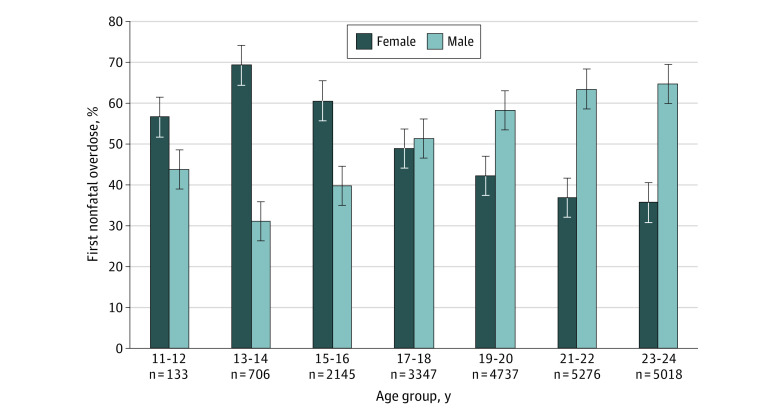
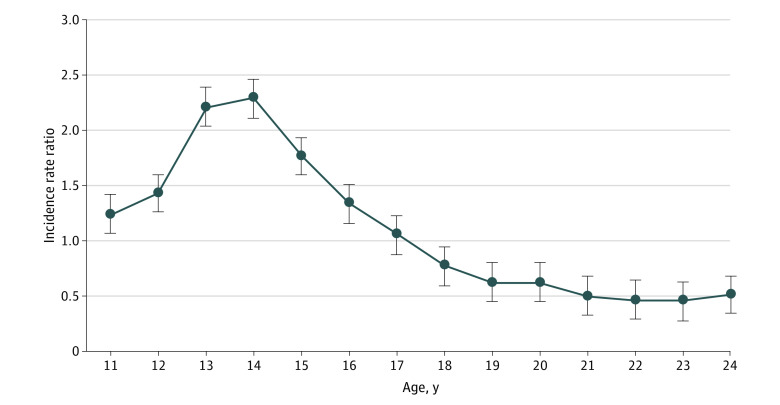
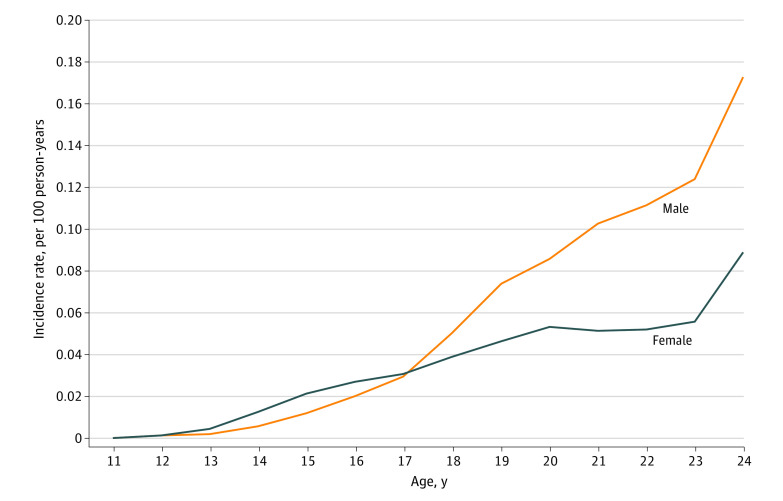
Among 20 312 youths aged 11 to 24 years who had a history of NFOD and met study eligibility criteria, the median age was 20 years (interquartile range, 18-22 years; mean [SD] age, 20.0 [2.9] years) and 56.7% were male. Compared with male youths, female youths had a higher baseline prevalence of mood or anxiety disorder (65.5% vs 51.9%, P < .001), trauma and stress-related disorders (16.4% vs 10.1%, P < .001), and history of suicide attempt or self-harm (14.6% vs 9.9%, P < .001). Male youths had a higher prevalence of opioid use disorder (44.7% vs 29.2%, P < .001), cannabis use disorder (18.3% vs 11.3%, P < .001), and alcohol use disorder (20.3% vs 14.4%, P < .001). The incidence rate ratio of NFODs in females vs males was greater than 1 for ages 11 to 16 years and was less than or equal to 1 after age 17 years.
This cohort study found differences between female and male youths in sociodemographic and clinical characteristics and incidence of NFOD. Although female and male youths who experience overdose appear to have different risk factors, many of these risk factors may be amenable to early detection through screening and intervention.
近年来,青少年和青年人群中阿片类药物相关过量的情况大幅增加。年轻人中,过量的情况在不同年龄段和性别之间存在差异,且与性别相关的过量因素描述不足。
比较经历过非致命性阿片类药物过量(NFOD)的女性和男性青少年的社会人口统计学和临床特征,并比较不同性别 NFOD 的发生率。
设计、设置和参与者:本回顾性队列研究使用了来自 IBM MarketScan 商业数据库的数据,纳入了 2006 年 1 月 1 日至 2017 年 12 月 31 日期间年龄在 11 至 24 岁之间,有 NFOD 诊断的美国个体。
性别。
主要结局为按性别分层的 NFOD;协变量包括社会人口统计学和临床特征。
在符合研究条件的 20312 名年龄在 11 至 24 岁之间有 NFOD 病史的青少年中,中位数年龄为 20 岁(四分位距,18-22 岁;平均[标准差]年龄,20.0[2.9]岁),56.7%为男性。与男性青少年相比,女性青少年有更高的基线情绪或焦虑障碍患病率(65.5% vs 51.9%,P<0.001)、创伤和应激相关障碍患病率(16.4% vs 10.1%,P<0.001)和自杀未遂或自残史患病率(14.6% vs 9.9%,P<0.001)。男性青少年有更高的阿片类药物使用障碍患病率(44.7% vs 29.2%,P<0.001)、大麻使用障碍患病率(18.3% vs 11.3%,P<0.001)和酒精使用障碍患病率(20.3% vs 14.4%,P<0.001)。女性青少年 NFOD 的发病率比值比(IRR)大于 1 是在 11 至 16 岁年龄组,而在 17 岁以上年龄组,IRR 小于或等于 1。
本队列研究发现女性和男性青少年在社会人口统计学和临床特征以及 NFOD 发生率方面存在差异。尽管经历过量的女性和男性青少年似乎有不同的风险因素,但这些风险因素中的许多因素可能通过筛查和干预进行早期发现。