Virginia Institute for Psychiatric and Behavioral Genetics, Virginia Commonwealth University, Richmond, Virginia, United States of America.
Integrative Life Sciences Doctoral Program, Virginia Commonwealth University, Richmond, Virginia, United States of America.
PLoS One. 2020 Dec 17;15(12):e0243857. doi: 10.1371/journal.pone.0243857. eCollection 2020.
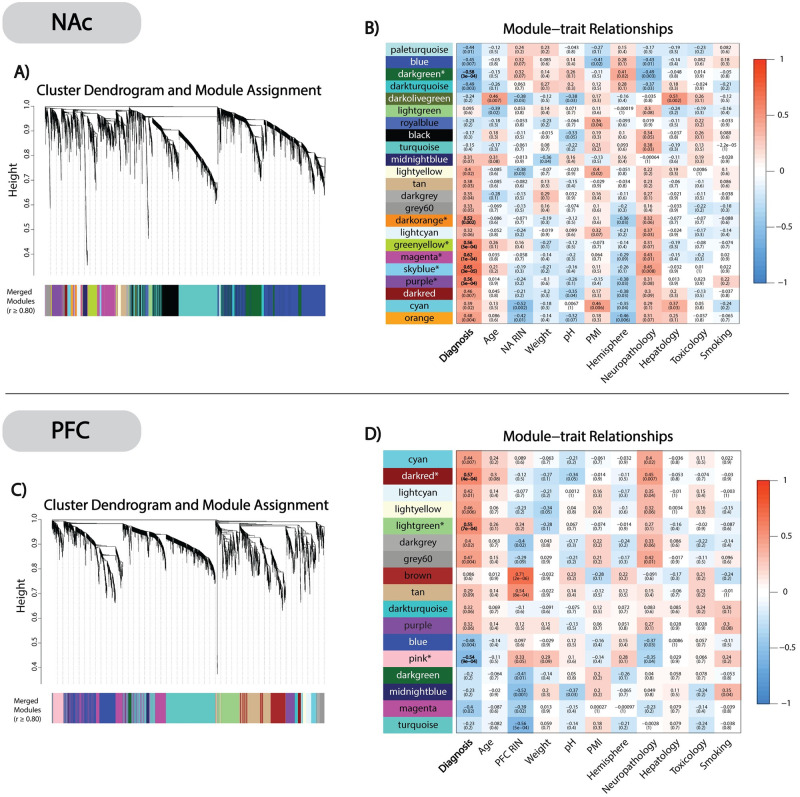
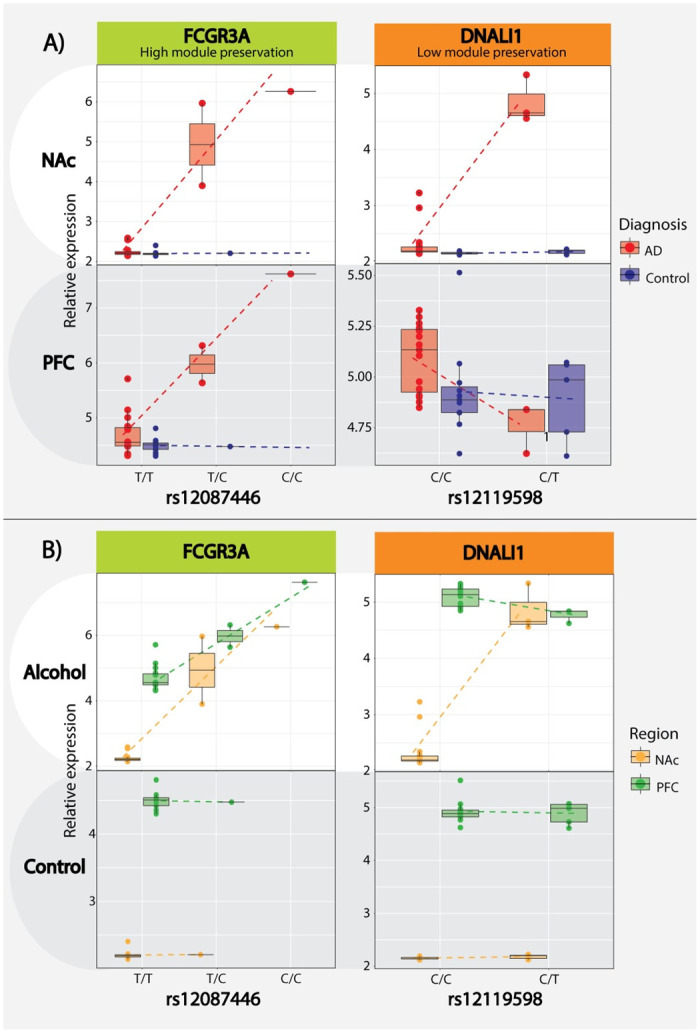
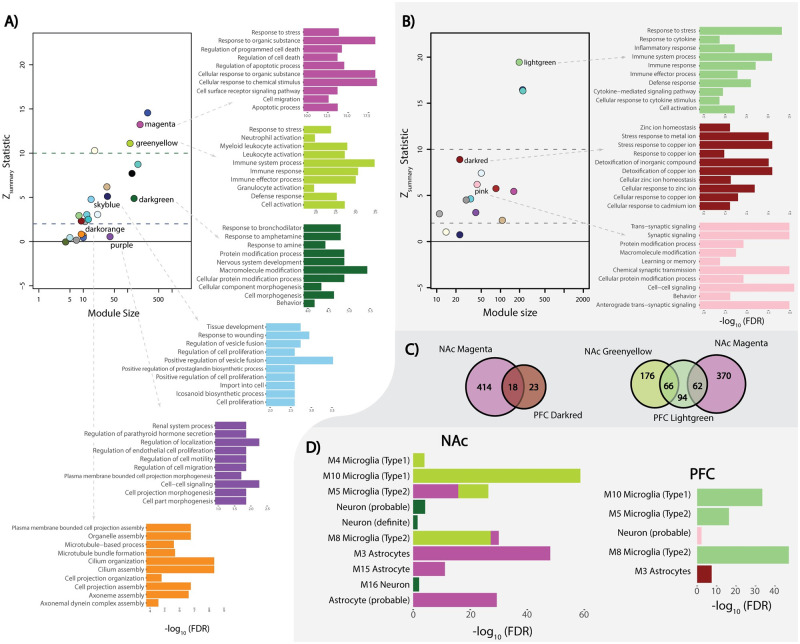
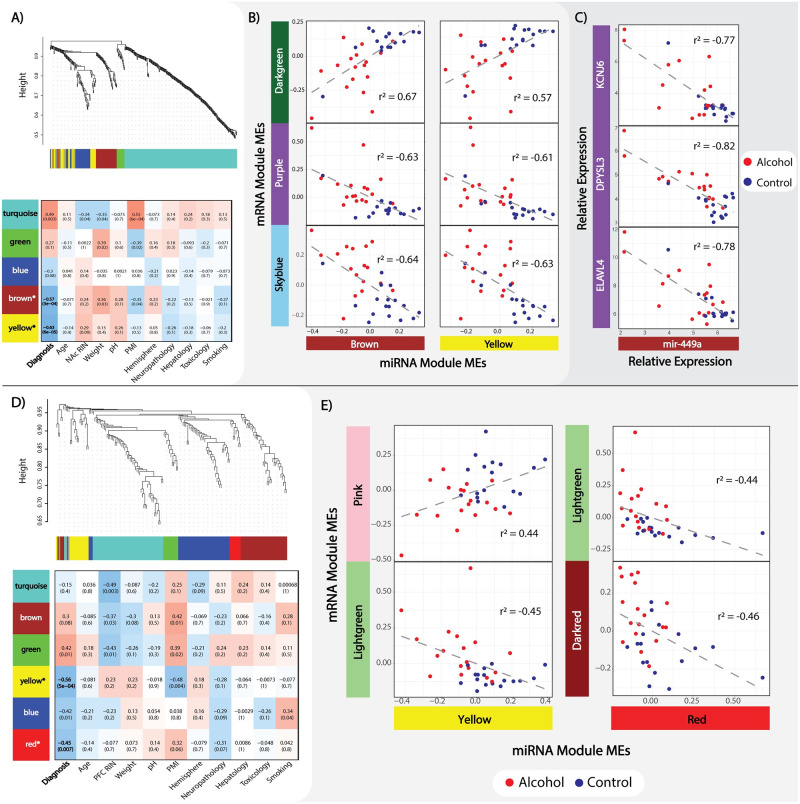
Chronic alcohol abuse has been linked to the disruption of executive function and allostatic conditioning of reward response dysregulation in the mesocorticolimbic pathway (MCL). Here, we analyzed genome-wide mRNA and miRNA expression from matched cases with alcohol dependence (AD) and controls (n = 35) via gene network analysis to identify unique and shared biological processes dysregulated in the prefrontal cortex (PFC) and nucleus accumbens (NAc). We further investigated potential mRNA/miRNA interactions at the network and individual gene expression levels to identify the neurobiological mechanisms underlying AD in the brain. By using genotyped and imputed SNP data, we identified expression quantitative trait loci (eQTL) uncovering potential genetic regulatory elements for gene networks associated with AD. At a Bonferroni corrected p≤0.05, we identified significant mRNA (NAc = 6; PFC = 3) and miRNA (NAc = 3; PFC = 2) AD modules. The gene-set enrichment analyses revealed modules preserved between PFC and NAc to be enriched for immune response processes, whereas genes involved in cellular morphogenesis/localization and cilia-based cell projection were enriched in NAc modules only. At a Bonferroni corrected p≤0.05, we identified significant mRNA/miRNA network module correlations (NAc = 6; PFC = 4), which at an individual transcript level implicated miR-449a/b as potential regulators for cellular morphogenesis/localization in NAc. Finally, we identified eQTLs (NAc: mRNA = 37, miRNA = 9; PFC: mRNA = 17, miRNA = 16) which potentially mediate alcohol's effect in a brain region-specific manner. Our study highlights the neurotoxic effects of chronic alcohol abuse as well as brain region specific molecular changes that may impact the development of alcohol addiction.
慢性酒精滥用与边缘叶皮质通路(MCL)中执行功能的中断以及奖赏反应调节的适应不良有关。在这里,我们通过基因网络分析,分析了来自酒精依赖(AD)和对照(n = 35)匹配病例的全基因组 mRNA 和 miRNA 表达,以鉴定前额叶皮质(PFC)和伏隔核(NAc)中失调的独特和共享生物学过程。我们进一步研究了网络和个体基因表达水平上的潜在 mRNA/miRNA 相互作用,以确定大脑中 AD 的神经生物学机制。通过使用基因分型和推断的 SNP 数据,我们鉴定了与 AD 相关的基因网络的表达数量性状基因座(eQTL),揭示了潜在的遗传调控元件。在 Bonferroni 校正的 p≤0.05 下,我们鉴定了显著的 AD 模块mRNA(NAc = 6;PFC = 3)和 miRNA(NAc = 3;PFC = 2)。基因集富集分析表明,在 PFC 和 NAc 之间保留的模块富集了免疫反应过程,而参与细胞形态发生/定位和纤毛细胞投射的基因仅在 NAc 模块中富集。在 Bonferroni 校正的 p≤0.05 下,我们鉴定了显著的 mRNA/miRNA 网络模块相关性(NAc = 6;PFC = 4),在个体转录本水平上,miR-449a/b 作为 NAc 中细胞形态发生/定位的潜在调节剂。最后,我们鉴定了 eQTL(NAc:mRNA = 37,miRNA = 9;PFC:mRNA = 17,miRNA = 16),它们可能以大脑区域特异性的方式介导酒精的作用。我们的研究强调了慢性酒精滥用的神经毒性作用以及可能影响酒精成瘾发展的大脑区域特异性分子变化。