Department of Otorhinolaryngology-Head & Neck Surgery and Audiology, Aalborg University Hospital, Aalborg, Denmark.
Clinical Cancer Research Center, Aalborg University Hospital, Aalborg, Denmark.
PLoS One. 2020 Dec 17;15(12):e0244101. doi: 10.1371/journal.pone.0244101. eCollection 2020.
Head and neck squamous cell carcinomas (HNSCC) are often diagnosed in advanced stages. In search of new diagnostic tools, focus has shifted towards the biological properties of the HNSCC, and the number of different biomarkers under investigation is rapidly growing.
The objective was to review the current literature regarding aberrantly methylated DNA found in peripheral blood plasma or serum in patients with HNSCC and to evaluate the diagnostic accuracy of these changes.
The inclusion criteria were clinical studies involving patients with verified HNSCC that reported findings of aberrantly methylated DNA in peripheral blood serum or plasma. We systematically searched PubMed, OVID Embase and Cochrane Library. In addition to the search, we performed forward and backward chaining in references and Web of Science. The protocol was registered in PROSPERO: CRD42019135406. Two authors independently extracted data. The quality and the risk of bias of the included studies were assessed by the QUADAS-2 tool.
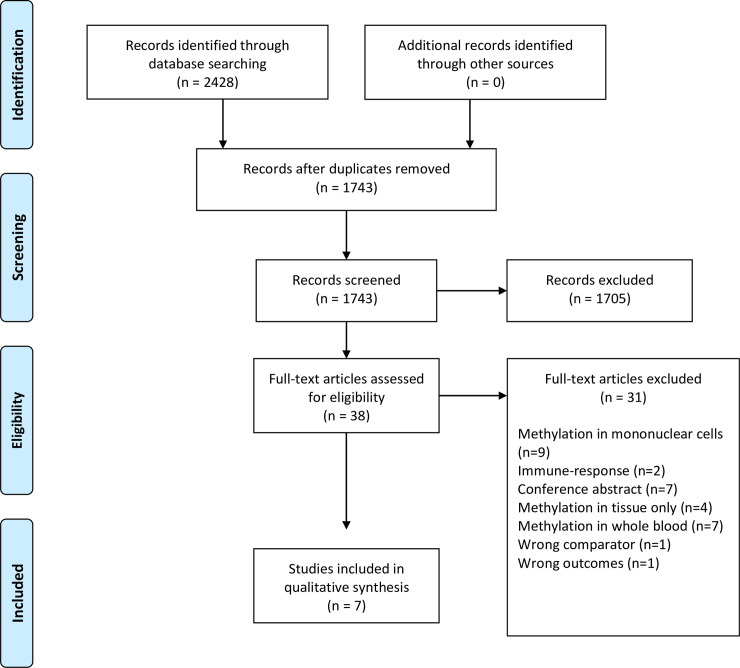
A total of 1,743 studies were found eligible for screening, while ultimately seven studies were included. All studies were found to have methodological weaknesses, mainly concerning patient selection bias. The best individual marker of HNSCC was Septin 9 in plasma with a sensitivity of 57% and a specificity of 95%.
None of the aberrantly methylated genes found in the retrieved studies are applicable as single diagnostic markers for HNSCC and the best gene-panels still lack diagnostic accuracy. Future studies may benefit from newer sequencing techniques but validation studies with well-designed cohorts are also needed in the process of developing epigenetic based diagnostic tests for HNSCC.
头颈部鳞状细胞癌(HNSCC)常被诊断为晚期。为寻找新的诊断工具,研究重点已转移到 HNSCC 的生物学特性上,目前正在研究的不同生物标志物的数量迅速增加。
本文旨在回顾目前有关 HNSCC 患者外周血血浆或血清中异常甲基化 DNA 的文献,并评估这些变化的诊断准确性。
纳入标准为涉及经证实患有 HNSCC 的患者的临床研究,这些研究报告了外周血血清或血浆中异常甲基化 DNA 的发现。我们系统地检索了 PubMed、OVID Embase 和 Cochrane Library。除了搜索之外,我们还在参考文献和 Web of Science 中进行了正向和反向链接。该方案已在 PROSPERO 中注册:CRD42019135406。两位作者独立提取数据。使用 QUADAS-2 工具评估纳入研究的质量和偏倚风险。
共发现 1743 项符合筛选条件的研究,最终纳入了 7 项研究。所有研究均存在方法学上的缺陷,主要涉及患者选择偏倚。血浆中 Septin 9 是诊断 HNSCC 的最佳单一标志物,其敏感性为 57%,特异性为 95%。
在检索到的研究中发现的异常甲基化基因都不能作为 HNSCC 的单一诊断标志物,而最佳的基因组合仍然缺乏诊断准确性。未来的研究可能受益于更新的测序技术,但在开发基于表观遗传学的 HNSCC 诊断测试的过程中,还需要进行设计良好的队列验证研究。