Visuomotor Control Laboratory, Human Systems Integration Division, NASA Ames Research Center, Moffett Field, CA, USA.
San José State University, San José, CA, USA.
J Physiol. 2021 Feb;599(4):1225-1242. doi: 10.1113/JP280395. Epub 2020 Dec 17.
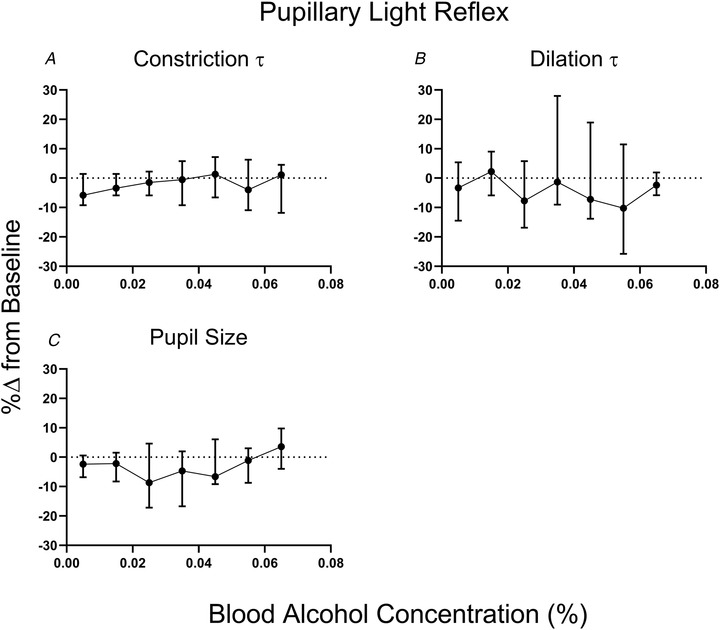
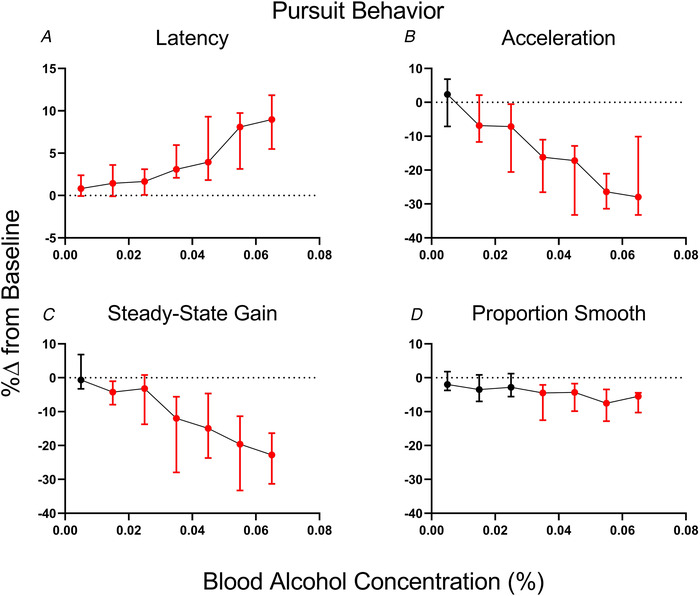
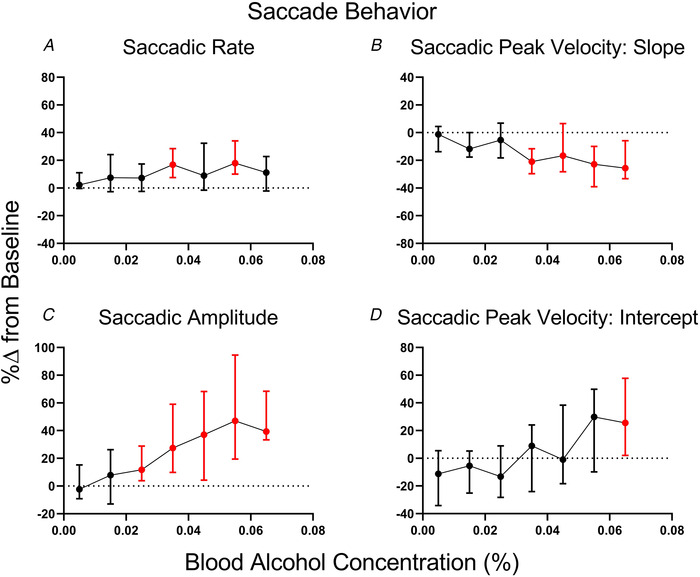
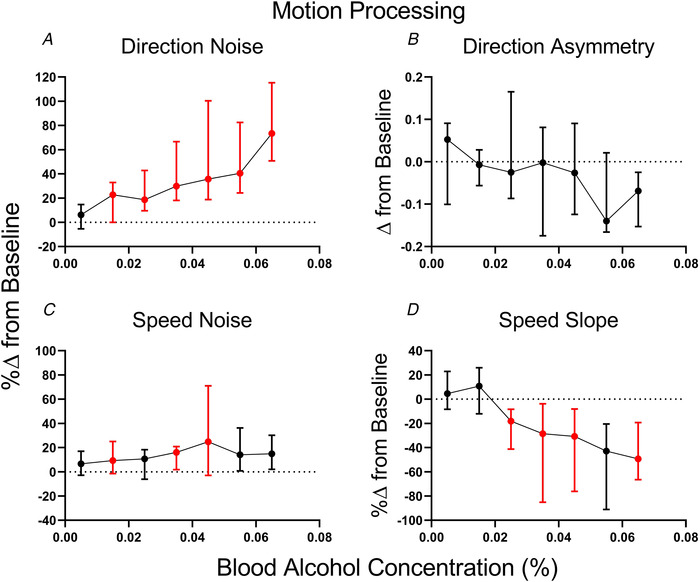
Oculomotor behaviours are commonly used to evaluate sensorimotor disruption due to ethanol (EtOH). The current study demonstrates the dose-dependent impairment in oculomotor and ocular behaviours across a range of ultra-low BACs (<0.035%). Processing of target speed and direction, as well as pursuit eye movements, are significantly impaired at 0.015% BAC, suggesting impaired neural activity within brain regions associated with the visual processing of motion. Catch-up saccades during steady visual tracking of the moving target compensate for the reduced vigour of smooth eye movements that occurs with the ingestion of low-dose alcohol. Saccade dynamics start to become 'sluggish' at as low as 0.035% BAC. Pupillary light responses appear unaffected at BAC levels up to 0.065%.
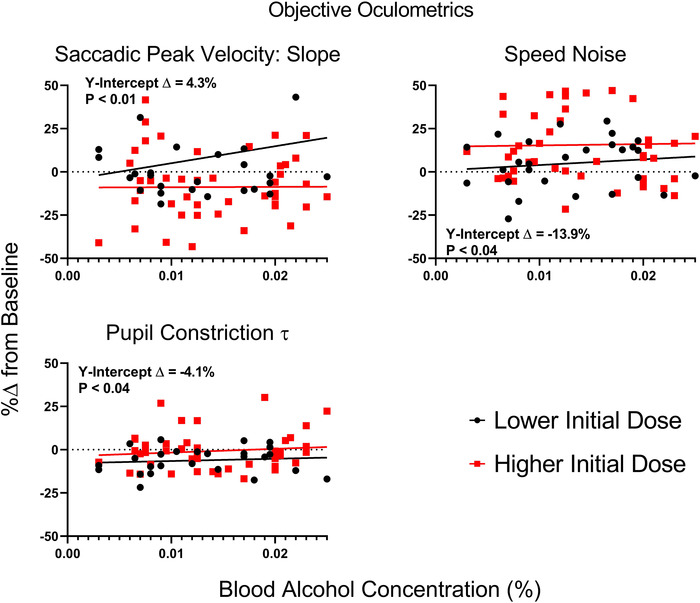
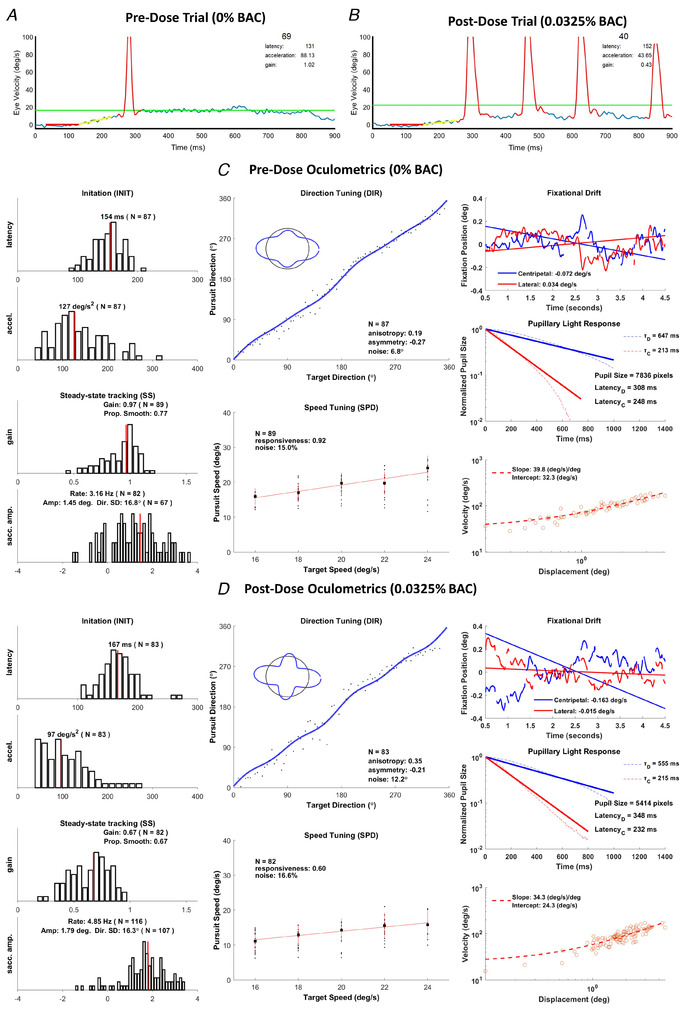
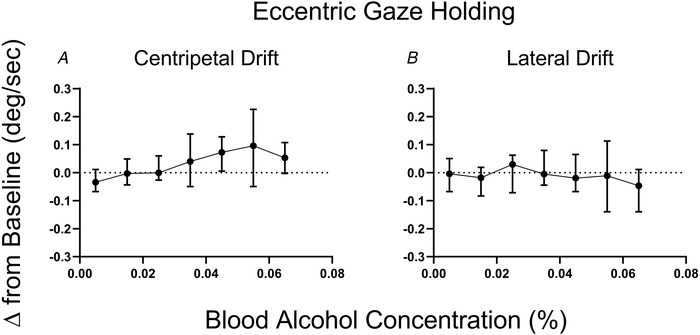
Changes in oculomotor behaviours are often used as metrics of sensorimotor disruption due to ethanol (EtOH); however, previous studies have focused on deficits at blood-alcohol concentrations (BACs) above about 0.04%. We investigated the dose dependence of the impairment in oculomotor and ocular behaviours caused by EtOH administration across a range of ultra-low BACs (≤0.035%). We took repeated measures of oculomotor and ocular performance from sixteen participants, both pre- and post-EtOH administration. To assess the neurological impacts across a wide range of brain areas and pathways, our protocol measured 21 largely independent performance metrics extracted from a range of behavioural responses ranging from ocular tracking of radial step-ramp stimuli, to eccentric gaze holding, to pupillary responses evoked by light flashes. Our results show significant impairment of pursuit and visual motion processing at 0.015% BAC, reflecting degraded neural processing within extrastriate cortical pathways. However, catch-up saccades largely compensate for the tracking displacement shortfall caused by low pursuit gain, although there still is significant residual retinal slip and thus degraded dynamic acuity. Furthermore, although saccades are more frequent, their dynamics are more sluggish (i.e. show lower peak velocities) starting at BAC levels as low as 0.035%. Small effects in eccentric gaze holding and no effect in pupillary response dynamics were observed at levels below 0.07%, showing the higher sensitivity of the pursuit response to very low levels of blood alcohol, under the conditions of our study.
眼动行为常用于评估由于乙醇(EtOH)引起的感觉运动障碍。本研究表明,在一系列超低 BAC(<0.035%)范围内,眼动和眼球行为会出现剂量依赖性损伤。对目标速度和方向的处理,以及追踪眼球运动,在 BAC 为 0.015%时显著受损,表明与运动视觉处理相关的大脑区域的神经活动受损。在稳定地追踪移动目标时,进行追视补偿了因摄入低剂量酒精而导致的平滑眼球运动活力的降低。在 BAC 低至 0.035%时,眼跳动力学开始变得“迟缓”。在 BAC 水平高达 0.065%时,瞳孔光反射似乎不受影响。
眼动行为的变化通常被用作由于乙醇(EtOH)引起的感觉运动障碍的指标;然而,以前的研究集中在血液酒精浓度(BAC)高于约 0.04%时的缺陷上。我们研究了在一系列超低 BAC(≤0.035%)范围内,乙醇给药引起的眼动和眼球行为损伤的剂量依赖性。我们在十六名参与者的乙醇给药前后,重复测量了眼动和眼球表现。为了评估广泛的大脑区域和通路的神经影响,我们的方案测量了 21 个主要从一系列行为反应中提取的独立性能指标,这些反应范围从径向阶梯-斜坡刺激的眼球追踪,到偏心凝视保持,再到光闪烁引起的瞳孔反应。我们的结果显示,在 0.015% BAC 时,追踪和视觉运动处理有显著损伤,反映了在外侧纹状皮质通路内的神经处理退化。然而,在低追踪增益导致的追踪位移不足的情况下,追视补偿在很大程度上得到了补偿,尽管仍存在显著的视网膜滑动,因此动态视力降低。此外,尽管眼跳更频繁,但它们的动力学更迟缓(即,峰值速度较低),从 BAC 水平低至 0.035%开始。在 0.07%以下的水平观察到偏心凝视保持的小效应和瞳孔反应动力学的无效应,表明在我们的研究条件下,追踪反应对非常低水平的血液酒精更敏感。