Faculty of Medicine, Nursing and Health Sciences, Monash University, Clayton, Victoria, Australia.
Oxford Uehiro Centre for Practical Ethics, Faculty of Philosophy, University of Oxford, Oxford, United Kingdom of Great Britain and Northern Ireland.
Bioethics. 2021 Mar;35(3):284-291. doi: 10.1111/bioe.12838. Epub 2020 Dec 17.
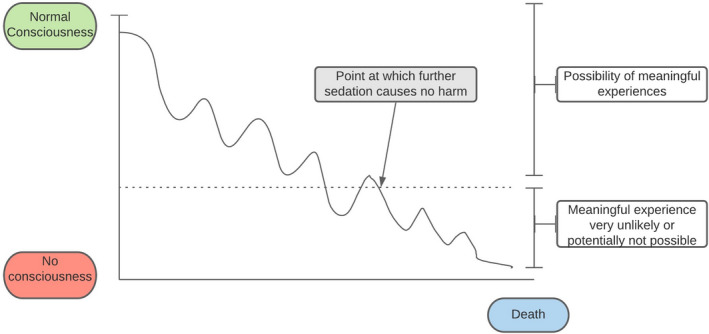
One of the most commonly referenced ethical principles when it comes to the management of dying patients is the doctrine of double effect (DDE). The DDE affirms that it is acceptable to cause side effects (e.g. respiratory depression) as a consequence of symptom-focused treatment. Much discussion of the ethics of end of life care focuses on the question of whether actions (or omissions) would hasten (or cause) death, and whether that is permissible. However, there is a separate question about the permissibility of hastening or causing unconsciousness in dying patients. Some authors have argued that the DDE would not permit end of life care that directly aims to render the patient unconscious. The claim is that consciousness is an objective human good and therefore doctors should not intentionally (and permanently) suppress it. Three types of end of life care (EOLC) practices will be explored in this article. The first is symptom-based management (e.g. analgesia); the second is proportional terminal sedation as a means of relieving suffering (also referred to as palliative sedation or continuous deep sedation); and finally, deliberate and rapid sedation to unconsciousness until death (a practice we call terminal anaesthesia in this paper). After examining the common arguments for the various types of symptom-based management and sedation, we apply the DDE to the latter two types of EOLC practices. We argue that aiming at unconsciousness, contrary to some claims, can be morally good or at least morally neutral in some dying patients.
当涉及临终患者的管理时,最常引用的伦理原则之一是双重效应原则(DDE)。DDE 肯定,为了进行以症状为中心的治疗而导致副作用(例如呼吸抑制)是可以接受的。临终关怀伦理的许多讨论都集中在行动(或不作为)是否会加速(或导致)死亡,以及是否允许这样做的问题上。然而,还有一个关于在临终患者中加速或导致无意识状态的可允许性的单独问题。一些作者认为,DDE 不允许直接旨在使患者失去意识的临终关怀。他们的观点是,意识是一种客观的人类利益,因此医生不应该故意(和永久性地)抑制它。本文将探讨三种临终关怀实践。第一种是基于症状的管理(例如镇痛);第二种是作为缓解痛苦的手段的比例性终末镇静(也称为姑息性镇静或持续深度镇静);最后,故意和快速镇静至无意识状态直至死亡(我们在本文中称之为终末麻醉)。在检查了各种基于症状的管理和镇静的常见论点之后,我们将 DDE 应用于后两种临终关怀实践。我们认为,与一些说法相反,在某些临终患者中,以无意识为目标可能是道德上的善,或者至少是道德上的中立。