Centre for Translational Microbiome Research (CTMR), Department of Microbiology, Tumor and Cell Biology (MTC), Karolinska Institutet, 171 77 Stockholm, Sweden.
Instituto de Biología Molecular y Biotecnología (IBMB), Carrera de Biología, Universidad Mayor de San Andrés (UMSA), La Paz 10077, Bolivia.
Int J Mol Sci. 2020 Dec 15;21(24):9543. doi: 10.3390/ijms21249543.
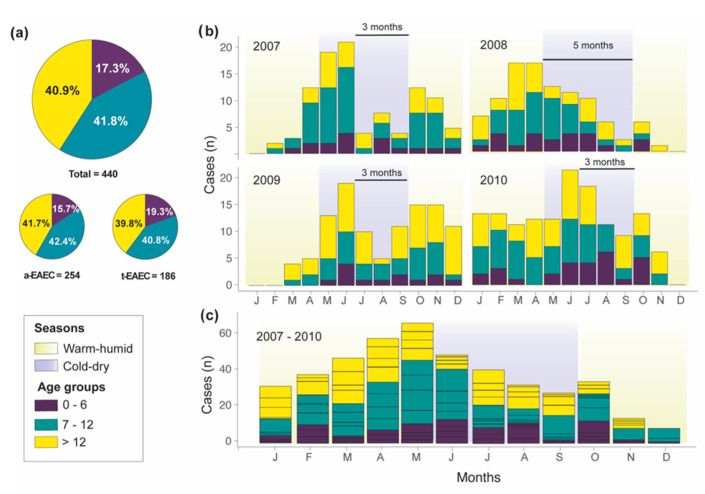
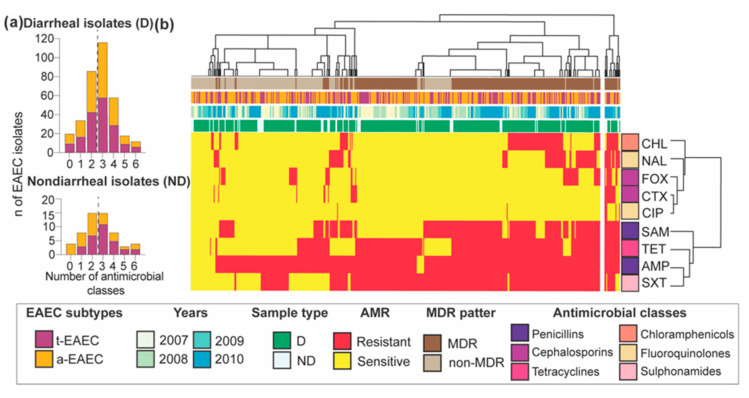
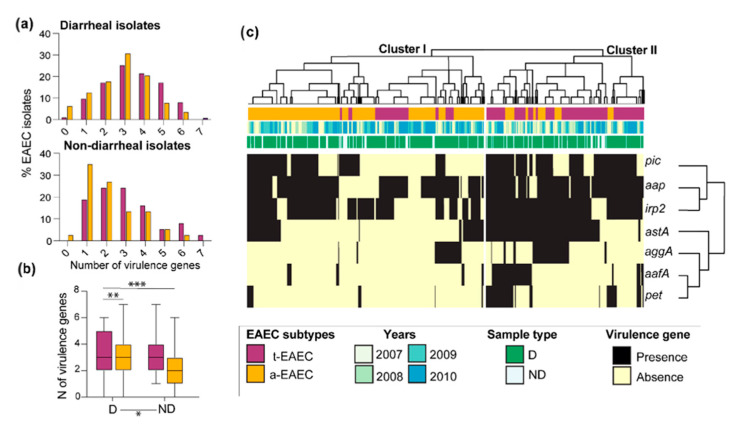
Enteroaggregative (EAEC) is an emerging pathogen frequently associated with acute diarrhea in children and travelers to endemic regions. EAEC was found the most prevalent bacterial diarrheal pathogen from hospitalized Bolivian children less than five years of age with acute diarrhea from 2007 to 2010. Here, we further characterized the epidemiology of EAEC infection, virulence genes, and antimicrobial susceptibility of EAEC isolated from 414 diarrheal and 74 non-diarrheal cases. EAEC isolates were collected and subjected to a PCR-based virulence gene screening of seven virulence genes and a phenotypic resistance test to nine different antimicrobials. Our results showed that atypical EAEC (a-EAEC, AggR-negative) was significantly associated with diarrhea (OR, 1.62, 95% CI, 1.25 to 2.09, < 0.001) in contrast to typical EAEC (t-EAEC, AggR-positive). EAEC infection was most prevalent among children between 7-12 months of age. The number of cases exhibited a biannual cycle with a major peak during the transition from warm to cold (April-June). Both typical and a-EAEC infections were graded as equally severe; however, t-EAEC harbored more virulence genes. , and were the most prevalent genes. Surprisingly, we detected 60% and 52.6% of multidrug resistance (MDR) EAEC among diarrheal and non-diarrheal cases. Resistance to ampicillin, sulfonamides, and tetracyclines was most common, being the corresponding antibiotics, the ones that are frequently used in Bolivia. Our work is the first study that provides comprehensive information on the high heterogenicity of virulence genes in t-EAEC and a- EAEC and the large prevalence of MDR EAEC in Bolivia.
肠聚集性大肠杆菌(EAEC)是一种新兴的病原体,常与儿童急性腹泻和前往流行地区的旅行者有关。2007 年至 2010 年,在玻利维亚住院的 5 岁以下患有急性腹泻的儿童中,EAEC 是最常见的细菌性腹泻病原体。在这里,我们进一步描述了 EAEC 感染的流行病学、毒力基因和分离自 414 例腹泻和 74 例非腹泻病例的 EAEC 的抗菌药物敏感性。收集 EAEC 分离株并进行基于 PCR 的 7 种毒力基因筛选和 9 种不同抗菌药物的表型耐药试验。我们的结果表明,非典型 EAEC(AggR 阴性,a-EAEC)与腹泻显著相关(OR,1.62,95%CI,1.25-2.09,<0.001),而典型 EAEC(AggR 阳性,t-EAEC)则无此关联。EAEC 感染在 7-12 个月龄的儿童中最为普遍。病例数量呈双年周期变化,主要高峰出现在从温暖到寒冷的过渡时期(4-6 月)。典型和非典型 EAEC 感染的严重程度相当;然而,t-EAEC 携带更多的毒力基因。 、 和 是最常见的基因。令人惊讶的是,我们在腹泻和非腹泻病例中分别检测到 60%和 52.6%的多重耐药(MDR)EAEC。对氨苄西林、磺胺类药物和四环素的耐药性最为常见,这些抗生素是玻利维亚经常使用的抗生素。我们的工作首次提供了关于 t-EAEC 和 a-EAEC 中毒力基因高度异质性以及 MDR EAEC 在玻利维亚高流行率的综合信息。