Brown School at Washington University in St. Louis, St. Louis (Cabassa, Guo, Wang); Department of Psychiatry, Columbia University, New York City (Stefancic, Lewis-Fernández); New York State Psychiatric Institute, New York City (Lewis-Fernández); Department of Medicine, Columbia University Medical Center, New York City (Luchsinger); Department of Family and Community Medicine, Jefferson Medical College, Philadelphia (Weinstein); Suzanne Dworak-Peck School of Social Work, University of Southern California, Los Angeles (Palinkas); School of Nursing, Columbia University, New York City (Bochicchio); School of Social Work, Columbia University, New York City (O'Hara); The Bridge, New York City (Blady); Pathways to Housing PA, Philadelphia (Simiriglia); Project Home, Stephen Klein Wellness Center, Philadelphia (McCurdy).
Psychiatr Serv. 2021 May 1;72(5):555-562. doi: 10.1176/appi.ps.202000304. Epub 2020 Dec 18.
The effectiveness of the Peer-led Group Lifestyle Balance (PGLB) intervention, a 12-month manualized healthy lifestyle intervention delivered by peer specialists, was investigated in a sample of persons with serious mental illness who were overweight or obese and living in supportive housing.
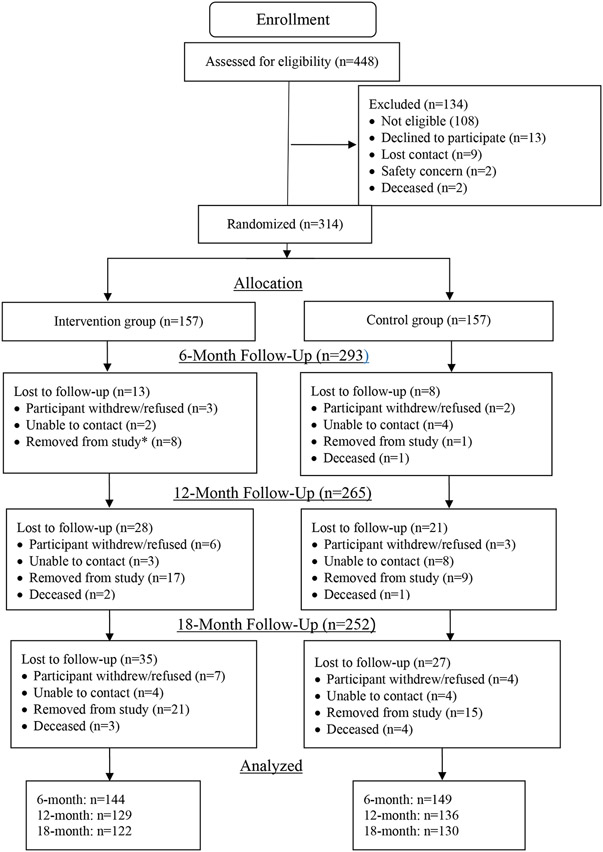
The authors randomly assigned 314 participants from three supportive housing agencies to PGLB or usual care, with assessments at baseline and 6, 12, and 18 months. Outcomes were clinically significant changes from baseline in weight (≥5% weight loss), cardiorespiratory fitness (CRF; increase of ≥50 meters in the 6-minute walk test), and cardiovascular disease (CVD) risk reduction (clinically significant weight loss or CRF improvement).
Most participants were from racial-ethnic minority groups (82%, N=255). The mean±SD baseline weight of this sample was 218.8±54.0 pounds, and the body mass index was 33.7±7.2. Compared with the usual care group, a larger proportion of the PGLB group achieved clinically significant changes in study outcomes at 12 and 18 months, but none of these changes was statistically significant. Outcomes differed by site: two sites reported no significant differences between the two groups, and one reported that PGLB significantly outperformed usual care on clinically significant weight loss at 18 months and CVD risk reduction at 6 and 12 months.
The null findings indicate that PGLB was not superior to usual care in helping participants achieve clinically significant changes in weight, CRF, and CVD risk reduction at 12 and 18 months. Questions remain regarding how PGLB works, for whom, and in which settings.
本研究调查了同伴主导的团体生活方式平衡(PGLB)干预在超重或肥胖且居住在支持性住房中的严重精神疾病患者中的有效性,该干预是一种由同伴专家提供的为期 12 个月的健康生活方式手册化干预。
作者从三个支持性住房机构中随机分配 314 名参与者,将他们分为 PGLB 组或常规护理组,在基线和 6、12 和 18 个月进行评估。主要结果是从基线开始体重(≥5%的体重减轻)、心肺功能(6 分钟步行试验中增加≥50 米)和心血管疾病(CVD)风险降低(临床显著的体重减轻或心肺功能改善)的临床显著变化。
大多数参与者来自少数族裔群体(82%,N=255)。该样本的平均基线体重为 218.8±54.0 磅,体重指数为 33.7±7.2。与常规护理组相比,PGLB 组在 12 个月和 18 个月时更有可能在研究结果中达到临床显著变化,但这些变化均无统计学意义。结果因地点而异:两个地点报告两组之间没有显著差异,一个地点报告 PGLB 在 18 个月时在临床显著体重减轻和 6 个月和 12 个月时在 CVD 风险降低方面显著优于常规护理。
阴性结果表明,在帮助参与者在 12 个月和 18 个月时实现体重、心肺功能和 CVD 风险降低的临床显著变化方面,PGLB 并不优于常规护理。关于 PGLB 如何发挥作用、对谁有效以及在哪些环境中有效,仍存在疑问。