Université de Paris, UMR 1153 CRESS Inserm, 75004, Paris, France.
Clinical Epidemiology Unit, Hôtel-Dieu Hospital, Assistance Publique-Hôpitaux de Paris, (AP-HP), 75004, Paris, France.
BMC Med. 2020 Dec 17;18(1):402. doi: 10.1186/s12916-020-01880-8.
The increasing use of preprints to disseminate evidence on the effect of interventions for the coronavirus disease 2019 (COVID-19) can lead to multiple evidence sources for a single study, which may differ in the reported evidence. We aim to describe the proportion of evidence on the effect of interventions for COVID-19 from preprints and journal articles and map changes in evidence between and within different sources reporting on the same study.
Meta-research study. We screened the Cochrane living systematic review and network meta-analysis (COVID-NMA) database to identify all preprints and journal articles on all studies assessing interventions for COVID-19 published up to 15 August 2020. We compared all evidence sources (i.e., preprint and associated journal article) and the first and latest versions of preprints for each study to identify changes in two evidence components: study results (e.g., numeric change in hazard ratio, odds ratio, event rate, or change in p value > or < 0.05 in any outcome) and abstract conclusions (classified as positive, negative or neutral regarding the intervention effect, and as reporting uncertainty in the findings or not). Changes in study results were further classified as important changes if they (1) represented a change in any effect estimate by ≥ 10% and/or (2) led to a change in the p value crossing the threshold of 0.05.
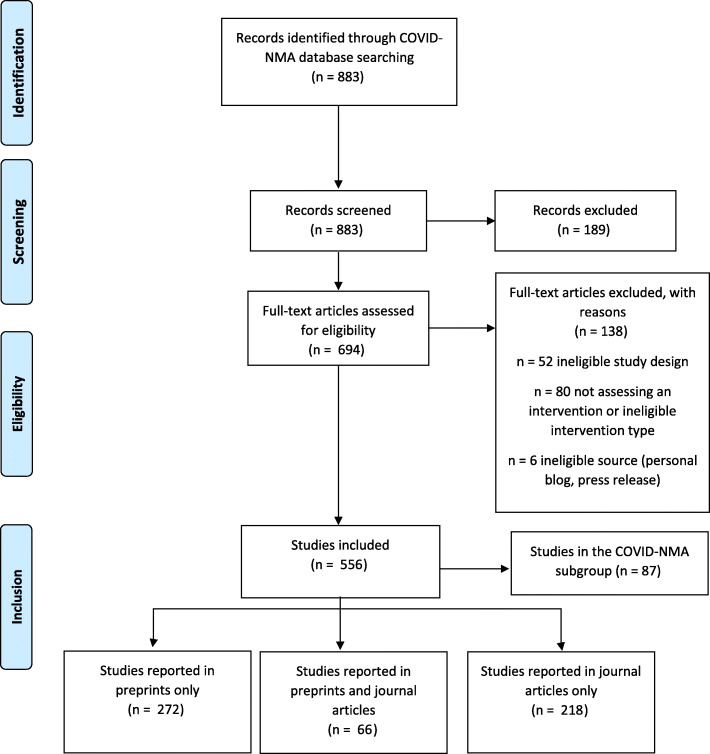
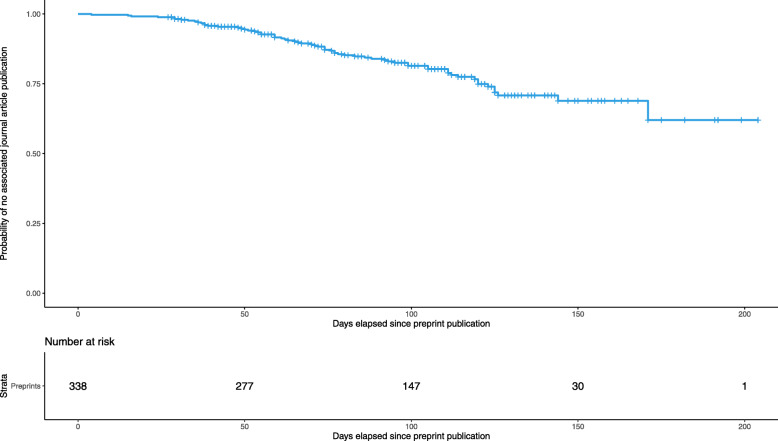
We identified 556 studies. In total, 338 (61%) had been reported in a preprint: 66 (20%) of these had an associated journal article (median time to publication 76 days [interquartile range (IQR) 55-106]) and 91 (27%) had > 1 preprint version. A total of 139 studies (25% of the overall sample) were reported in multiple evidence sources or versions of the same source: for 63 (45%), there was a change in at least one evidence component between or within sources (42 [30%] had a change in study results, and in 29 [21%] the change was classified as important; 33 [24%] had a change in the abstract conclusion). For studies with both a preprint and an article, a median of 29% (IQR 14-50) of total citations were attributed to the preprint instead of the article.
Results on the effect of interventions for COVID-19 are often reported in multiple evidence sources or source versions for a single study. Evidence is not stable between and within evidence sources. Real-time linkage of all sources per study could help to keep systematic reviews up-to-date.
越来越多地使用预印本来传播有关 2019 年冠状病毒病(COVID-19)干预效果的证据,可能会导致对单个研究有多个证据来源,这些来源在报告的证据方面可能存在差异。我们旨在描述来自预印本和期刊文章的有关 COVID-19 干预效果的证据比例,并绘制同一研究不同来源之间和内部证据的变化情况。
这是一项元研究。我们筛选了 Cochrane 生活系统评价和网络荟萃分析(COVID-NMA)数据库,以确定截至 2020 年 8 月 15 日发表的所有评估 COVID-19 干预效果的预印本和期刊文章。我们比较了所有证据来源(即预印本及其相关的期刊文章)以及每项研究的预印本的第一版和最新版,以确定两个证据组成部分的变化:研究结果(例如,风险比、优势比、事件发生率的数值变化,或任何结果中 p 值的变化>或<0.05)和摘要结论(根据干预效果分类为阳性、阴性或中性,以及是否报告结果不确定)。如果研究结果的变化(1)代表任何效应估计值的变化≥10%,和/或(2)导致 p 值跨越 0.05 的阈值,则进一步将其分类为重要变化。
我们确定了 556 项研究。总共,338 项(61%)在预印本中报告:其中 66 项(20%)有相关的期刊文章(中位数发表时间为 76 天[四分位距(IQR)55-106]),91 项(27%)有超过 1 个预印本版本。共有 139 项研究(总体样本的 25%)在多个证据来源或同一来源的多个版本中报告:对于 63 项(45%),来源之间或来源内部至少有一个证据组成部分发生了变化(42 项[30%]的研究结果发生了变化,其中 29 项[21%]的变化被归类为重要;33 项[24%]的摘要结论发生了变化)。对于既有预印本又有文章的研究,预印本的总引用量中位数(IQR 14-50)中有 29%归因于预印本,而不是文章。
有关 COVID-19 干预效果的研究结果通常在单个研究的多个证据来源或来源版本中报告。证据在证据来源之间和内部并不稳定。对每项研究的所有来源进行实时链接,可以帮助保持系统评价的最新状态。