Yoshimatsu K, Hasegawa N, Nambu Y, Ishii Y, Wakabayashi Y, Kumigashira H
Institute of Multidisciplinary Research for Advanced Materials, Tohoku University, Sendai, Miyagi, 980-8577, Japan.
Materials Research Center for Element Strategy (MCES), Tokyo Institute of Technology, Yokohama, 226-8503, Japan.
Sci Rep. 2020 Dec 17;10(1):22109. doi: 10.1038/s41598-020-79182-5.
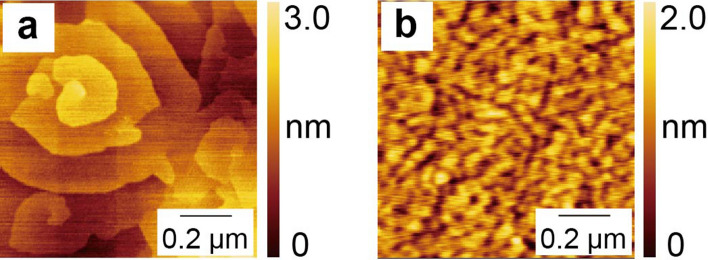
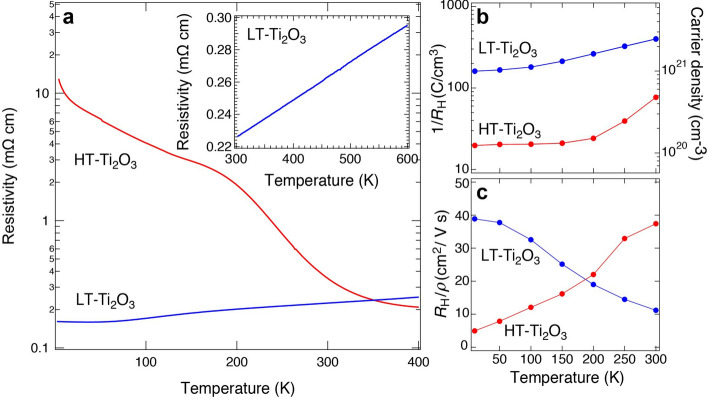
TiO exhibits unique metal-insulator transition (MIT) at ~ 450 K over a wide temperature range of ~ 150 K. The close relationship between MIT and crystal deformation has been proposed. However, as physical properties are governed by the thermodynamic equilibrium in bulk systems, conducting experimental studies under different lattice deformations remains challenging. Epitaxial thin films can offer high flexibility to accommodate adaptive crystal lattices and provide efficient platforms for investigating the MIT. In this study, we report the synthesis of corundum-type TiO films on various growth temperatures. We found that the metallic ground states appeared in the films grown at low temperatures. The electronic ground states were further investigated by the electronic-structure calculations. Results suggest that the electrical properties of TiO films were governed by the c/a ratio of the crystal structure, and the absence of the MIT was attributed to the lattice deformation characterized by an elongated c lattice constant.
二氧化钛(TiO)在约450K的温度下,在约150K的宽温度范围内呈现出独特的金属-绝缘体转变(MIT)。人们已经提出了MIT与晶体变形之间的密切关系。然而,由于物理性质受大块体系中热力学平衡的支配,在不同晶格变形下进行实验研究仍然具有挑战性。外延薄膜可以提供高度的灵活性来适应适应性晶格,并为研究MIT提供有效的平台。在本研究中,我们报告了在不同生长温度下合成刚玉型TiO薄膜。我们发现,在低温下生长的薄膜中出现了金属基态。通过电子结构计算进一步研究了电子基态。结果表明,TiO薄膜的电学性质受晶体结构的c/a比支配,MIT的缺失归因于以拉长的c晶格常数为特征的晶格变形。