
沉积的超薄氮化钛纳米棒阵列作为一种等离子体近完美光吸收体。
Deposited ultra-thin titanium nitride nanorod array as a plasmonic near-perfect light absorber.
作者信息
Jen Yi-Jun, Yang Kai-Bin, Lin Po-Chun, Chung Meng-Hsun
机构信息
Department of Electro-Optical Engineering, National Taipei University of Technology, Taipei, 106, Taiwan.
出版信息
Sci Rep. 2020 Dec 17;10(1):22269. doi: 10.1038/s41598-020-79399-4.
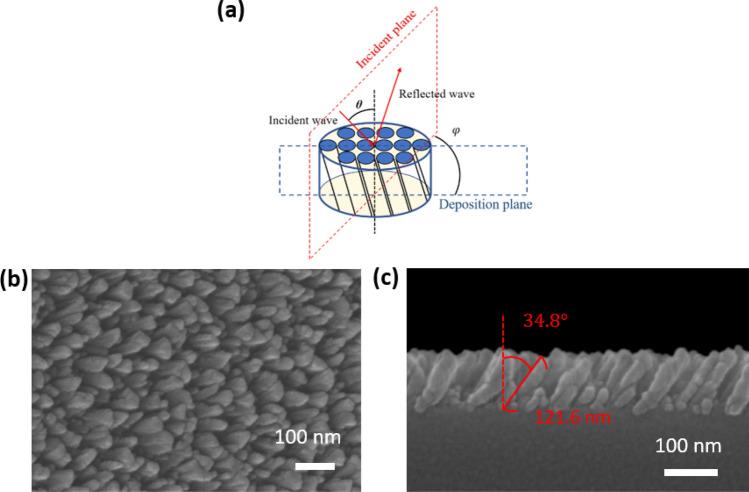
The transmittance, reflectance, and extinctance that correspond to the localized plasmonic resonance within TiN nanorods were investigated. The obliquely deposited TiN nanorod array shows polarization-independent admittance matching to air. Unlike noble metal nanorods, the near-field localized longitudinal and transverse plasmonic resonance of TiN nanorod arrays present polarization-dependent light extinction in the far field. The longitudinal plasmonic mode presents stronger extinction than transverse plasmonic mode. In order to have high efficient light absorption, an ultra-thin two-layered TiN nanorod array was fabricated with orthogonal deposition planes for upper layer and bottom layer to absorb different polarized light energy. The measured spectrum shows broadband and wide-angle light extinction.
研究了与TiN纳米棒内局域等离子体共振相对应的透过率、反射率和消光率。倾斜沉积的TiN纳米棒阵列显示出与空气的偏振无关的导纳匹配。与贵金属纳米棒不同,TiN纳米棒阵列的近场局域纵向和横向等离子体共振在远场呈现出偏振依赖的光消光。纵向等离子体模式比横向等离子体模式呈现出更强的消光。为了实现高效光吸收,制备了一种超薄双层TiN纳米棒阵列,其上层和底层具有正交的沉积平面,以吸收不同偏振的光能。测量光谱显示出宽带和广角光消光。



 Zotero 插件