Song Jia, Chu Shuaishuai, Fang Xin, Xu Fangxia, Zhang Peng, Zhao Xin, Ma Zhengliang, Xia Tianjiao, Gu Xiaoping
Department of Anesthesiology, Affiliated Drum Tower Hospital of Medical Department of Nanjing University, 321 Zhong Shan Road, Nanjing, Jiangsu 210008, P. R. China.
Department of Anesthesiology, Nanjing Stomatological Hospital, Medical School of Nanjing University, No 30 Zhongyang Road, Nanjing, 210008, China.
Transl Neurosci. 2020 Sep 21;11(1):341-355. doi: 10.1515/tnsci-2020-0130. eCollection 2020.
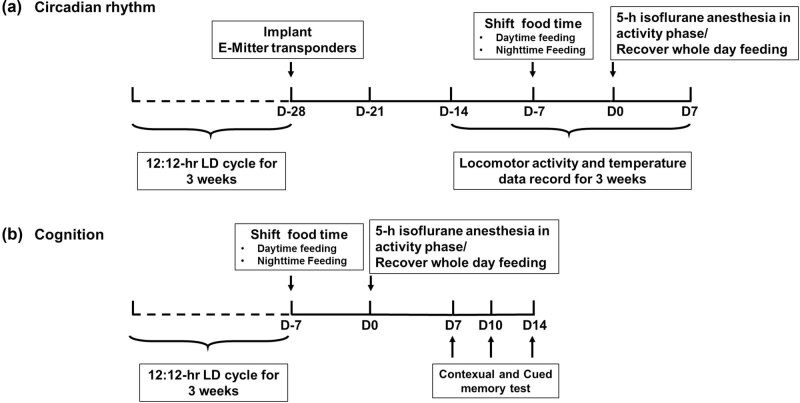
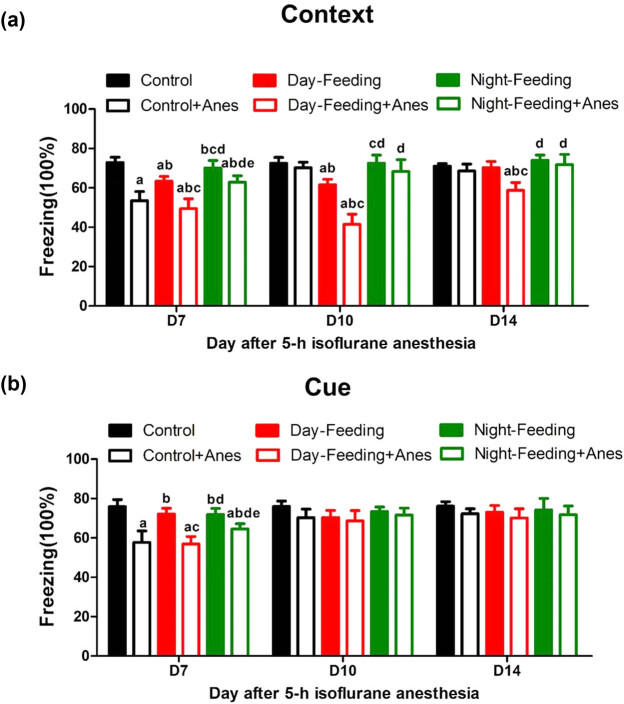
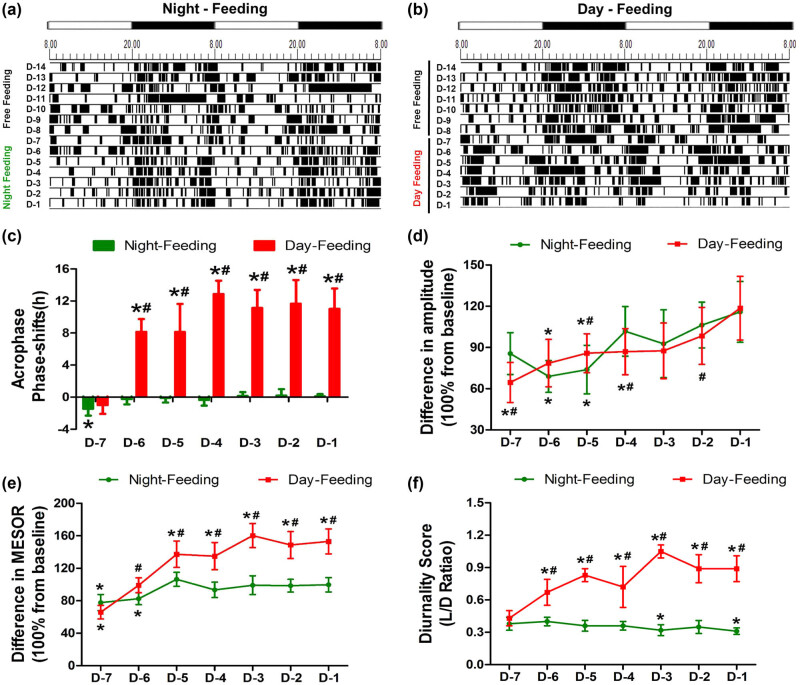
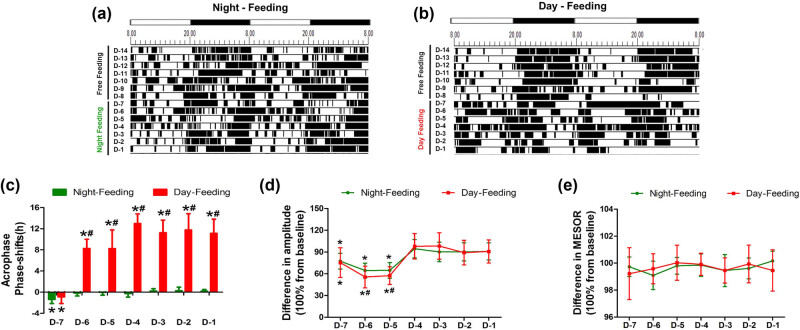
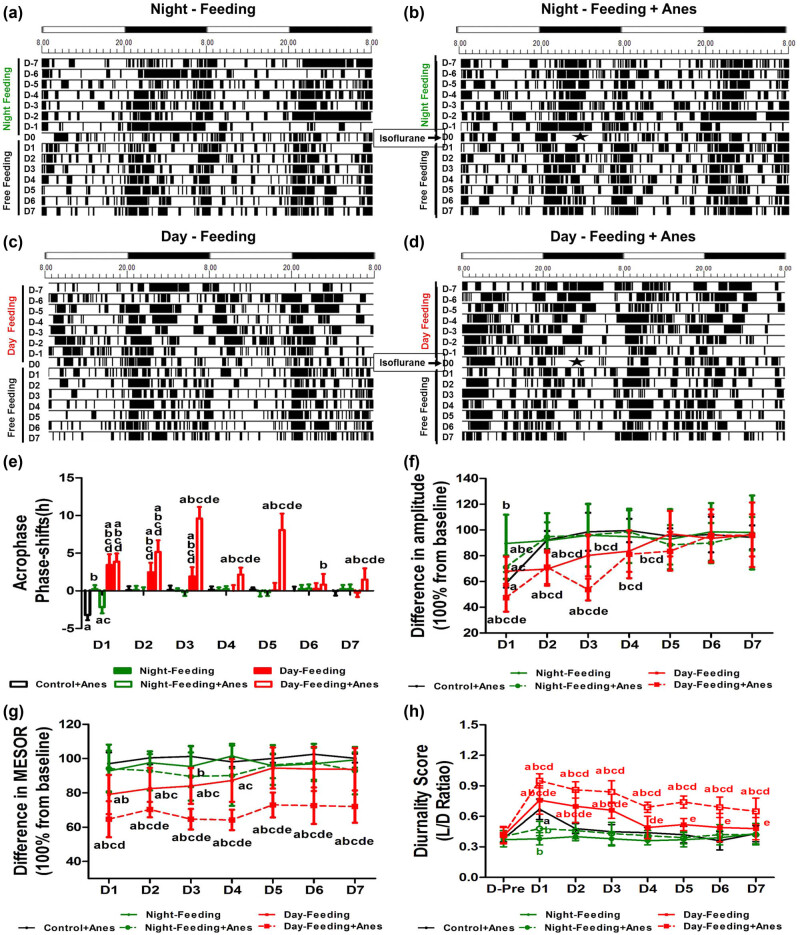
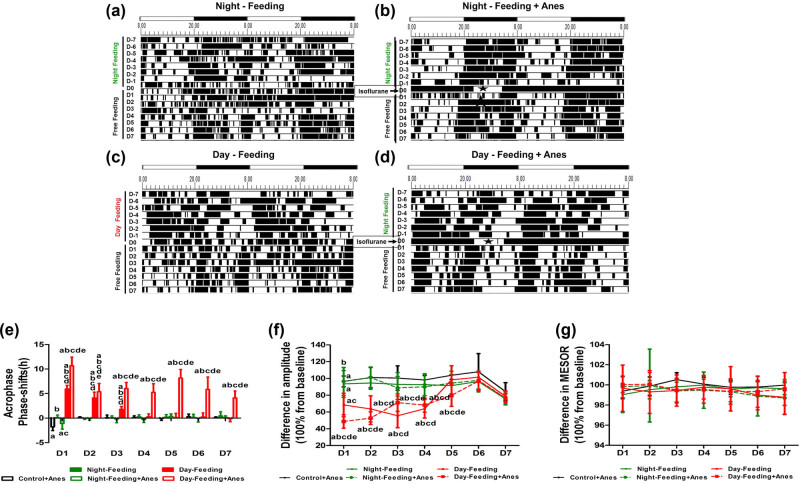
Food consumption during the rest phase promotes circadian desynchrony, which is corrected with harmful physiological and mental disorders. Previously, we found that circadian desynchrony was involved in isoflurane-induced cognitive impairment. Here, we scheduled food access to modulate daily rhythm to examine its impact on isoflurane-induced cognitive impairments. Mice were randomly transferred to restricted feeding (RF) time groups: Control group (Zeitgeber time (ZT) 0-ZT24, feeding), Day-Feeding group (ZT0-ZT12, misaligned feeding), and Night-Feeding group (ZT12-ZT24, aligned feeding). Then, some of them were subjected to 5 h of 1.3% isoflurane anaesthesia from ZT14 to ZT19 and were divided into the Control + Anes group, the Day-Feeding + Anes group, and the Night-Feeding + Anes group. Mini-Mitter was used to monitor the daily rhythm. Fear conditioning system was conducted to assess cognition of mice. We observed that the Night-Feeding group adapted to RF gradually, whereas the Day-Feeding group exhibited a disturbed daily rhythm. The Night-Feeding + Anes group exhibited a partially enhanced daily rhythm, whereas the Day-Feeding + Anes group exhibited sustained phase advances and diurnality score increase 7 days after isoflurane anaesthesia. Notably, in tests of hippocampus-dependent contextual memory, the Night-Feeding + Anes group demonstrated decreased deficits; the Day-Feeding + Anes group showed prolonged post-anaesthetic deficits 14 days after isoflurane anaesthesia. However, amygdala-dependent cued-fear conditioning post-anaesthesia was not altered by the RF schedule. In conclusion, we demonstrated that misaligned feeding disturbed the daily rhythm and led to persistent post-anaesthetic cognitive dysfunction. Aligned feeding enhanced the daily rhythm partially and improved post-anaesthetic cognitive dysfunction.
休息阶段的食物摄入会促进昼夜节律失调,而这种失调会引发有害的生理和精神紊乱。此前,我们发现昼夜节律失调与异氟烷诱导的认知障碍有关。在此,我们安排食物获取时间来调节日常节律,以研究其对异氟烷诱导的认知障碍的影响。将小鼠随机分为限时进食(RF)时间组:对照组(时间信号(ZT)0-ZT24,正常进食)、白天进食组(ZT0-ZT12,进食时间错位)和夜间进食组(ZT12-ZT24,进食时间对齐)。然后,其中一些小鼠在ZT14至ZT19接受5小时1.3%异氟烷麻醉,并分为对照组+麻醉组、白天进食+麻醉组和夜间进食+麻醉组。使用Mini-Mitter监测日常节律。采用恐惧条件反射系统评估小鼠的认知能力。我们观察到,夜间进食组逐渐适应了限时进食,而白天进食组的日常节律出现紊乱。夜间进食+麻醉组的日常节律部分增强,而白天进食+麻醉组在异氟烷麻醉7天后出现持续的相位提前和昼夜节律评分增加。值得注意的是,在海马体依赖的情境记忆测试中,夜间进食+麻醉组的缺陷减少;白天进食+麻醉组在异氟烷麻醉14天后出现麻醉后缺陷延长。然而,麻醉后的杏仁核依赖的线索性恐惧条件反射并未因限时进食时间表而改变。总之,我们证明进食时间错位会扰乱日常节律并导致持续的麻醉后认知功能障碍。进食时间对齐可部分增强日常节律并改善麻醉后认知功能障碍。