Sohn Jason W, Kim Haksoo, Park Samuel B, Lee Soyoung, Monroe James I, Malone Thomas B, Kinsella Timothy, Yao Min, Kunos Charles, Lo Simon S, Shenk Robert, Machtay Mitchell
Radiation Oncology, Allegheny Health Network, Pittsburgh, PA, United States.
Proton Therapy Center, National Cancer Center, Goyang, South Korea.
Front Oncol. 2020 Dec 1;10:586232. doi: 10.3389/fonc.2020.586232. eCollection 2020.
To reduce patient and procedure identification errors by human interactions in radiotherapy delivery and surgery, a Biometric Automated Patient and Procedure Identification System (BAPPIS) was developed. BAPPIS is a patient identification and treatment procedure verification system using fingerprints.
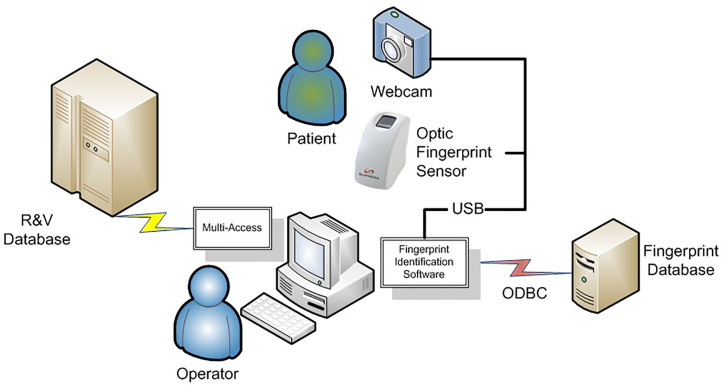
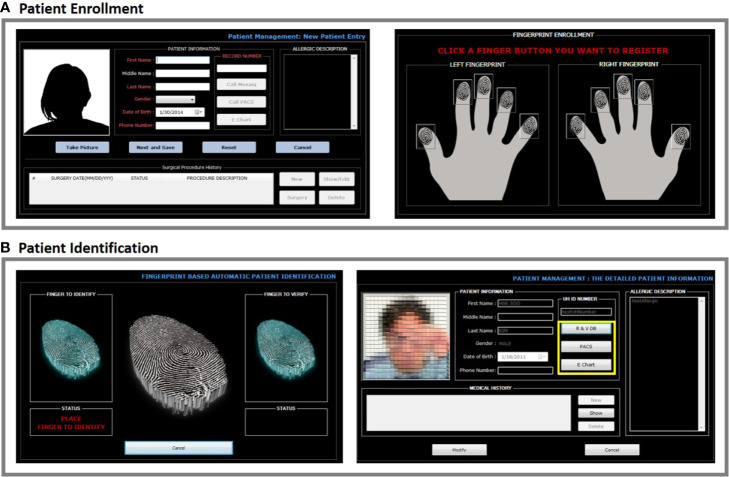
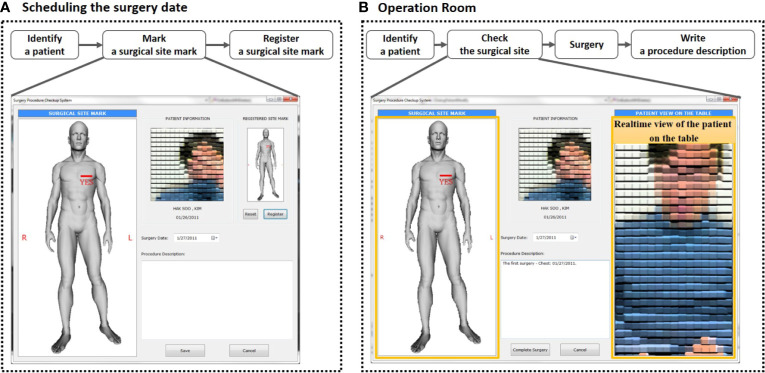
The system was developed using C++, the Microsoft Foundation Class Library, the Oracle database system, and a fingerprint scanner. To register a patient, the BAPPIS system requires three steps: capturing a photograph using a web camera for photo identification, taking at least two fingerprints, and recording other specific patient information including name, date of birth, allergies, . To identify a patient, the BAPPIS reads a fingerprint, identifies the patient, verifies with a second fingerprint to confirm when multiple patients have same fingerprint features, and connects to the patient's record in electronic medical record (EMR) systems. To validate the system, 143 and 21 patients ranging from 36 to 98 years of ages were recruited from radiotherapy and breast surgery, respectively. The registration process for surgery patients includes an additional module, which has a 3D patient model. A surgeon could mark 'O' on the model and save a snap shot of patient in the preparation room. In the surgery room, a webcam displayed the patient's real-time image next to the 3D model. This may prevent a possible surgical mistake.
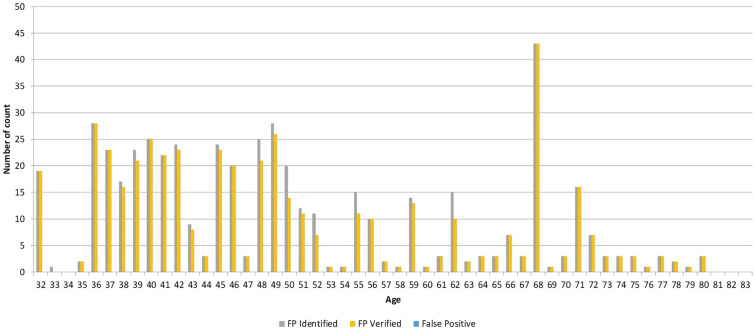
1,271 (96.9%) of 1,311 fingerprints were verified by BAPPIS using patients' 2 fingerprints from 143 patients as the system designed. A false positive recognition was not reported. The 96.9% completion ratio is because the operator did not verify with another fingerprint after identifying the first fingerprint. The reason may be due to lack of training at the beginning of the study.
We successfully demonstrated the use of BAPPIS to correctly identify and recall patient's record in EMR. BAPPIS may significantly reduce errors by limiting the number of non-automated steps.
为减少放射治疗和手术过程中因人为操作导致的患者及手术识别错误,研发了一种生物特征自动患者及手术识别系统(BAPPIS)。BAPPIS是一种利用指纹进行患者识别和治疗程序验证的系统。
该系统采用C++、微软基础类库、甲骨文数据库系统以及指纹扫描仪进行开发。为患者进行注册时,BAPPIS系统需要三个步骤:使用网络摄像头拍摄照片用于身份识别,采集至少两枚指纹,并记录包括姓名、出生日期、过敏史等其他特定患者信息。为识别患者,BAPPIS读取一枚指纹,识别患者身份,当多名患者具有相同指纹特征时,用另一枚指纹进行验证以确认身份,并连接到电子病历(EMR)系统中的患者记录。为验证该系统,分别从放射治疗科和乳腺外科招募了143名年龄在36至98岁之间的患者以及21名患者。手术患者的注册过程包括一个额外的模块,该模块具有一个3D患者模型。外科医生可以在模型上标记“O”,并在准备室保存患者的快照。在手术室中,网络摄像头在3D模型旁边显示患者的实时图像。这可能会防止可能出现的手术失误。
如系统设计的那样,BAPPIS使用143名患者的两枚指纹对1311枚指纹中的1271枚(96.9%)进行了验证。未报告误识情况。96.9%的完成率是因为操作员在识别第一枚指纹后未用另一枚指纹进行验证。原因可能是研究开始时缺乏培训。
我们成功展示了BAPPIS在电子病历中正确识别和调出患者记录的应用。BAPPIS通过限制非自动化步骤的数量可能会显著减少错误。