Li Zhonghui, Qu Zhenjie, Wang Ying, Qin Meilin, Zhang Hua
Department of Oncology, the Third Affiliated Hospital of Inner Mongolia Medical University, Inner Mongolia, China.
Department of Gerontology, the Third Affiliated Hospital of Inner Mongolia Medical University, Inner Mongolia, China.
Open Med (Wars). 2020 Jun 7;15(1):413-423. doi: 10.1515/med-2020-0044. eCollection 2020.
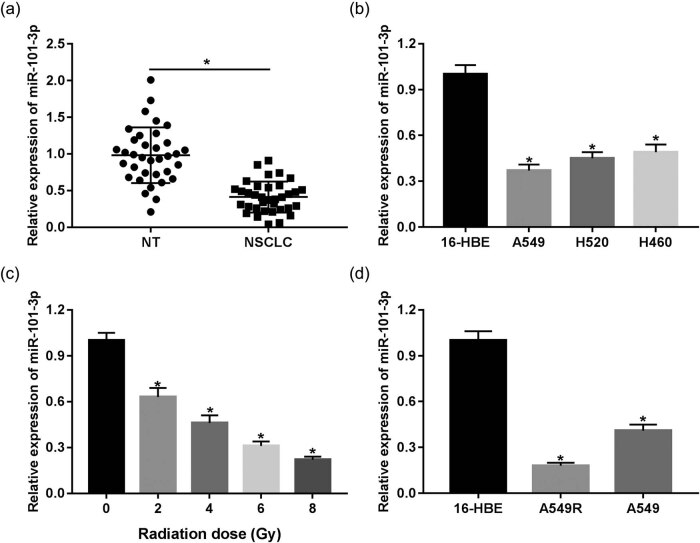
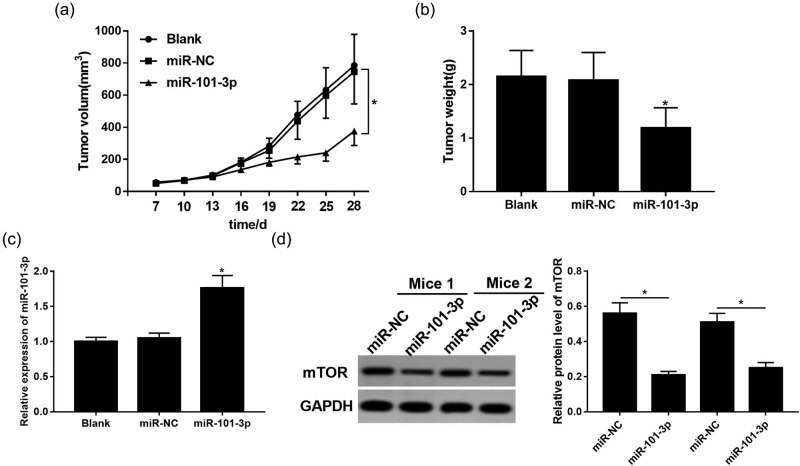
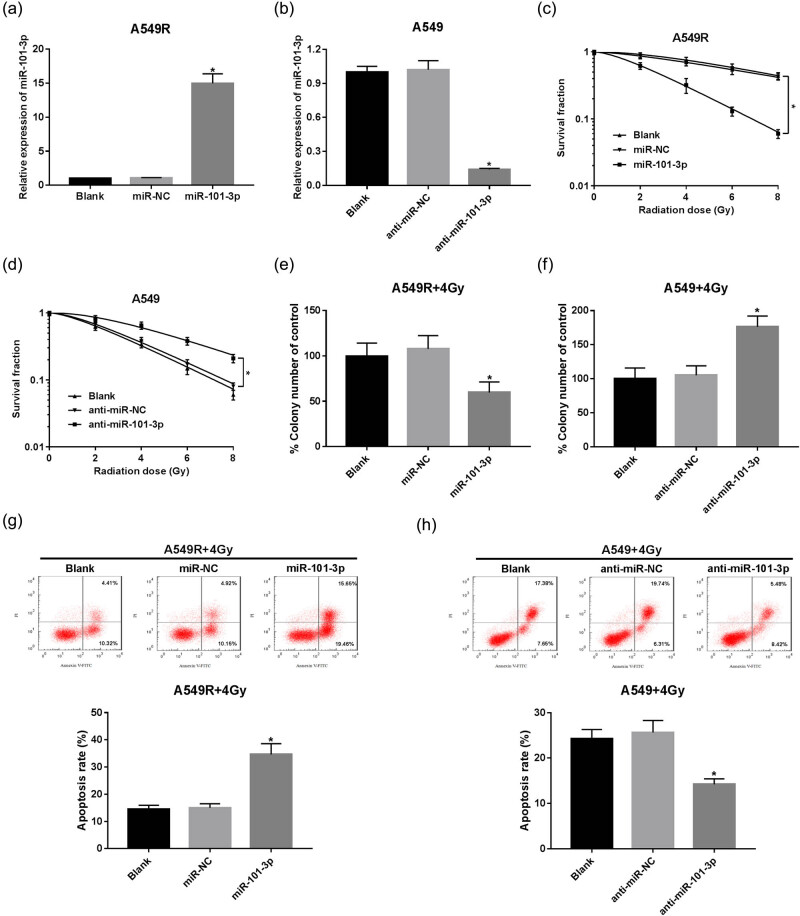
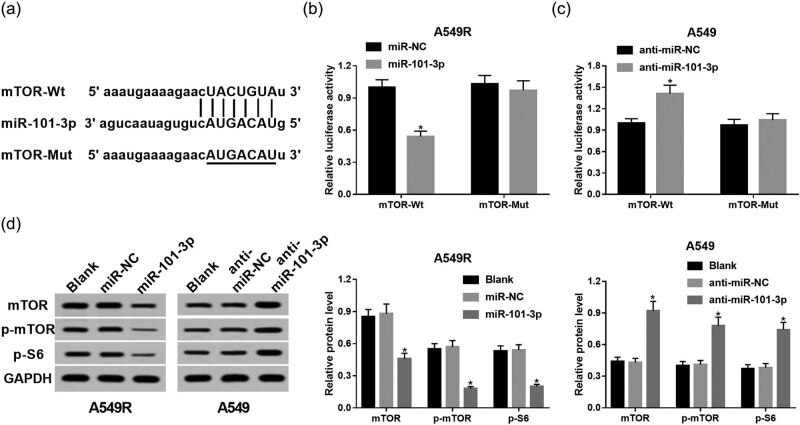
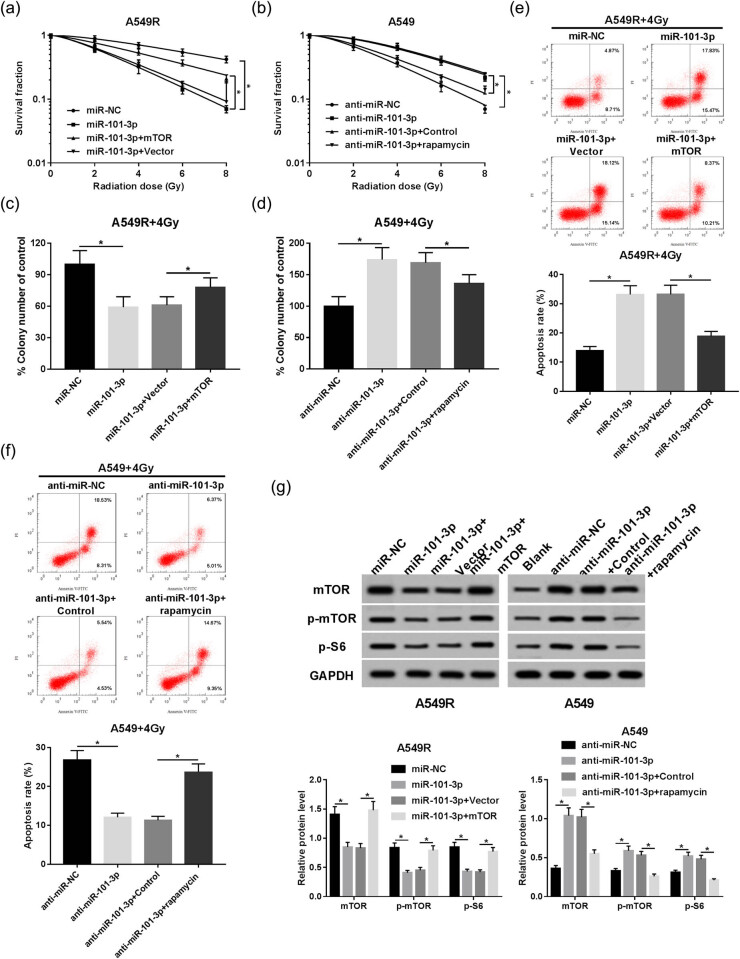
Recent studies have revealed that microRNAs regulate radiosensitivity of non-small cell lung cancer (NSCLC). The aim of this study was to investigate whether miR-101-3p is correlated with radiosensitivity of NSCLC. According to our results, miR-101-3p was downregulated in NSCLC tissues and cell lines. Moreover, miR-101-3p was decreased in A549 cells' response to irradiation in a dose-dependent manner. Upregulation of miR-101-3p decreased survival fraction and colony formation rate and increased irradiation-induced apoptosis in irradiation-resistant cells, while miR-101-3p depletion had the opposite effects in irradiation-sensitive cells. Furthermore, mechanistic target of rapamycin (mTOR) is a target gene of miR-101-3p. The expressions of mTOR, p-mTOR, and p-S6 were curbed by overexpression of miR-101-3p in A549R cells, which was enhanced by repression of miR-101-3p in A549 cells. Intriguingly, elevation in mTOR abated miR-101-3p upregulation-induced increase in irradiation sensitivity in irradiation-resistant cell line. In contrast, rapamycin undermined miR-101-3p inhibitor-mediated reduction of irradiation sensitivity in irradiation-sensitive cell line. Besides, miR-101-3p overexpression enhanced the efficacy of radiation in an NSCLC xenograft mouse model. In conclusion, miR-101-3p sensitized A549 cells to irradiation via inhibition of mTOR-signaling pathway.
最近的研究表明,微小RNA可调节非小细胞肺癌(NSCLC)的放射敏感性。本研究旨在探讨miR-101-3p是否与NSCLC的放射敏感性相关。根据我们的结果,miR-101-3p在NSCLC组织和细胞系中表达下调。此外,A549细胞对辐射的反应中,miR-101-3p呈剂量依赖性降低。上调miR-101-3p可降低抗辐射细胞的存活分数和集落形成率,并增加辐射诱导的细胞凋亡,而在辐射敏感细胞中,miR-101-3p的缺失则产生相反的效果。此外,雷帕霉素靶蛋白(mTOR)是miR-101-3p的靶基因。在A549R细胞中,miR-101-3p的过表达抑制了mTOR、p-mTOR和p-S6的表达,而在A549细胞中,miR-101-3p的抑制则增强了这些蛋白的表达。有趣的是,mTOR的升高减弱了miR-101-3p上调诱导的抗辐射细胞系辐射敏感性的增加。相反,雷帕霉素削弱了miR-101-3p抑制剂介导的辐射敏感细胞系辐射敏感性的降低。此外,miR-101-3p的过表达增强了NSCLC异种移植小鼠模型中的放疗效果。总之,miR-101-3p通过抑制mTOR信号通路使A549细胞对辐射敏感。