Sheffield Institute for Translational Neuroscience, University of Sheffield, Sheffield, UK.
Translational and Clinical Research Institute, University of Newcastle, Newcastle upon Tyne, UK.
Brain Pathol. 2021 May;31(3):e12928. doi: 10.1111/bpa.12928. Epub 2021 Feb 15.
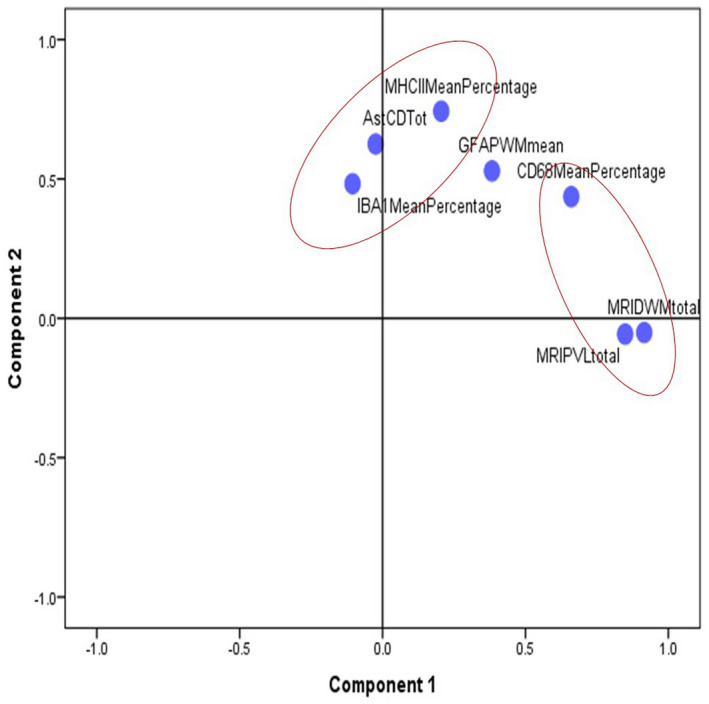
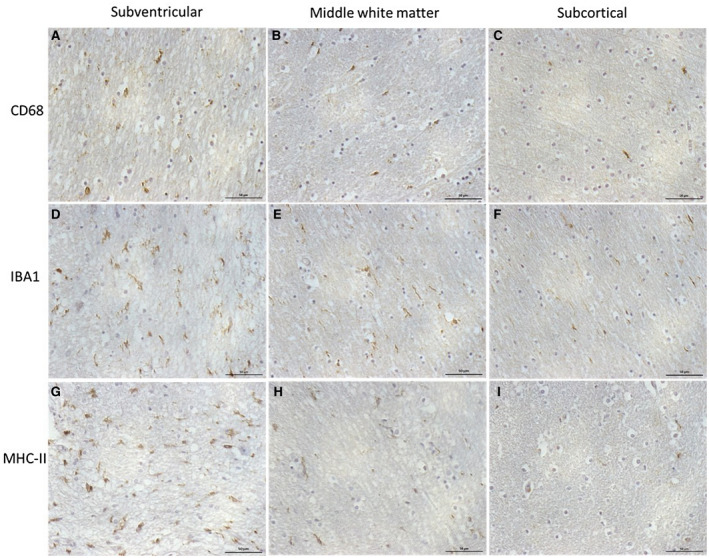
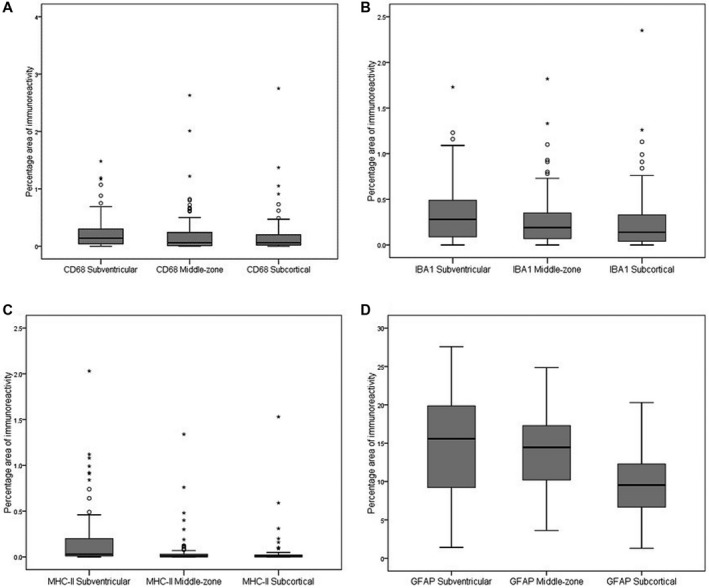
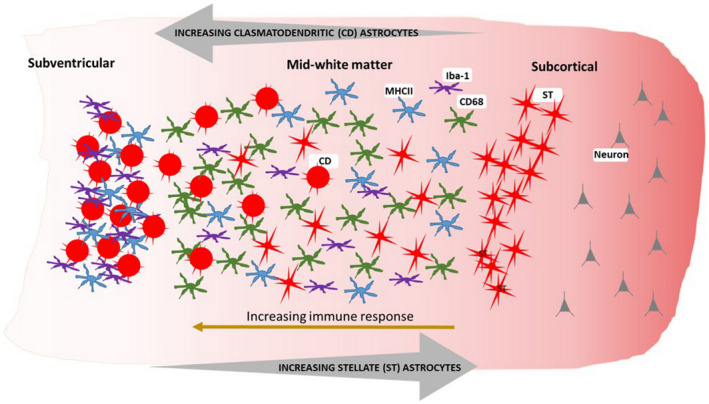
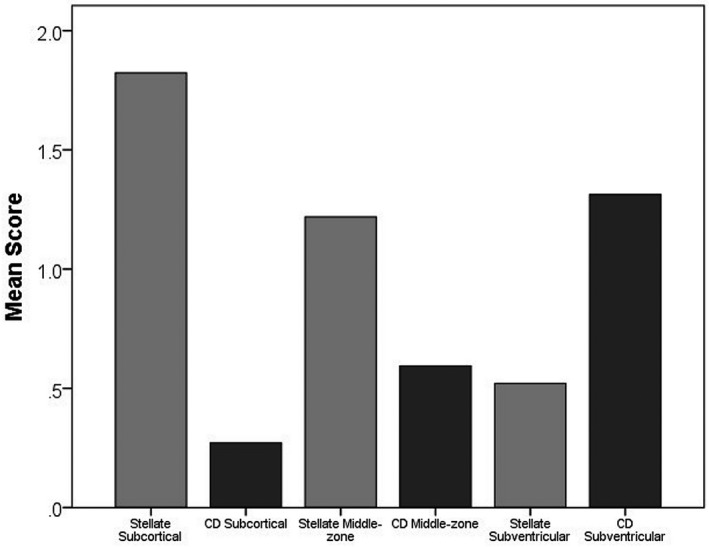
White matter lesions (WML) are common in the ageing brain, often arising in a field effect of diffuse white matter abnormality. Although WML are associated with cerebral small vessel disease (SVD) and Alzheimer's disease (AD), their cause and pathogenesis remain unclear. The current study tested the hypothesis that different patterns of neuroinflammation are associated with SVD compared to AD neuropathology by assessing the immunoreactive profile of the microglial (CD68, IBA1 and MHC-II) and astrocyte (GFAP) markers in ageing parietal white matter (PARWM) obtained from the Cognitive Function and Ageing Study (CFAS), an ageing population-representative neuropathology cohort. Glial responses varied extensively across the PARWM with microglial markers significantly higher in the subventricular region compared to either the middle-zone (CD68 p = 0.028, IBA1 p < 0.001, MHC-II p < 0.001) or subcortical region (CD68 p = 0.002, IBA1 p < 0.001, MHC-II p < 0.001). Clasmatodendritic (CD) GFAP astrocytes significantly increased from the subcortical to the subventricular region (p < 0.001), whilst GFAP stellate astrocytes significantly decreased (p < 0.001). Cellular reactions could be grouped into two distinct patterns: an immune response associated with MHC-II/IBA1 expression and CD astrocytes; and a more innate response characterised by CD68 expression associated with WML. White matter neuroinflammation showed weak relationships to the measures of SVD, but not to the measures of AD neuropathology. In conclusion, glial responses vary extensively across the PARWM with diverse patterns of white matter neuroinflammation. Although these findings support a role for vascular factors in the pathogenesis of age-related white matter neuroinflammation, additional factors other than SVD and AD pathology may drive this. Understanding the heterogeneity in white matter neuroinflammation will be important for the therapeutic targeting of age-associated white matter damage.
脑白质病变(WML)在老年大脑中很常见,通常是弥漫性脑白质异常的场效应所致。虽然 WML 与脑小血管病(SVD)和阿尔茨海默病(AD)有关,但它们的病因和发病机制尚不清楚。本研究通过评估认知功能与衰老研究(CFAS)中获得的衰老顶叶白质(PARWM)中小胶质细胞(CD68、IBA1 和 MHC-II)和星形胶质细胞(GFAP)标志物的免疫反应谱,来检验 SVD 与 AD 神经病理学相关的不同神经炎症模式的假设。CFAS 是一个具有代表性的老龄化人群神经病理学队列。在 PARWM 中,神经胶质的反应差异很大,与中间区(CD68 p=0.028,IBA1 p<0.001,MHC-II p<0.001)或皮质下区(CD68 p=0.002,IBA1 p<0.001,MHC-II p<0.001)相比,室旁区的小胶质细胞标志物明显更高。Clasmatodendritic(CD)GFAP 星形胶质细胞从皮质下区到室旁区显著增加(p<0.001),而 GFAP 星状星形胶质细胞显著减少(p<0.001)。细胞反应可分为两种不同的模式:一种与 MHC-II/IBA1 表达和 CD 星形胶质细胞相关的免疫反应;以及一种以 CD68 表达为特征的更先天反应,与 WML 相关。白质神经炎症与 SVD 的测量值呈弱相关,但与 AD 神经病理学的测量值无关。总之,PARWM 中的神经胶质反应差异很大,白质神经炎症表现出不同的模式。虽然这些发现支持血管因素在与年龄相关的白质神经炎症发病机制中的作用,但除了 SVD 和 AD 病理学之外,其他因素可能会导致这种情况。了解白质神经炎症的异质性对于针对与年龄相关的白质损伤的治疗靶向非常重要。