Department of Anesthesiology, Duke University Medical Center, Durham, NC, USA.
Center for Cognitive Neuroscience, Duke Institute for Brain Sciences, Durham, NC, USA.
J Alzheimers Dis. 2021;79(2):511-530. doi: 10.3233/JAD-200747.
APOE4 has been hypothesized to increase Alzheimer's disease risk by increasing neuroinflammation, though the specific neuroinflammatory pathways involved are unclear.
Characterize cerebrospinal fluid (CSF) proteomic changes related to APOE4 copy number.
We analyzed targeted proteomic data from ADNI CSF samples using a linear regression model adjusting for age, sex, and APOE4 copy number, and additional linear models also adjusting for AD clinical status or for CSF Aβ, tau, or p-tau levels. False discovery rate was used to correct for multiple comparisons correction.
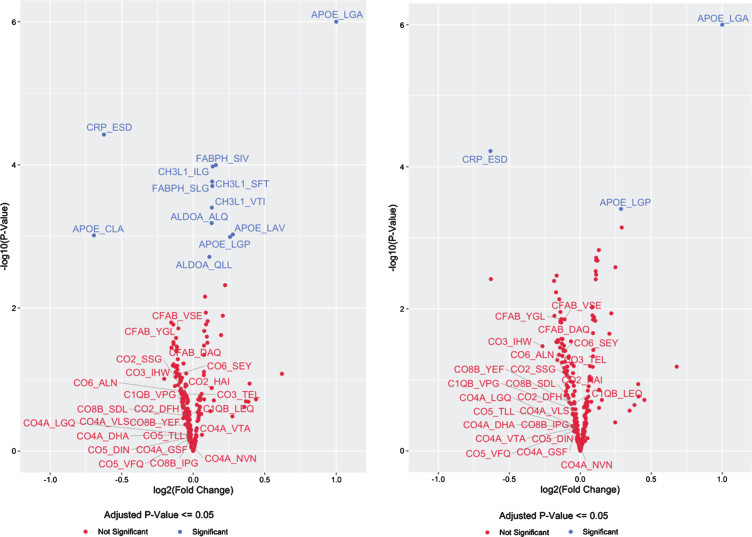
Increasing APOE4 copy number was associated with a significant decrease in a CRP peptide level across all five models (q < 0.05 for each), and with significant increases in ALDOA, CH3L1 (YKL-40), and FABPH peptide levels (q < 0.05 for each) except when controlling for AD clinical status or neurodegeneration biomarkers (i.e., CSF tau or p-tau). In all models except the one controlling for CSF Aβ levels, though not statistically significant, there was a consistent inverse direction of association between APOE4 copy number and the levels of all 24 peptides from all 8 different complement proteins measured. The odds of this happening by chance for 24 unrelated peptides would be less than 1 in 16 million.
Increasing APOE4 copy number was associated with decreased CSF CRP levels across all models, and increased CSF ALDOA, CH3L1, and FABH levels when controlling for CSF Aβ levels. Increased APOE4 copy number may also be associated with decreased CSF complement pathway protein levels, a hypothesis for investigation in future studies.
APOE4 被假设通过增加神经炎症来增加阿尔茨海默病的风险,尽管涉及的具体神经炎症途径尚不清楚。
描述与 APOE4 拷贝数相关的脑脊液(CSF)蛋白质组变化。
我们使用线性回归模型分析了 ADNI CSF 样本的靶向蛋白质组数据,该模型调整了年龄、性别和 APOE4 拷贝数,并且还使用了另外的线性模型来调整 AD 临床状态或 CSF Aβ、tau 或 p-tau 水平。使用错误发现率对多重比较进行了校正。
在所有五个模型中,随着 APOE4 拷贝数的增加,CRP 肽水平显著降低(每个 q 值均<0.05),而 ALDOA、CH3L1(YKL-40)和 FABPH 肽水平显著增加(每个 q 值均<0.05),除了控制 AD 临床状态或神经退行性变生物标志物(即 CSF tau 或 p-tau)时。在所有模型中,除了控制 CSF Aβ 水平的模型外,尽管没有统计学意义,但 APOE4 拷贝数与所有 8 种不同补体蛋白测量的 24 种肽的水平之间存在一致的负向关联。24 个不相关肽发生这种情况的可能性小于 1600 万分之一。
在所有模型中,随着 APOE4 拷贝数的增加,CSF CRP 水平降低,而当控制 CSF Aβ 水平时,CSF ALDOA、CH3L1 和 FABH 水平升高。APOE4 拷贝数的增加也可能与 CSF 补体途径蛋白水平的降低有关,这是未来研究的一个假说。