Department of Chemistry - BMC, Uppsala University, Box 576, 75123 Uppsala, Sweden.
Department of Medicinal Chemistry, Research and Early Development, Early Cardiovascular, Renal and Metabolism, BioPharmaceuticals R&D, AstraZeneca, 43183 Mölndal, Sweden.
J Med Chem. 2021 Jan 28;64(2):1054-1072. doi: 10.1021/acs.jmedchem.0c01569. Epub 2020 Dec 18.
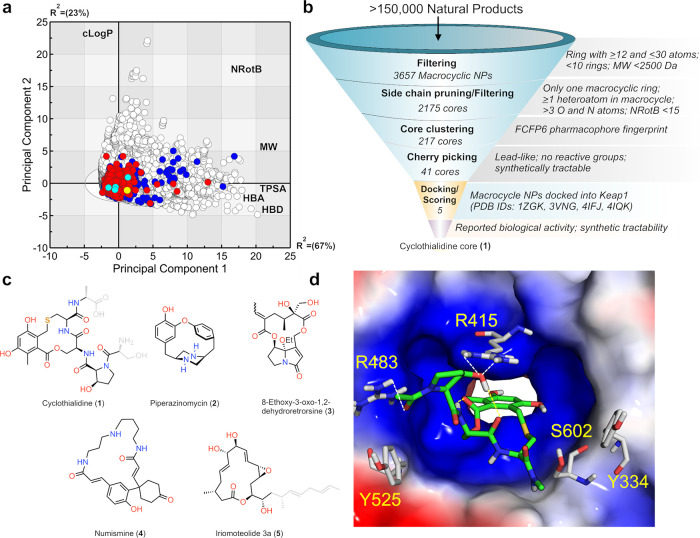
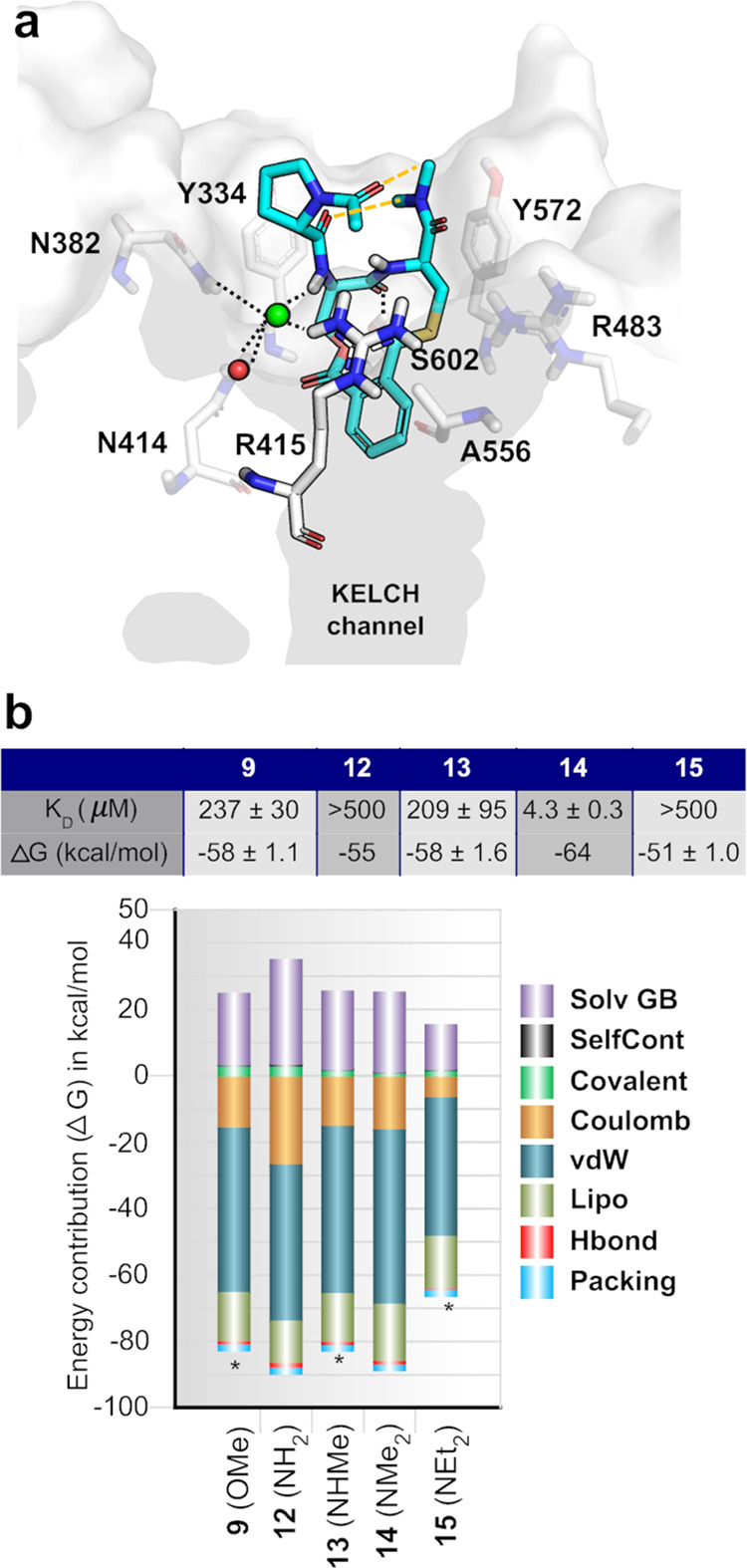
Lead generation for difficult-to-drug targets that have large, featureless, and highly lipophilic or highly polar and/or flexible binding sites is highly challenging. Here, we describe how cores of macrocyclic natural products can serve as a high-quality screening library that provides leads for difficult-to-drug targets. Two iterative rounds of docking of a carefully selected set of natural-product-derived cores led to the discovery of an uncharged macrocyclic inhibitor of the Keap1-Nrf2 protein-protein interaction, a particularly challenging target due to its highly polar binding site. The inhibitor displays cellular efficacy and is well-positioned for further optimization based on the structure of its complex with Keap1 and synthetic access. We believe that our work will spur interest in using macrocyclic cores for -based lead generation and also inspire the design of future macrocycle screening collections.
针对具有大而无特征、高度亲脂性或高度极性和/或柔性结合位点的难成药靶点进行的先导化合物生成极具挑战性。在这里,我们描述了大环天然产物的核心如何作为高质量的筛选文库,为难成药靶点提供先导化合物。两轮精心挑选的天然产物衍生核心的对接,发现了一种无电荷的大环抑制剂,可抑制 Keap1-Nrf2 蛋白-蛋白相互作用,由于其结合位点高度极性,该靶点极具挑战性。该抑制剂具有细胞功效,并且基于其与 Keap1 的复合物结构和合成途径,为进一步优化提供了良好的基础。我们相信,我们的工作将激发人们使用大环核心进行基于结构的先导化合物生成的兴趣,并为未来大环筛选库的设计提供灵感。