Departamento de Puericultura e Pediatria, Faculdade de Medicina de Ribeirão Preto, Universidade de São Paulo, Ribeirão Preto, SP, Brasil.
Departamento de Clínica Infantil, Faculdade de Odontologia Ribeirão Preto, Universidade de São Paulo, Ribeirão Preto, SP, Brasil.
Braz J Med Biol Res. 2020 Dec 21;54(1):10252-0. doi: 10.1590/1414-431X202010252. eCollection 2020.
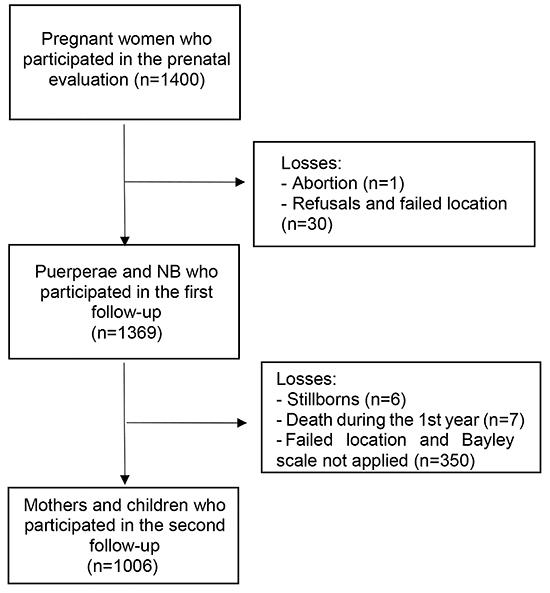
Fetuses exposed to alcohol and/or tobacco are at risk for perinatal adversities. However, little is currently known about the association of the separate or concomitant use of alcohol and tobacco with infant motor and cognitive development. Thus, the objective of the present study was to investigate the association between maternal consumption of alcohol and/or tobacco during pregnancy and the motor and cognitive development of children starting from the second year of life. The study included 1006 children of a cohort started during the prenatal period (22-25 weeks of pregnancy), evaluated at birth and reevaluated during the second year of life in 2011/2013. The children were divided into four groups according to the alcohol and/or tobacco consumption reported by their mothers at childbirth: no consumption (NC), separate alcohol consumption (AC), separate tobacco consumption (TC), and concomitant use of both (ACTC). The Bayley Scale of Infant and Toddler Development Third Edition screening tool was used for the assessment of motor and cognitive development. Adjusted Poisson regression models were used to determine the association between groups and delayed development. The results indicated that only the ACTC group showed a higher risk of motor delay, specifically regarding fine motor skills, compared to the NC group (RR=2.81; 95%CI: 1.65; 4.77). Separate alcohol or tobacco consumption was not associated with delayed gross motor or cognitive development. However, the concomitant use of the two substances increased the risk of delayed acquisition of fine motor skills.
胎儿在子宫内暴露于酒精和/或烟草中会面临围产期不良的风险。然而,目前对于酒精和烟草的单独或同时使用与婴儿运动和认知发育之间的关联知之甚少。因此,本研究的目的是调查母亲在怀孕期间饮酒和/或吸烟与儿童从两岁开始的运动和认知发育之间的关系。本研究纳入了一个在孕期(22-25 周)开始的队列中的 1006 名儿童,他们在出生时进行了评估,并在 2011/2013 年的第二年进行了重新评估。根据母亲在分娩时报告的酒精和/或烟草消费情况,将儿童分为四组:无消费(NC)、单独饮酒(AC)、单独吸烟(TC)和同时使用两种(ACTC)。采用贝利婴幼儿发育量表第三版筛查工具评估运动和认知发育。采用调整后的泊松回归模型来确定各组与发育迟缓之间的关系。结果表明,只有 ACTC 组与 NC 组相比,运动发育迟缓的风险更高,特别是精细运动技能(RR=2.81;95%CI:1.65;4.77)。单独饮酒或吸烟与粗大运动或认知发育迟缓无关。然而,同时使用这两种物质会增加精细运动技能获得延迟的风险。