Department of Neurology, Massachusetts General Hospital, Boston, MA, USA; Massachusetts Alzheimer's Disease Research Center, Charlestown, MA, USA; Harvard Medical School, Boston, MA, USA.
Department of Neurology, Massachusetts General Hospital, Boston, MA, USA; Massachusetts Alzheimer's Disease Research Center, Charlestown, MA, USA; Harvard Medical School, Boston, MA, USA.
Lancet Neurol. 2021 Jan;20(1):68-80. doi: 10.1016/S1474-4422(20)30412-9.
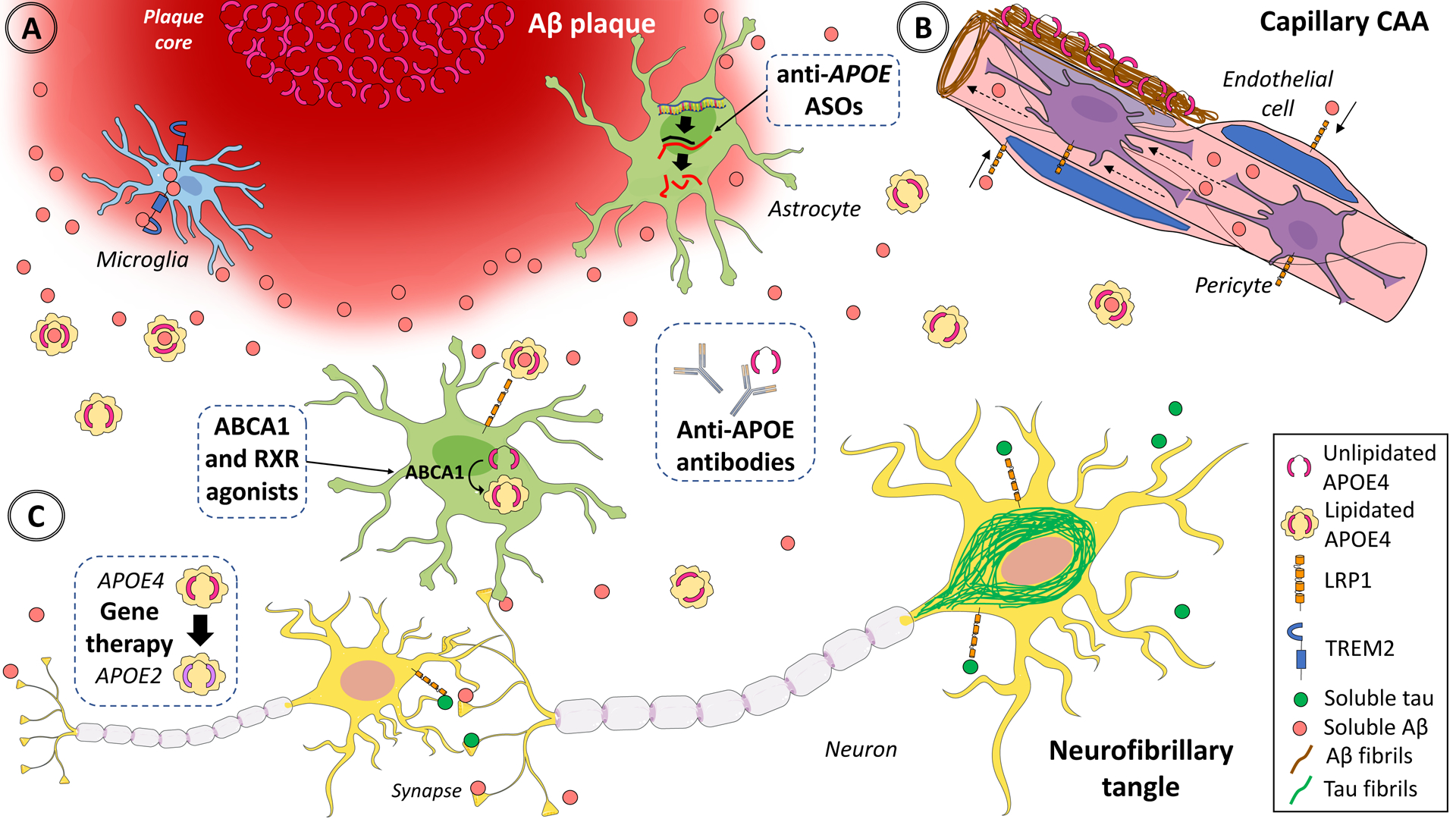
The APOE ε4 allele remains the strongest genetic risk factor for sporadic Alzheimer's disease and the APOE ε2 allele the strongest genetic protective factor after multiple large scale genome-wide association studies and genome-wide association meta-analyses. However, no therapies directed at APOE are currently available. Although initial studies causally linked APOE with amyloid-β peptide aggregation and clearance, over the past 5 years our understanding of APOE pathogenesis has expanded beyond amyloid-β peptide-centric mechanisms to tau neurofibrillary degeneration, microglia and astrocyte responses, and blood-brain barrier disruption. Because all these pathological processes can potentially contribute to cognitive impairment, it is important to use this new knowledge to develop therapies directed at APOE. Several therapeutic approaches have been successful in mouse models expressing human APOE alleles, including increasing or reducing APOE levels, enhancing its lipidation, blocking the interactions between APOE and amyloid-β peptide, and genetically switching APOE4 to APOE3 or APOE2 isoforms, but translation to human clinical trials has proven challenging.
APOE ε4 等位基因仍然是散发性阿尔茨海默病最强的遗传风险因素,而 APOE ε2 等位基因是经过多次大规模全基因组关联研究和全基因组关联荟萃分析后最强的遗传保护因素。然而,目前尚无针对 APOE 的治疗方法。尽管最初的研究将 APOE 与淀粉样蛋白-β肽聚集和清除联系起来,但在过去的 5 年中,我们对 APOE 发病机制的理解已经超出了以淀粉样蛋白-β肽为中心的机制,扩展到了 tau 神经原纤维变性、小胶质细胞和星形胶质细胞反应以及血脑屏障破坏。由于所有这些病理过程都可能导致认知障碍,因此利用这些新知识开发针对 APOE 的治疗方法非常重要。几种治疗方法在表达人 APOE 等位基因的小鼠模型中取得了成功,包括增加或降低 APOE 水平、增强其脂化、阻断 APOE 与淀粉样蛋白-β肽之间的相互作用,以及将 APOE4 基因转换为 APOE3 或 APOE2 同工型,但向人类临床试验的转化证明具有挑战性。