Kang Ki-Woon, Ok Minho, Lee Seong-Kyu
Division of Cardiology, Department of Internal Medicine, Eulji University School of Medicine, Daejeon, Korea.
Department of Cardiovascular Pharmacology, Mokpo National University, Mokpo, Korea.
J Obes Metab Syndr. 2020 Dec 30;29(4):248-259. doi: 10.7570/jomes20120.
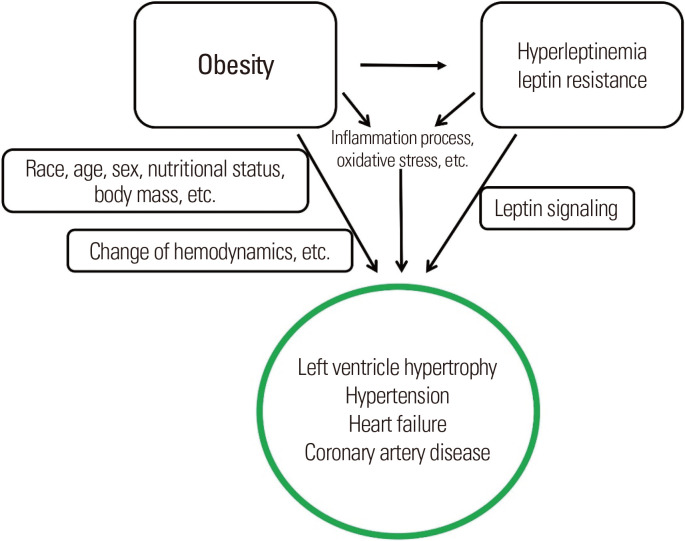
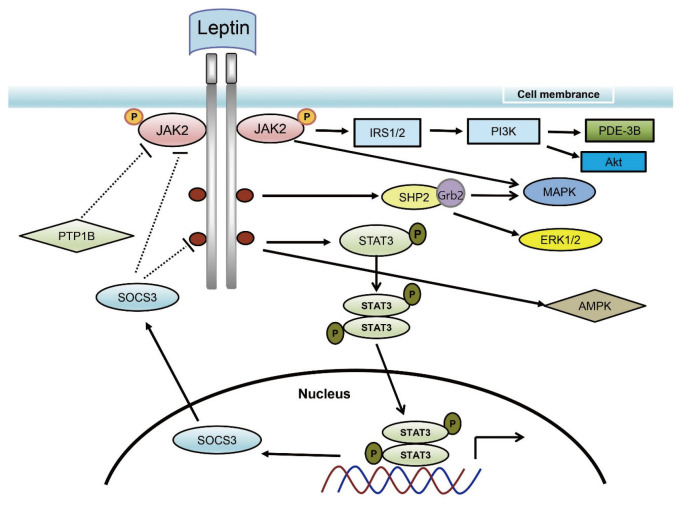
Obesity increases the risk of cardiovascular disease through various influencing factors. Leptin, which is predominantly secreted by adipose tissue, regulates satiety homeostasis and energy balance, and influences cardiovascular functions directly and indirectly. Leptin appears to play a role in heart protection in leptin-deficient and leptin-receptor-deficient rodent model experiments. Hyperleptinemia or leptin resistance in human obesity influences the vascular endothelium, cardiovascular structure and functions, inflammation, and sympathetic activity, which may lead to cardiovascular disease. Leptin is involved in many processes, including signal transduction, vascular endothelial function, and cardiac structural remodeling. However, the dual (positive and negative) regulator effect of leptin and its receptor on cardiovascular disease has not been completely understood. The protective role of leptin signaling in cardiovascular disease could be a promising target for cardiovascular disease prevention in obese patients.
肥胖通过多种影响因素增加心血管疾病风险。瘦素主要由脂肪组织分泌,调节饱腹感稳态和能量平衡,并直接或间接影响心血管功能。在瘦素缺乏和瘦素受体缺乏的啮齿动物模型实验中,瘦素似乎发挥心脏保护作用。人类肥胖中的高瘦素血症或瘦素抵抗会影响血管内皮、心血管结构与功能、炎症及交感神经活动,这可能导致心血管疾病。瘦素参与许多过程,包括信号转导、血管内皮功能及心脏结构重塑。然而,瘦素及其受体对心血管疾病的双重(正向和负向)调节作用尚未完全明确。瘦素信号在心血管疾病中的保护作用可能成为肥胖患者心血管疾病预防的一个有前景的靶点。