Scholze Petra, Huck Sigismund
Department of Pathobiology of the Nervous System, Center for Brain Research, Medical University of Vienna, Vienna, Austria.
Front Synaptic Neurosci. 2020 Dec 3;12:607959. doi: 10.3389/fnsyn.2020.607959. eCollection 2020.
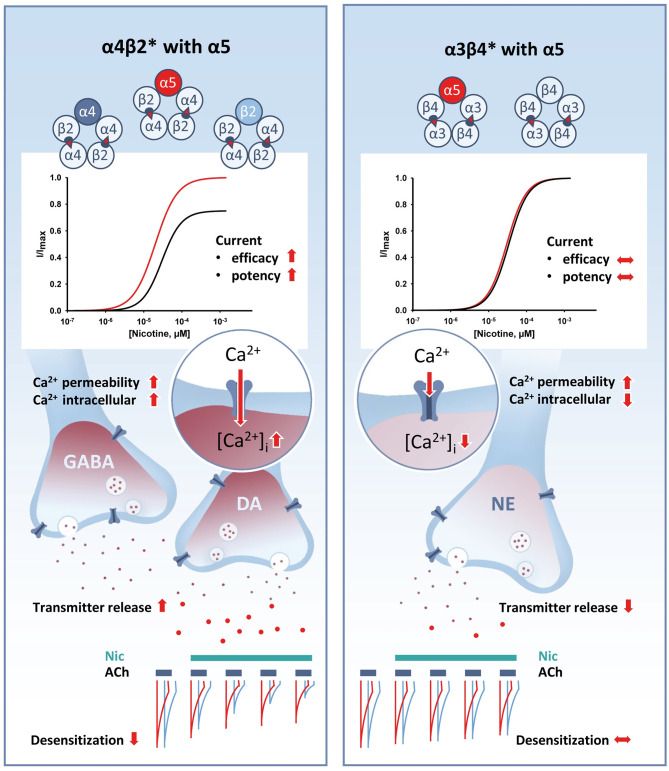
Nicotine, the principal reinforcing compound in tobacco, acts in the brain by activating neuronal nicotinic acetylcholine receptors (nAChRs). This review summarizes our current knowledge regarding how the α5 accessory nAChR subunit, encoded by the gene, differentially modulates α4β2 and α3β4 receptors at the cellular level. Genome-wide association studies have linked a gene cluster in chromosomal region 15q25 to increased susceptibility to nicotine addiction, lung cancer, chronic obstructive pulmonary disease, and peripheral arterial disease. Interestingly, this gene cluster contains a non-synonymous single-nucleotide polymorphism (SNP) in the human gene, causing an aspartic acid (D) to asparagine (N) substitution at amino acid position 398 in the α5 nAChR subunit. Although other SNPs have been associated with tobacco smoking behavior, efforts have focused predominantly on the D398 and N398 variants in the α5 subunit. In recent years, significant progress has been made toward understanding the role that the α5 nAChR subunit-and the role of the D398 and N398 variants-plays on nAChR function at the cellular level. These insights stem primarily from a wide range of experimental models, including receptors expressed heterologously in oocytes, various cell lines, and neurons derived from human induced pluripotent stem cells (iPSCs), as well as endogenous receptors in genetically engineered mice and-more recently-rats. Despite providing a wealth of available data, however, these studies have yielded conflicting results, and our understanding of the modulatory role that the α5 subunit plays remains incomplete. Here, we review these reports and the various techniques used for expression and analysis in order to examine how the α5 subunit modulates key functions in α4β2 and α3β4 receptors, including receptor trafficking, sensitivity, efficacy, and desensitization. In addition, we highlight the strikingly different role that the α5 subunit plays in Ca signaling between α4β2 and α3β4 receptors, and we discuss whether the N398 α5 subunit variant can partially replace the D398 variant.
尼古丁是烟草中的主要成瘾成分,通过激活神经元烟碱型乙酰胆碱受体(nAChRs)在大脑中发挥作用。本综述总结了我们目前关于由该基因编码的α5辅助nAChR亚基如何在细胞水平上差异调节α4β2和α3β4受体的知识。全基因组关联研究已将染色体区域15q25中的一个基因簇与尼古丁成瘾、肺癌、慢性阻塞性肺疾病和外周动脉疾病易感性增加联系起来。有趣的是,该基因簇在人类基因中包含一个非同义单核苷酸多态性(SNP),导致α5 nAChR亚基第398位氨基酸处的天冬氨酸(D)被天冬酰胺(N)取代。尽管其他SNP与吸烟行为有关,但研究主要集中在α5亚基中的D398和N398变体上。近年来,在理解α5 nAChR亚基以及D398和N398变体在细胞水平上对nAChR功能的作用方面取得了重大进展。这些见解主要源于广泛的实验模型,包括在卵母细胞、各种细胞系和源自人类诱导多能干细胞(iPSC)的神经元中异源表达的受体,以及基因工程小鼠和最近的大鼠中的内源性受体。然而,尽管提供了大量可用数据,但这些研究结果相互矛盾,我们对α5亚基所起的调节作用的理解仍然不完整。在这里,我们回顾这些报告以及用于表达和分析的各种技术,以研究α5亚基如何调节α4β2和α3β4受体的关键功能,包括受体转运、敏感性、效能和脱敏。此外,我们强调α5亚基在α4β2和α3β4受体之间的Ca信号传导中所起的显著不同作用,并讨论N398 α5亚基变体是否可以部分替代D398变体。