Brahmer Alexandra, Neuberger Elmo W I, Simon Perikles, Krämer-Albers Eva-Maria
Extracellular Vesicles Research Group, Institute of Developmental Biology and Neurobiology, Johannes Gutenberg University of Mainz, Mainz, Germany.
Department of Sports Medicine, Rehabilitation and Disease Prevention, Johannes Gutenberg University of Mainz, Mainz, Germany.
Front Physiol. 2020 Dec 3;11:576150. doi: 10.3389/fphys.2020.576150. eCollection 2020.
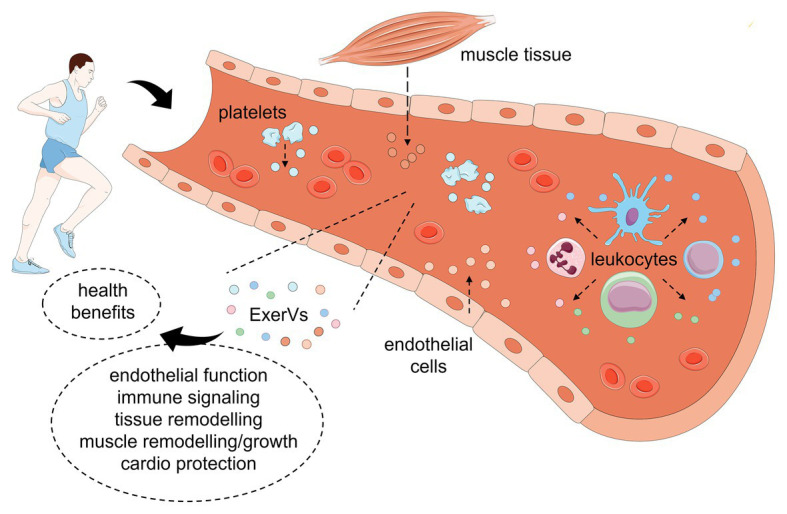
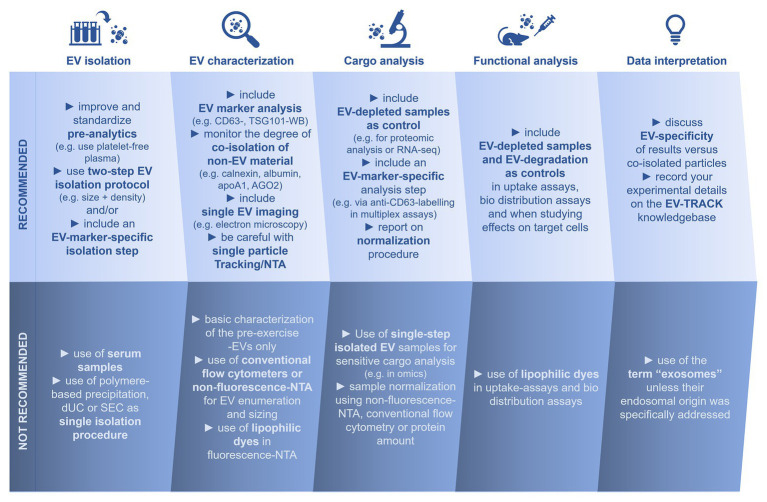
Physical exercise induces acute physiological changes leading to enhanced tissue cross-talk and a liberation of extracellular vesicles (EVs) into the circulation. EVs are cell-derived membranous entities which carry bioactive material, such as proteins and RNA species, and are important mediators of cell-cell-communication. Different types of physical exercise interventions trigger the release of diverse EV subpopulations, which are hypothesized to be involved in physiological adaptation processes leading to health benefits and longevity. Large EVs ("microvesicles" and "microparticles") are studied frequently in the context of physical exercise using straight forward flow cytometry approaches. However, the analysis of small EVs (sEVs) including exosomes is hampered by the complex composition of blood, confounding the methodology of EV isolation and characterization. This mini review presents a concise overview of the current state of research on sEVs released upon physical exercise (ExerVs), highlighting the technical limits of ExerV analysis. The purity of EV preparations is highly influenced by the co-isolation of non-EV structures in the size range or density of EVs, such as lipoproteins and protein aggregates. Technical constraints associated with EV purification challenge the quantification of distinct ExerV populations, the identification of their cargo, and the investigation of their biological functions. Here, we offer recommendations for the isolation and characterization of ExerVs to minimize the effects of these drawbacks. Technological advances in the ExerV research field will improve understanding of the inter-cellular cross-talk induced by physical exercise leading to health benefits.
体育锻炼会引发急性生理变化,导致组织间的相互作用增强,细胞外囊泡(EVs)释放到循环系统中。EVs是细胞来源的膜性结构,携带生物活性物质,如蛋白质和RNA,是细胞间通讯的重要介质。不同类型的体育锻炼干预会触发不同EV亚群的释放,据推测这些亚群参与了导致健康益处和长寿的生理适应过程。在体育锻炼的背景下,大型EVs(“微泡”和“微粒”)常使用直接的流式细胞术方法进行研究。然而,包括外泌体在内的小型EVs(sEVs)的分析受到血液复杂成分的阻碍,这使得EV分离和表征的方法变得复杂。本综述简要概述了体育锻炼后释放的sEVs(ExerVs)的研究现状,强调了ExerV分析的技术局限性。EV制剂的纯度受到与EV大小范围或密度相同的非EV结构(如脂蛋白和蛋白质聚集体)共分离的高度影响。与EV纯化相关的技术限制对不同ExerV群体的定量、其货物的鉴定及其生物学功能的研究提出了挑战。在此,我们提供了ExerVs分离和表征的建议,以尽量减少这些缺点的影响。ExerV研究领域的技术进步将增进对体育锻炼诱导的细胞间相互作用导致健康益处的理解。