Darboe Alansana, Nielsen Carolyn M, Wolf Asia-Sophia, Wildfire Jacob, Danso Ebrima, Sonko Bakary, Bottomley Christian, Moore Sophie E, Riley Eleanor M, Goodier Martin R
Department of Infection Biology, London School of Hygiene and Tropical Medicine, London, United Kingdom.
Vaccines & Immunity Theme, Infant Immunology, MRC Unit The Gambia at London School of Hygiene and Tropical Medicine, Fajara, Gambia.
Front Immunol. 2020 Dec 2;11:594107. doi: 10.3389/fimmu.2020.594107. eCollection 2020.
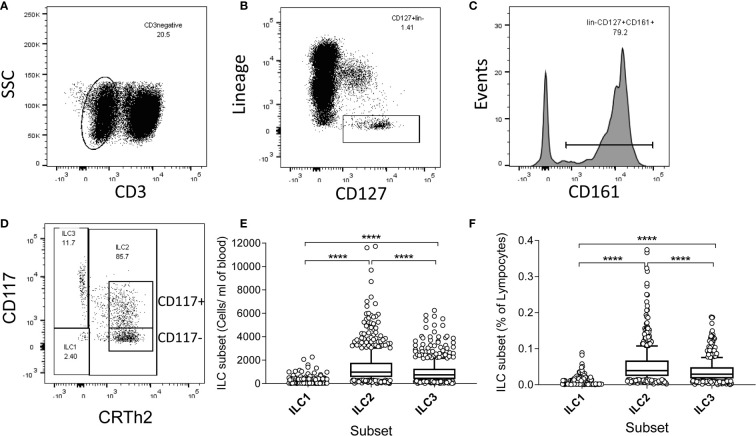
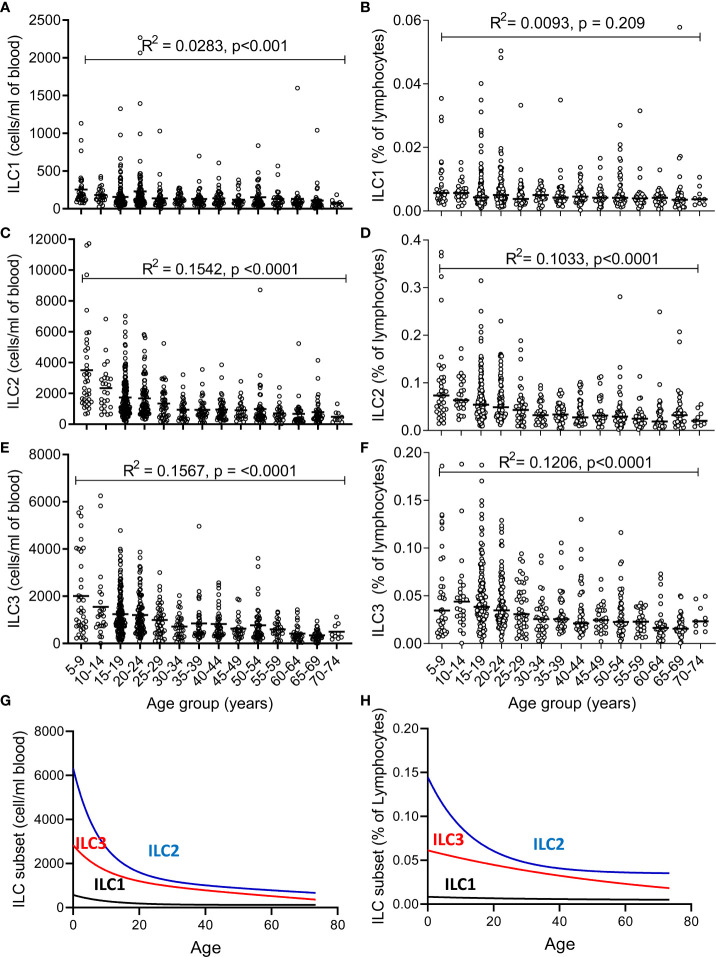
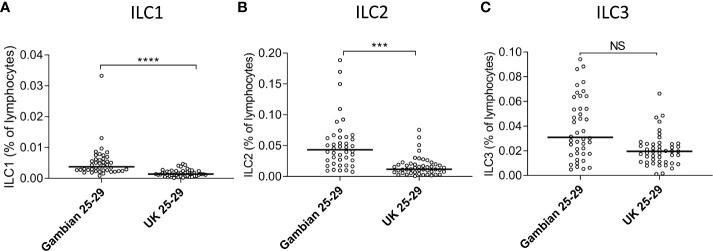
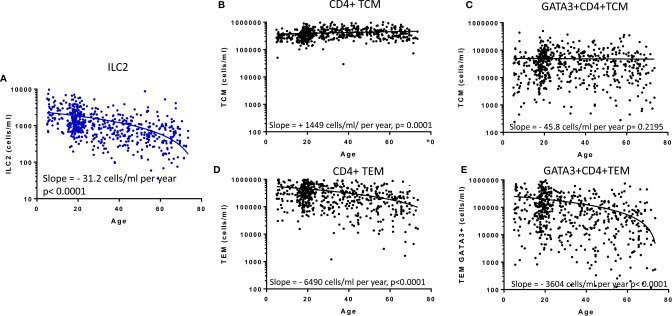
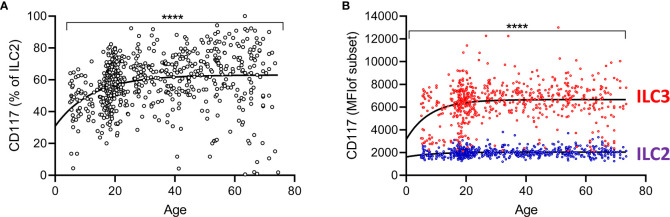
Innate lymphoid cell (ILC) lineages mirror those of CD4+ T helper cell subsets, producing type 1, 2 and 3 cytokines respectively. Studies in adult human populations have shown contributions of non-cytotoxic ILC to immune regulation or pathogenesis in a wide range of diseases and have prompted investigations of potential functional redundancy between ILC and T helper cell compartments in neonates and children. To investigate the potential for ILC to contribute to immune responses across the human lifespan, we examined the numbers and frequencies of peripheral blood ILC subsets in a cohort of Gambians aged between 5 and 73 years of age. ILC2 were the most abundant peripheral blood ILC subset in this Gambian cohort, while ILC1 were the rarest at all ages. Moreover, the frequency of ILC1s (as a proportion of all lymphocytes) was remarkably stable over the life course whereas ILC3 cell frequencies and absolute numbers declined steadily across the life course and ILC2 frequencies and absolute numbers declined from childhood until the age of approx. 30 years of age. Age-related reductions in ILC2 cell numbers appeared to be partially offset by increasing numbers of total and GATA3+ central memory (CD45RA-CCR7+) CD4+ T cells, although there was also a gradual decline in numbers of total and GATA3+ effector memory (CD45RA-CCR7-) CD4+ T cells. Despite reduced overall abundance of ILC2 cells, we observed a coincident increase in the proportion of CD117+ ILC2, indicating potential for age-related adaptation of these cells in childhood and early adulthood. While both CD117+ and CD117- ILC2 cells produced IL-13, these responses occurred predominantly within CD117- cells. Furthermore, comparison of ILC frequencies between aged-matched Gambian and UK young adults (25-29 years) revealed an overall higher proportion of ILC1 and ILC2, but not ILC3 in Gambians. Thus, these data indicate ongoing age-related changes in ILC2 cells throughout life, which retain the capacity to differentiate into potent type 2 cytokine producing cells, consistent with an ongoing role in immune modulation.
固有淋巴细胞(ILC)谱系与CD4 +辅助性T细胞亚群相似,分别产生1型、2型和3型细胞因子。对成年人群的研究表明,非细胞毒性ILC在多种疾病的免疫调节或发病机制中发挥作用,并促使人们对新生儿和儿童中ILC与辅助性T细胞区室之间潜在的功能冗余进行研究。为了研究ILC在人类整个生命周期中对免疫反应的潜在贡献,我们检查了5至73岁冈比亚人群队列中外周血ILC亚群的数量和频率。在这个冈比亚队列中,ILC2是外周血中最丰富的ILC亚群,而ILC1在所有年龄段都是最罕见的。此外,ILC1的频率(占所有淋巴细胞的比例)在生命过程中非常稳定,而ILC3细胞频率和绝对数量在生命过程中稳步下降,ILC2频率和绝对数量从儿童期到大约30岁逐渐下降。ILC2细胞数量与年龄相关的减少似乎被总CD4 + T细胞和GATA3 +中央记忆(CD45RA-CCR7 +)CD4 + T细胞数量的增加部分抵消,尽管总CD4 + T细胞和GATA3 +效应记忆(CD45RA-CCR7-)CD4 + T细胞数量也逐渐下降。尽管ILC2细胞的总体丰度降低,但我们观察到CD117 + ILC2的比例同时增加,这表明这些细胞在儿童期和成年早期可能存在与年龄相关的适应性变化。虽然CD117 +和CD117- ILC2细胞都产生IL-13,但这些反应主要发生在CD117-细胞内。此外,对年龄匹配的冈比亚和英国年轻成年人(25-29岁)之间的ILC频率进行比较发现冈比亚人的ILC1和ILC2总体比例较高,但ILC3并非如此。因此,这些数据表明ILC2细胞在整个生命过程中持续发生与年龄相关的变化,这些细胞保留分化为产生强效2型细胞因子的细胞的能力,这与它们在免疫调节中的持续作用一致