Broad Ronan C, Bonneau Julien P, Beasley Jesse T, Roden Sally, Sadowski Pawel, Jewell Nathaniel, Brien Chris, Berger Bettina, Tako Elad, Glahn Raymond P, Hellens Roger P, Johnson Alexander A T
School of Biosciences, The University of Melbourne, Melbourne, VIC, Australia.
Centre for Agriculture and the Bioeconomy, Institute for Future Environments, Queensland University of Technology, Brisbane, QLD, Australia.
Front Plant Sci. 2020 Dec 3;11:595439. doi: 10.3389/fpls.2020.595439. eCollection 2020.
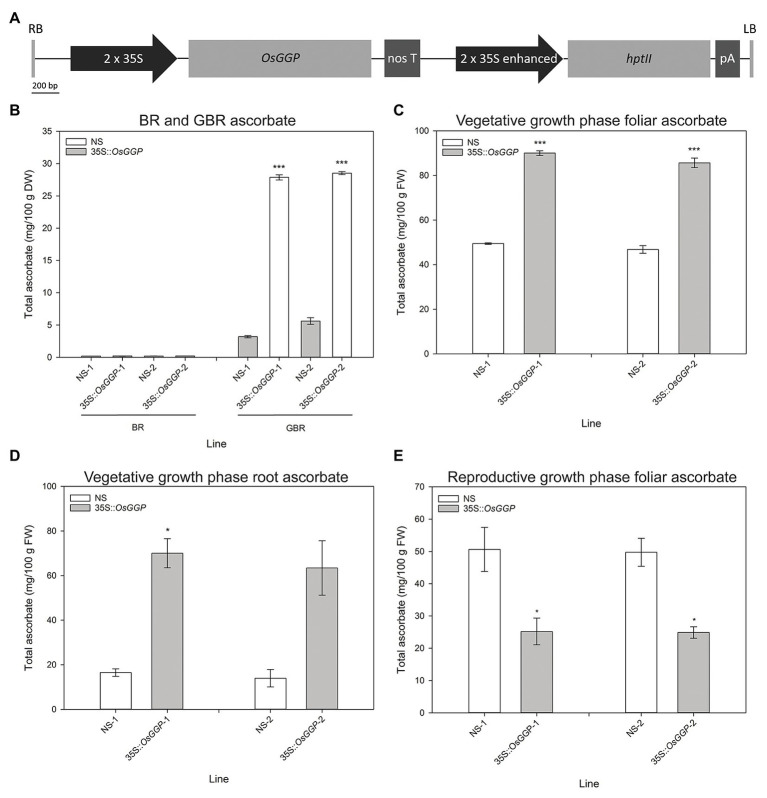
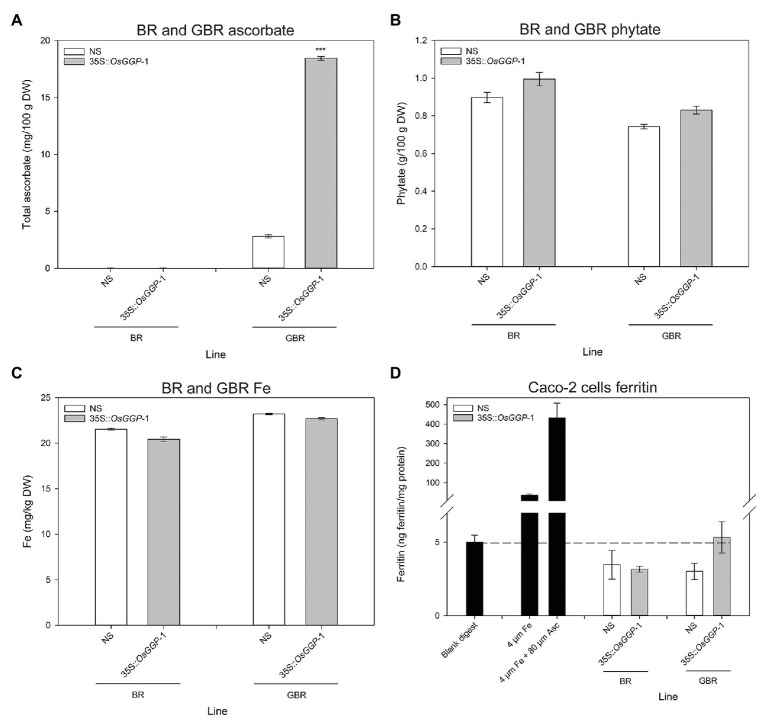
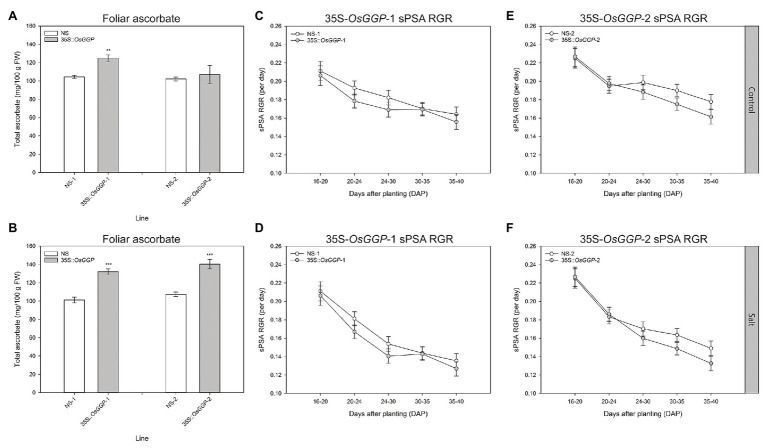
Ascorbate (vitamin C) is an essential multifunctional molecule for both plants and mammals. In plants, ascorbate is the most abundant water-soluble antioxidant that supports stress tolerance. In humans, ascorbate is an essential micronutrient and promotes iron (Fe) absorption in the gut. Engineering crops with increased ascorbate levels have the potential to improve both crop stress tolerance and human health. Here, rice ( L.) plants were engineered to constitutively overexpress the rice coding sequence (35S-), which encodes the rate-limiting enzymatic step of the L-galactose pathway. Ascorbate concentrations were negligible in both null segregant (NS) and 35S- brown rice (BR, unpolished grain), but significantly increased in 35S- germinated brown rice (GBR) relative to NS. Foliar ascorbate concentrations were significantly increased in 35S- plants in the vegetative growth phase relative to NS, but significantly reduced at the reproductive growth phase and were associated with reduced transcript levels. The 35S- plants did not display altered salt tolerance at the vegetative growth phase despite having elevated ascorbate concentrations. Ascorbate concentrations were positively correlated with ferritin concentrations in Caco-2 cells - an accurate predictor of Fe bioavailability in human digestion - exposed to digests of NS and 35S- BR and GBR samples.
抗坏血酸盐(维生素C)对植物和哺乳动物来说都是一种必需的多功能分子。在植物中,抗坏血酸盐是最丰富的水溶性抗氧化剂,可支持植物的胁迫耐受性。在人类中,抗坏血酸盐是一种必需的微量营养素,可促进肠道对铁(Fe)的吸收。培育抗坏血酸盐含量增加的作物有可能同时提高作物的胁迫耐受性和人类健康水平。在此,对水稻(L.)植株进行基因工程改造,使其组成型过表达水稻编码序列(35S-),该序列编码L-半乳糖途径的限速酶促步骤。在无效分离株(NS)和35S-糙米(BR,未抛光的谷粒)中,抗坏血酸盐浓度均可忽略不计,但相对于NS,35S-发芽糙米(GBR)中的抗坏血酸盐浓度显著增加。在营养生长阶段,35S-植株的叶片抗坏血酸盐浓度相对于NS显著增加,但在生殖生长阶段显著降低,且与转录水平降低有关。尽管35S-植株的抗坏血酸盐浓度升高,但其在营养生长阶段并未表现出盐耐受性的改变。在暴露于NS和35S-糙米及GBR样品消化物的Caco-2细胞(人类消化中铁生物利用度的准确预测指标)中,抗坏血酸盐浓度与铁蛋白浓度呈正相关。