Prom-U-Thai Chanakan, Rashid Abdul, Ram Hari, Zou Chunqin, Guilherme Luiz Roberto Guimaraes, Corguinha Ana Paula Branco, Guo Shiwei, Kaur Charanjeet, Naeem Asif, Yamuangmorn Supapohn, Ashraf Muhammad Yasin, Sohu Virinder Singh, Zhang Yueqiang, Martins Fábio Aurélio Dias, Jumrus Suchada, Tutus Yusuf, Yazici Mustafa Atilla, Cakmak Ismail
Agronomy Division, Department of Plant and Soil Sciences, Faculty of Agriculture, Chiang Mai University, Chiang Mai, Thailand.
Pakistan Academy of Sciences, Islamabad, Pakistan.
Front Plant Sci. 2020 Nov 13;11:589835. doi: 10.3389/fpls.2020.589835. eCollection 2020.
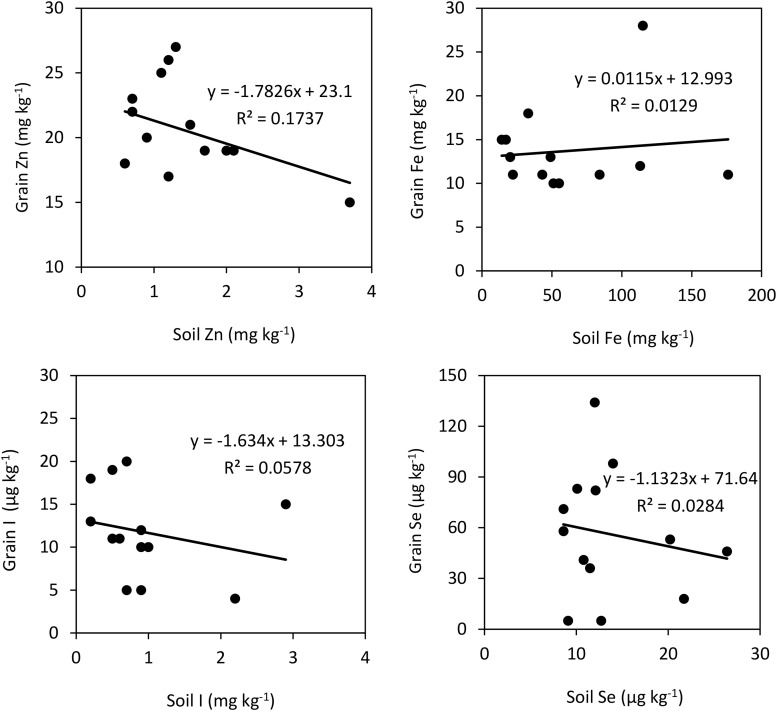
Widespread malnutrition of zinc (Zn), iodine (I), iron (Fe) and selenium (Se), known as hidden hunger, represents a predominant cause of several health complications in human populations where rice ( L.) is the major staple food. Therefore, increasing concentrations of these micronutrients in rice grain represents a sustainable solution to hidden hunger. This study aimed at enhancing concentration of Zn, I, Fe and Se in rice grains by agronomic biofortification. We evaluated effects of foliar application of Zn, I, Fe and Se on grain yield and grain concentration of these micronutrients in rice grown at 21 field sites during 2015 to 2017 in Brazil, China, India, Pakistan and Thailand. Experimental treatments were: (i) local control (LC); (ii) foliar Zn; (iii) foliar I; and (iv) foliar micronutrient cocktail (i.e., Zn + I + Fe + Se). Foliar-applied Zn, I, Fe or Se did not affect rice grain yield. However, brown rice Zn increased with foliar Zn and micronutrient cocktail treatments at all except three field sites. On average, brown rice Zn increased from 21.4 mg kg to 28.1 mg kg with the application of Zn alone and to 26.8 mg kg with the micronutrient cocktail solution. Brown rice I showed particular enhancements and increased from 11 μg kg to 204 μg kg with the application of I alone and to 181 μg kg with the cocktail. Grain Se also responded very positively to foliar spray of micronutrients and increased from 95 to 380 μg kg. By contrast, grain Fe was increased by the same cocktail spray at only two sites. There was no relationship between soil extractable concentrations of these micronutrients with their grain concentrations. The results demonstrate that irrespective of the rice cultivars used and the diverse soil conditions existing in five major rice-producing countries, the foliar application of the micronutrient cocktail solution was highly effective in increasing grain Zn, I and Se. Adoption of this agronomic practice in the target countries would contribute significantly to the daily micronutrient intake and alleviation of micronutrient malnutrition in human populations.
锌(Zn)、碘(I)、铁(Fe)和硒(Se)的广泛营养不良,即所谓的隐性饥饿,是大米(Oryza L.)为主食的人群中多种健康并发症的主要原因。因此,提高水稻籽粒中这些微量营养素的含量是解决隐性饥饿的可持续办法。本研究旨在通过农艺生物强化提高水稻籽粒中锌、碘、铁和硒的含量。我们评估了2015年至2017年期间在巴西、中国、印度、巴基斯坦和泰国的21个田间试验点,叶面喷施锌、碘、铁和硒对水稻籽粒产量以及这些微量营养素在籽粒中含量的影响。试验处理包括:(i)当地对照(LC);(ii)叶面喷施锌;(iii)叶面喷施碘;(iv)叶面喷施微量营养素组合(即锌+碘+铁+硒)。叶面喷施锌、碘、铁或硒对水稻籽粒产量没有影响。然而,除三个试验点外,糙米锌含量在叶面喷施锌和微量营养素组合处理下均有所增加。平均而言,单独施用锌时,糙米锌含量从21.4毫克/千克增加到28.1毫克/千克,施用微量营养素组合溶液时增加到26.8毫克/千克。糙米碘含量有显著提高,单独施用碘时从11微克/千克增加到204微克/千克,施用组合溶液时增加到181微克/千克。籽粒硒含量对叶面喷施微量营养素也有非常积极的反应,从95微克/千克增加到380微克/千克。相比之下,只有两个试验点的籽粒铁含量因喷施相同的组合溶液而增加。这些微量营养素在土壤中的可提取浓度与其在籽粒中的浓度之间没有关系。结果表明,无论使用何种水稻品种以及五个主要水稻生产国存在何种不同的土壤条件,叶面喷施微量营养素组合溶液对提高籽粒锌、碘和硒含量非常有效。在目标国家采用这种农艺措施将对人群每日微量营养素摄入量以及缓解微量营养素营养不良做出重大贡献。