Equipe Labellisée Par La Ligue Contre Le Cancer, Université De Paris, Sorbonne Université, INSERM U1138, Centre De Recherche Des Cordeliers, Paris, France.
Metabolomics and Cell Biology Platforms, Gustave Roussy Cancer Campus, Villejuif, France.
Oncoimmunology. 2020 Dec 8;9(1):1857112. doi: 10.1080/2162402X.2020.1857112.
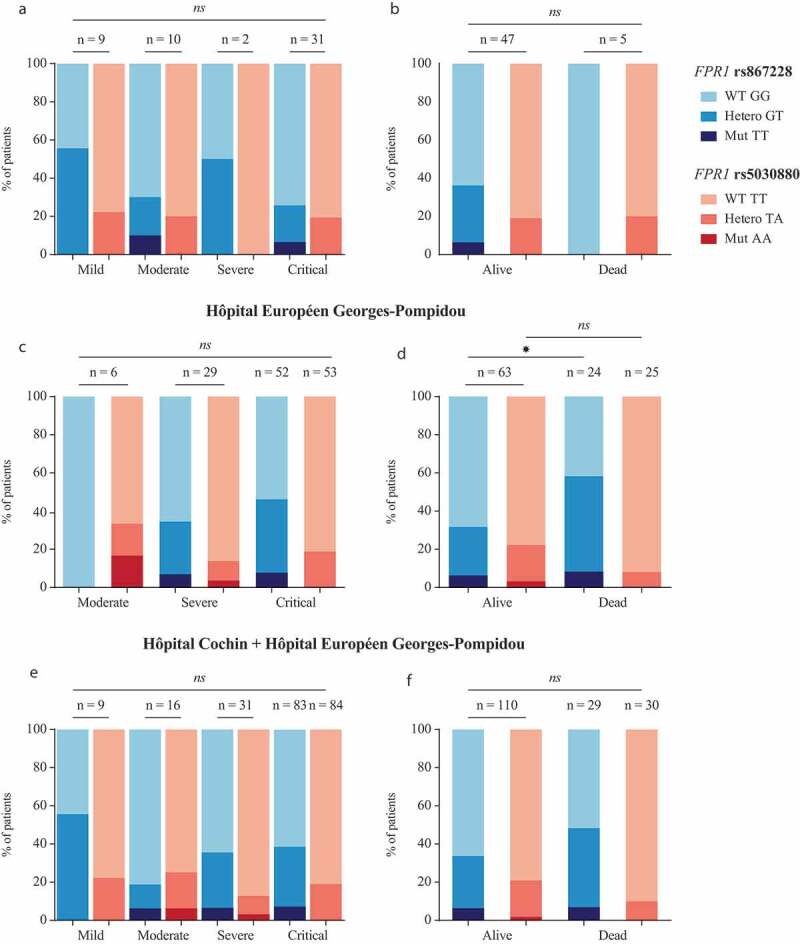
Formyl peptide receptor 1 (FPR1) is a pattern-recognition receptor that detects bacterial as well as endogenous danger-associated molecular patterns to trigger innate immune responses by myeloid cells. A single nucleotide polymorphism, rs867228 (allelic frequency 19-20%), in the gene coding for FPR1 accelerates the manifestation of multiple carcinomas, likely due to reduced anticancer immunosurveillance secondary to a defect in antigen presentation by dendritic cells. Another polymorphism in , rs5030880 (allelic frequency 12-13%), has been involved in the resistance to plague, correlating with the fact that FPR1 is the receptor for . Driven by the reported preclinical effects of FPR1 on lung inflammation and fibrosis, we investigated whether rs867228 or rs5030880 would affect the severity of coronavirus disease-19 (COVID-19). Data obtained on patients from two different hospitals in Paris refute the hypothesis that rs867228 or rs5030880 would affect the severity of COVID-19.
甲酰肽受体 1(FPR1)是一种模式识别受体,可识别细菌和内源性危险相关分子模式,从而触发髓样细胞的固有免疫反应。编码 FPR1 的基因中的单核苷酸多态性 rs867228(等位基因频率为 19-20%)加速了多种癌症的发生,这可能是由于树突状细胞抗原呈递缺陷导致抗癌免疫监视减少所致。另一种多态性 rs5030880(等位基因频率为 12-13%)与鼠疫的耐药性有关,这与 FPR1 是鼠疫的受体有关。由于 FPR1 对肺部炎症和纤维化的临床前作用的报道,我们研究了 rs867228 或 rs5030880 是否会影响 COVID-19 的严重程度。从巴黎两家不同医院的患者中获得的数据否定了 rs867228 或 rs5030880 会影响 COVID-19 严重程度的假设。