Zhang Zhen, Rahmat Juwita Norasmara, Mahendran Ratha, Zhang Yong
Department of Biomedical Engineering Faculty of Engineering National University of Singapore Singapore 117583 Singapore.
Department of Surgery Yong Loo Lin School of Medicine National University of Singapore Singapore 119228 Singapore.
Adv Sci (Weinh). 2020 Nov 7;7(24):2001831. doi: 10.1002/advs.202001831. eCollection 2020 Dec.
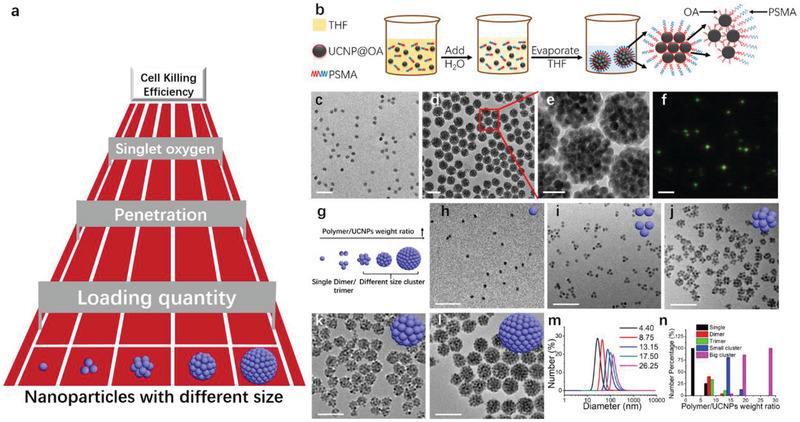
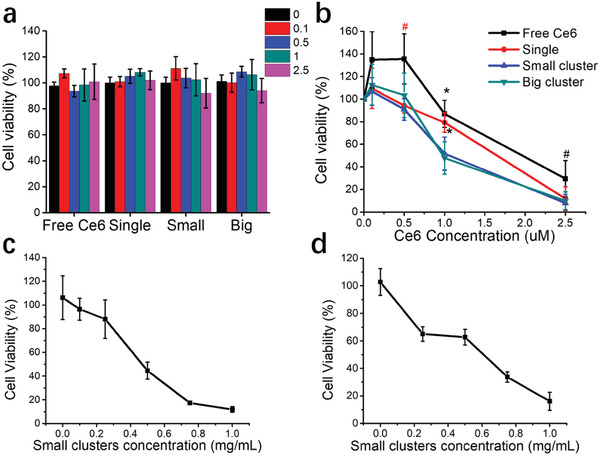
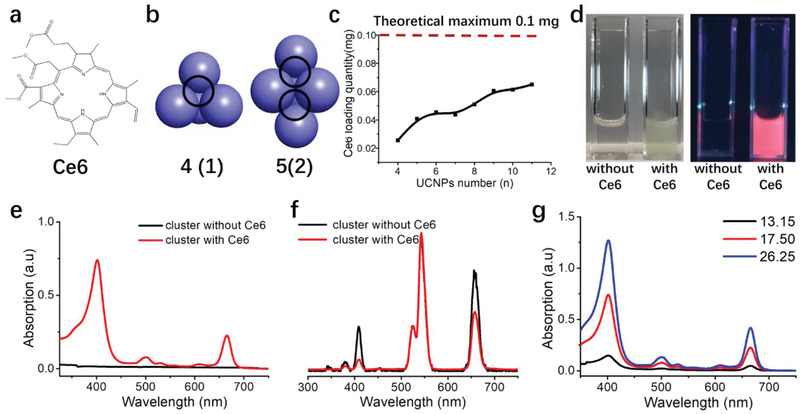
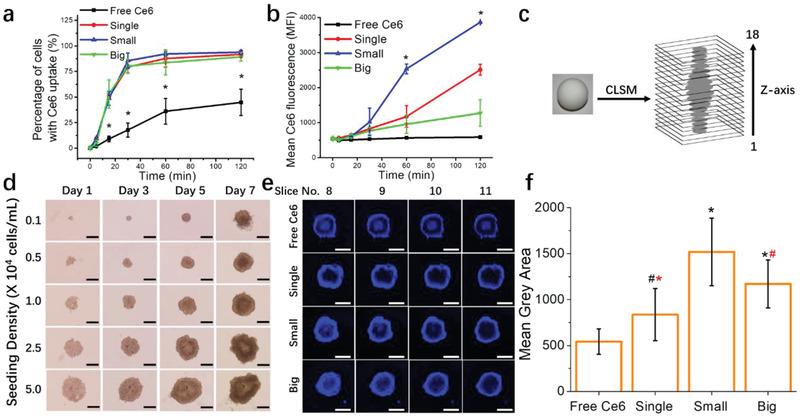
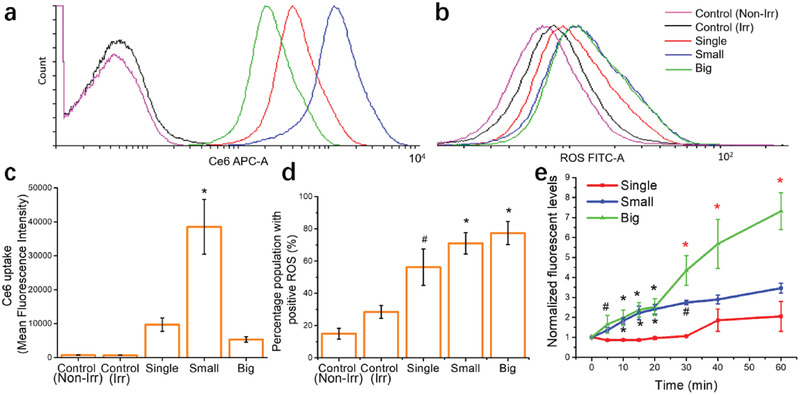
The use of upconversion nanoparticles (UCNPs) for treating deep-seated cancers and large tumors has recently been gaining momentum. Conventional approaches for loading photosensitizers (PS) to UCNPs using noncovalent physical adsorption and covalent conjugation had been previously described. However, these methods are time-consuming and require extra modification steps. Incorporating PS loading during the controlled UCNPs assembly process is seldom reported. In this study, an amphiphilic copolymer, poly(styrene--maleic anhydride), is used to instruct UCNPs assembly formations into well-controlled UCNPs clusters of various sizes, and the gap zones formed between individual UCNPs can be used to encapsulate PS. This nanostructure production process results in a considerably simpler and reliable method to load PS and other compounds. Also, after considering factors such as PS loading quantity, penetration in 3D bladder tumor organoids, and singlet oxygen production, the small UCNPs clusters displayed superior cell killing efficacy compared to single and big sized clusters. Therefore, these UCNPs clusters with different sizes could facilitate a clear and deep understanding of nanoparticle-based delivery platform systems for cell killing and may pave a new way for other fields of UCNPs based applications.
近年来,将上转换纳米颗粒(UCNPs)用于治疗深部癌症和大型肿瘤的研究日益受到关注。此前已有使用非共价物理吸附和共价共轭将光敏剂(PS)负载到UCNPs上的传统方法。然而,这些方法耗时且需要额外的修饰步骤。在UCNPs可控组装过程中进行PS负载的报道很少。在本研究中,一种两亲性共聚物聚(苯乙烯-马来酸酐)被用于指导UCNPs组装形成各种尺寸可控的UCNPs簇,并且单个UCNPs之间形成的间隙区域可用于封装PS。这种纳米结构生产过程产生了一种相当简单且可靠的PS及其他化合物负载方法。此外,在考虑了PS负载量、在三维膀胱肿瘤类器官中的穿透性以及单线态氧生成等因素后,小尺寸的UCNPs簇与单个及大尺寸簇相比显示出更高的细胞杀伤效果。因此,这些不同尺寸的UCNPs簇有助于更清晰、深入地理解基于纳米颗粒的细胞杀伤递送平台系统,并可能为UCNPs在其他应用领域开辟一条新途径。