Yang Ming, Cheng Yong-Ran, Zhou Meng-Yun, Wang Ming-Wei, Ye Lan, Xu Zu-Cai, Feng Zhan-Hui, Ma Xun-Tai
Neurosurgical Department, Affiliated Hospital of Guizhou Medical University, Guiyang, China.
School of Public Health, Hangzhou Medical College, Hangzhou, China.
Front Oncol. 2020 Dec 4;10:568369. doi: 10.3389/fonc.2020.568369. eCollection 2020.
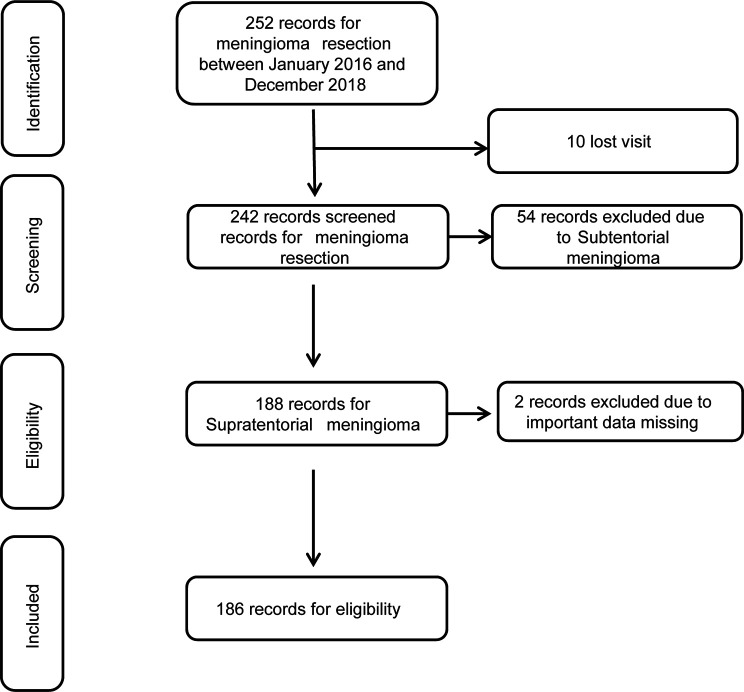
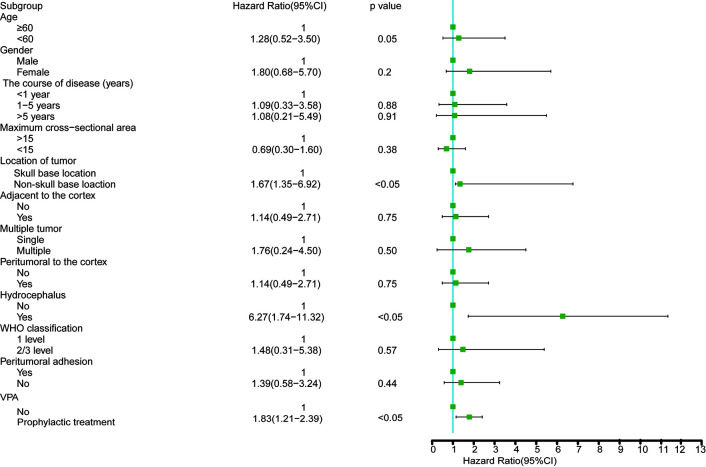
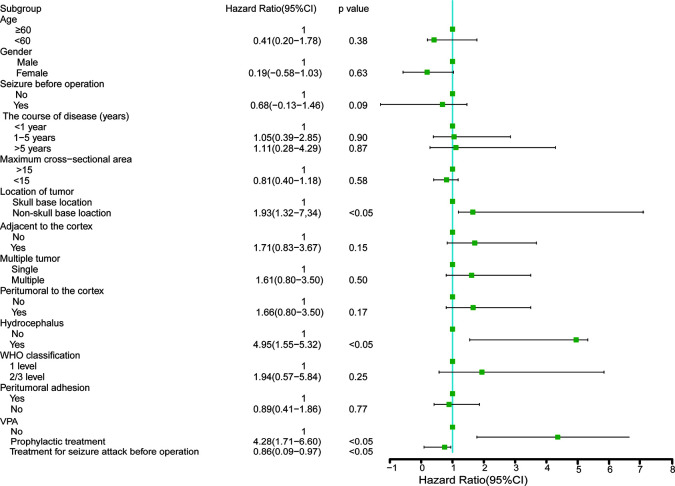
Meningiomas, the most common brain tumor, inevitably require surgical treatment. However, the efficacy of prophylactic antiepileptic drugs (AEDs), in reducing the frequency of new-onset seizures during the perioperative period remains controversial. To further clarify if prophylactic antiepileptic drug treatment for patients with meningioma had value, we reviewed the medical records of 186 supratentorial meningioma patients who were operated at our hospital between 2016 and 2018. SPSS 24.0 software was used for statistical analysis. The results of univariate analysis showed that factors including age, sex, the course of the disease (years), maximum cross-sectional area of the tumor, location of the tumor, multiple or single tumors, adjacent to the cortex, peritumoral brain edema, World Health Organization classification, and peritumoral adhesion were not associated with perioperative seizures ( >0.05). Furthermore, the results of multivariate analysis revealed hydrocephalus (OR 4.87 P = 0.05) and non-skull base location (OR 1.88 P = 0.04) were significant risk factors for perioperative in-hospital seizures. Prophylactic valproic acid treatment did not contribute to the alleviation of perioperative seizures (OR 1.76 P = 0.04). However, Multivariate logistic regression analyses excluding the patients with seizures before operation confirmed prophylactic valproic acid treatment did not reduce the frequency of seizures during the perioperative period (OR 1.84 P = 0.04). Taken together, the data suggest that prophylactic valproic acid treatment for patients with supratentorial meningioma does not reduce the rate of perioperative seizures.
脑膜瘤是最常见的脑肿瘤,不可避免地需要手术治疗。然而,预防性抗癫痫药物(AEDs)在降低围手术期新发癫痫发作频率方面的疗效仍存在争议。为了进一步明确脑膜瘤患者预防性抗癫痫药物治疗是否有价值,我们回顾了2016年至2018年在我院接受手术的186例幕上脑膜瘤患者的病历。使用SPSS 24.0软件进行统计分析。单因素分析结果显示,年龄、性别、病程(年)、肿瘤最大横截面积、肿瘤位置、肿瘤多发或单发、是否邻近皮质、瘤周脑水肿、世界卫生组织分级以及瘤周粘连等因素与围手术期癫痫发作无关(P>0.05)。此外,多因素分析结果显示脑积水(OR 4.87,P = 0.05)和非颅底位置(OR 1.88,P = 0.04)是围手术期院内癫痫发作的显著危险因素。预防性丙戊酸治疗对缓解围手术期癫痫发作无作用(OR 1.76,P = 0.04)。然而,排除术前有癫痫发作的患者后进行多因素逻辑回归分析证实,预防性丙戊酸治疗并不能降低围手术期癫痫发作频率(OR 1.84,P = 0.04)。综上所述,数据表明幕上脑膜瘤患者预防性丙戊酸治疗并不能降低围手术期癫痫发作率。