Murakami Michio, Takebayashi Yoshitake, Harigane Mayumi, Mizuki Rie, Suzuki Yuriko, Ohira Tetsuya, Maeda Masaharu, Yasumura Seiji
Radiation Medical Science Center for the Fukushima Health Management Survey, Fukushima Medical University, Fukushima, 960-1295, Japan.
Department of Health Risk Communication, Fukushima Medical University School of Medicine, Fukushima, 960-1295, Japan.
SSM Popul Health. 2020 Dec 3;12:100706. doi: 10.1016/j.ssmph.2020.100706. eCollection 2020 Dec.
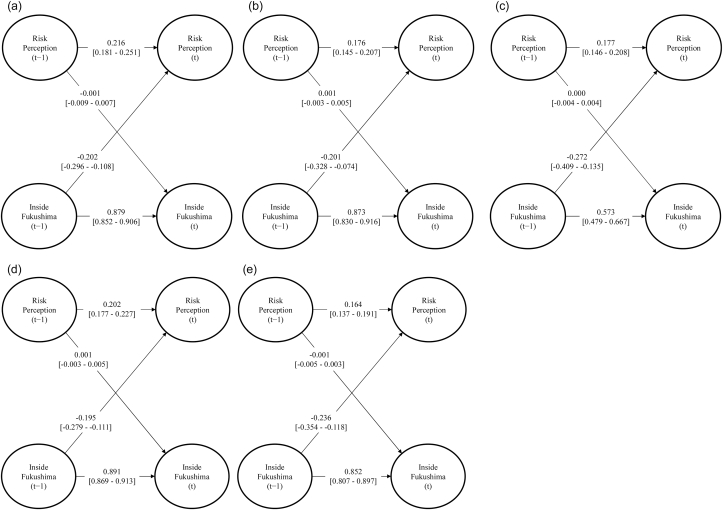
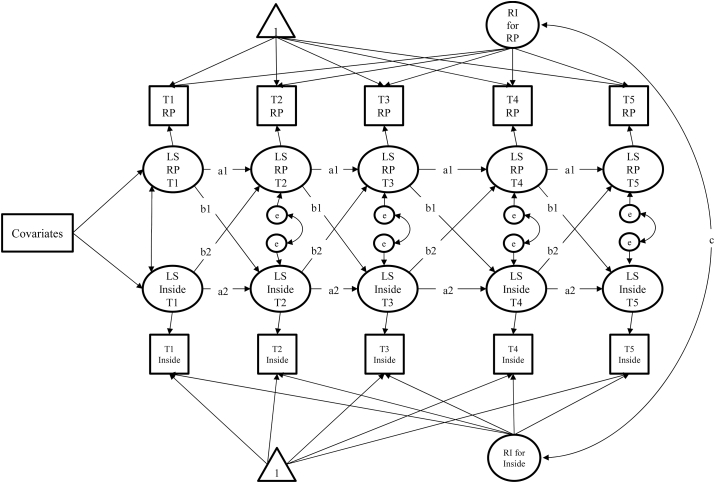
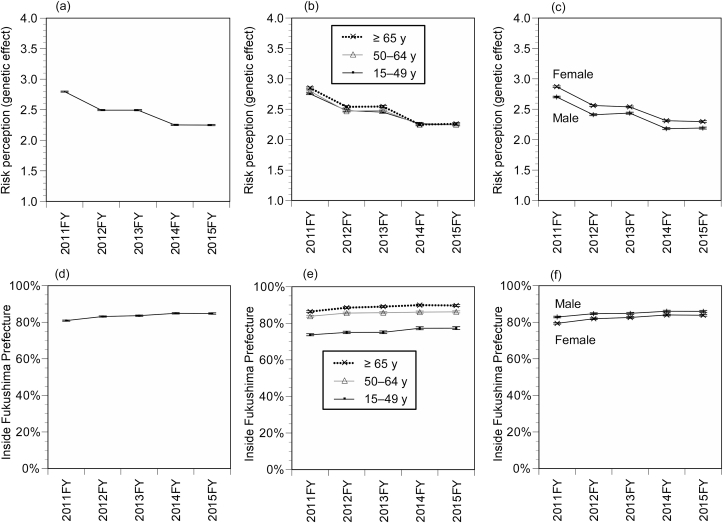
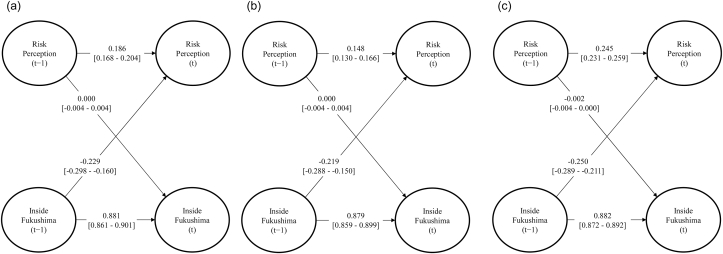
In the aftermath of a nuclear disaster, a person's radiation risk perception can harm their sociopsychological health. Although there are reports of an association between radiation risk perception and relocation, the direction of this association has not been clarified yet. In this study, we used a random-intercept and cross lagged panel model (RI-CLPM) to investigate the association and its direction between radiation risk perception and the prefectural-level relocation (i.e., inside/outside of Fukushima Prefecture). We did this by using five waves of longitudinal surveys between 2011 fiscal year and 2015 fiscal year among the people affected by the Fukushima disaster in 2011. We included 90,567 participants aged ≥15 years during the time of the disaster who responded to the questionnaire at least once. RI-CLPM was applied to examine the reciprocal relationship between radiation risk perception and locations. We used two radiation risk perception indicators (i.e., genetic effect and delayed effect) and two handling methods on missing data (i.e., listwise deletion and full information maximum likelihood estimation) as sensitive analyses. The effects of radiation risk perception on relocation were found to be negligibly small. Living inside Fukushima Prefecture reduced radiation risk perception irrespective of the difference of indicators or methods, highlighting that radiation risk perception did not dominantly govern whether people were living inside Fukushima Prefecture, but that the locations also affected radiation risk perception. This was the first study to reveal the direction of the association between radiation risk perception and relocation in the aftermath of nuclear disasters.
在核灾难之后,一个人的辐射风险认知可能会损害其社会心理健康。尽管有报道称辐射风险认知与搬迁之间存在关联,但这种关联的方向尚未明确。在本研究中,我们使用随机截距和交叉滞后面板模型(RI-CLPM)来调查辐射风险认知与县级搬迁(即福岛县境内/境外)之间的关联及其方向。我们通过对2011年受福岛灾难影响的人群在2011财年至2015财年期间进行的五波纵向调查来做到这一点。我们纳入了90567名在灾难发生时年龄≥15岁且至少回复过一次问卷的参与者。应用RI-CLPM来检验辐射风险认知与地点之间的相互关系。我们使用两个辐射风险认知指标(即遗传效应和延迟效应)以及两种处理缺失数据的方法(即列删除法和全信息极大似然估计法)作为敏感性分析。结果发现辐射风险认知对搬迁的影响极小。无论指标或方法的差异如何,居住在福岛县境内都会降低辐射风险认知,这突出表明辐射风险认知并非主要决定人们是否居住在福岛县境内,而是地点也会影响辐射风险认知。这是第一项揭示核灾难后辐射风险认知与搬迁之间关联方向的研究。