Martínez Aaron, Nakazato Kosuke, Scheiber Peter, Snyder Cory, Stöggl Thomas
Department of Sport and Exercise Science, University of Salzburg, Salzburg, Austria.
Faculty of Information Media, Hokkaido Information University, Ebetsu, Japan.
Front Sports Act Living. 2020 Jan 23;2:2. doi: 10.3389/fspor.2020.00002. eCollection 2020.
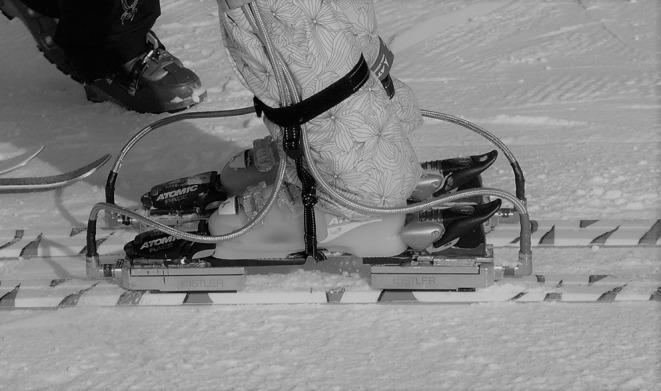
Several methods to determine turn switch points during alpine skiing using the vertical GRF exist in the literature. Although comparative studies between pressure insoles (PI) and force platforms (FP) have been conducted, there are no reports comparing the detected time points. Yet, these sensors and methods have been used interchangeably. This study aims to compare the turn switch time points with both sensors and various methods. Twenty skiers performed turns with FP and PI for two different ski styles (high and low dynamic turns). Three different assessment methodologies were compared: minima, functional minima, and crossings. Bland Altman and repeated measures ANOVA were used to assess statistical differences. Main effects of sensor and method were observed ( < 0.001). Although there was a low effect size ( = 0.013) between FP and PI, the 95% CI yielded values representing >30% of the turn duration. A large effect size (η = 0.153) was found between the crossing method and the minima and functional minima methods. This indicates that those methods assess different events during the turn switch phase. In conclusion, the sensors and assessment methodologies compared in this study are not interchangeable with the possible exception of the minima and functional minima assessed with FP.
文献中存在几种利用垂直地面反作用力(GRF)来确定高山滑雪时转弯切换点的方法。尽管已经对压力鞋垫(PI)和测力平台(FP)进行了比较研究,但尚无比较检测时间点的报告。然而,这些传感器和方法一直被交替使用。本研究旨在比较两种传感器以及各种方法的转弯切换时间点。20名滑雪者使用FP和PI进行两种不同滑雪风格(高动态转弯和低动态转弯)的转弯。比较了三种不同的评估方法:最小值、功能最小值和交叉点。采用布兰德-奥特曼分析和重复测量方差分析来评估统计差异。观察到传感器和方法的主要效应(<0.001)。尽管FP和PI之间的效应量较低(=0.013),但95%置信区间产生的值占转弯持续时间的>30%。交叉点方法与最小值和功能最小值方法之间发现了较大的效应量(η=0.153)。这表明这些方法在转弯切换阶段评估的是不同的事件。总之,本研究中比较的传感器和评估方法除了用FP评估的最小值和功能最小值外不可互换。