Department of Sport Science and Kinesiology, University of Salzburg, Hallein-Rif, Austria.
Laboratory of Movement Analysis and Measurement, École Polytechnique Fédérale de Lausanne, Lausanne, Switzerland.
Orthop J Sports Med. 2016 Feb 25;4(2):2325967116630719. doi: 10.1177/2325967116630719. eCollection 2016 Feb.
A combination of frontal bending, lateral bending, and torsion in the loaded trunk has been suggested to be a mechanism leading to overuse injuries of the back in Alpine ski racing. However, there is limited knowledge about the effect of course setting on the aforementioned back-loading patterns.
To investigate the effect of increased gate offset on the skier's overall trunk kinematics and the occurring ground-reaction forces and to compare these variables between the competition disciplines giant slalom (GS) and slalom (SL).
Controlled laboratory study.
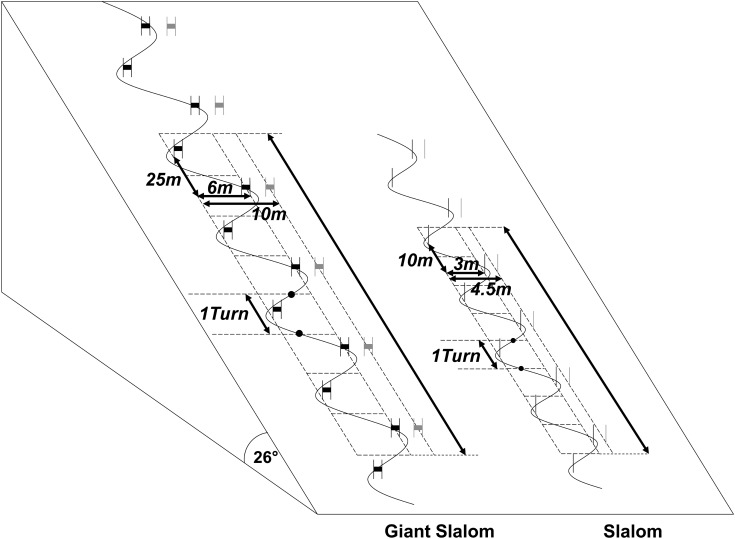
Ten top-level athletes were divided into GS and SL groups. Both groups performed a total of 240 GS and 240 SL turns at 2 different course settings. The overall trunk movement components (frontal bending, lateral bending, and torsion angle) were measured using 2 inertial measurement units fixed on the sacrum and sternum. Total ground-reaction forces were measured by pressure insoles.
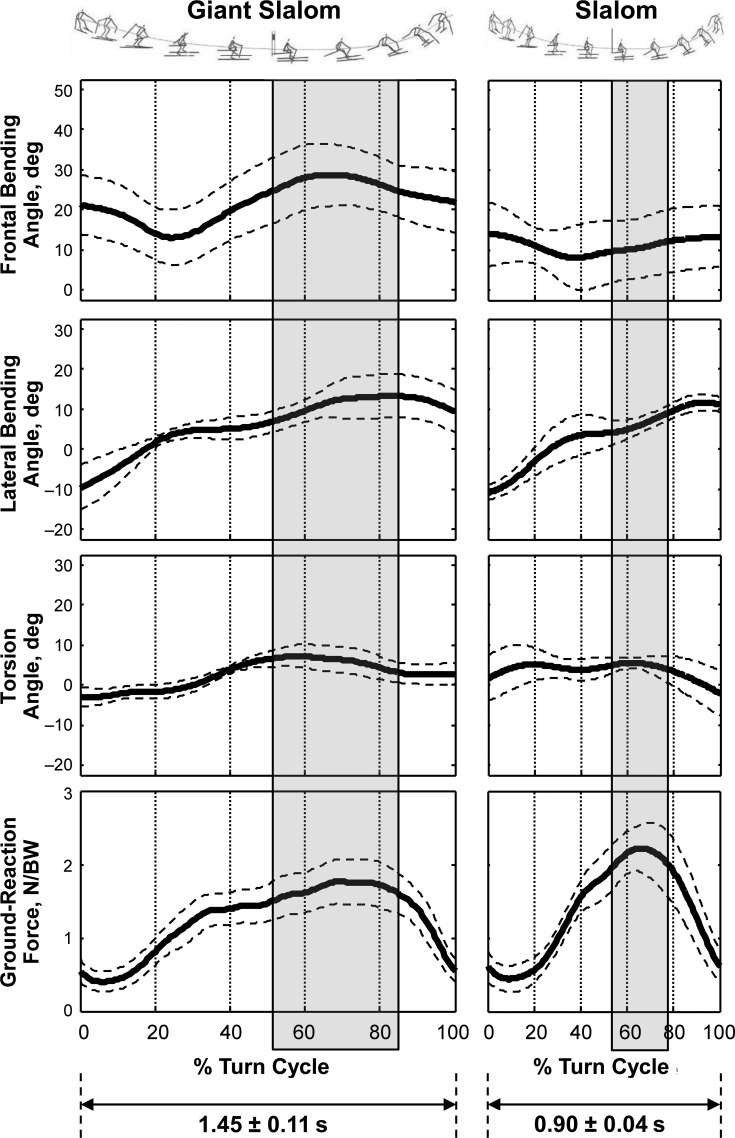
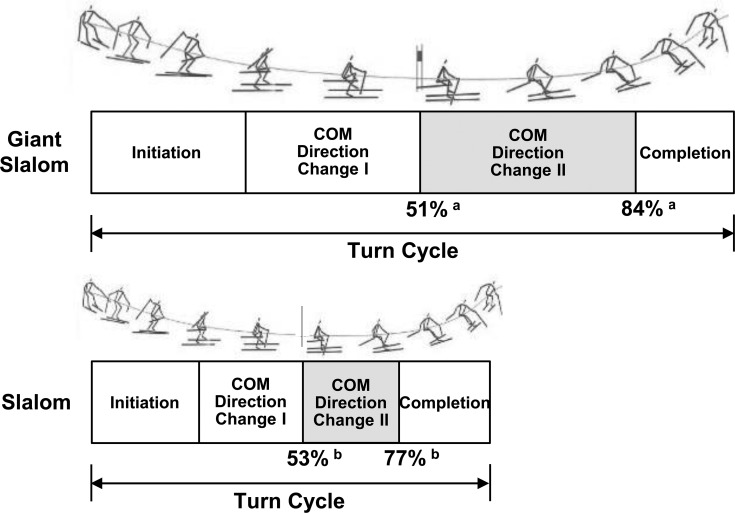
In SL, ground-reaction force peaks were significantly lower when the gate offset was increased, while in GS, no differences between course settings were observed. During the turn phase in which the highest spinal disc loading is expected to occur, the back-loading patterns in both GS and SL included a combination of frontal bending, lateral bending, and torsion in the loaded trunk. SL was characterized by shorter turns, lower frontal and lateral bending angles after gate passage, and a trend toward greater total ground-reaction force peaks compared with GS.
Course setting is a reasonable measure to reduce the skier's overall back loading in SL but not in GS. The distinct differences observed between GS and SL should be taken into account when defining discipline-specific prevention measures for back overuse injuries.
To reduce the magnitude of the overall back loading, in SL, minimal gate offsets should be avoided. Prevention measures in GS might particularly need to control and/or reduce the magnitude of frontal and lateral bending in the loaded trunk, whereas prevention measures in SL might especially need to mitigate the short and high total ground-reaction force peaks.
在高山滑雪比赛中,人们认为负荷躯干的前屈、侧屈和扭转的组合是导致背部过度使用损伤的机制。然而,对于赛道设置对上述背部负荷模式的影响,人们的了解有限。
研究增加门间距对滑雪者整体躯干运动学和地面反作用力的影响,并比较大回转(GS)和小回转(SL)这两个竞赛项目之间的这些变量。
对照实验室研究。
10 名顶级运动员分为 GS 和 SL 两组。两组在 2 种不同的赛道设置下,分别完成了 240 次 GS 和 240 次 SL 转弯。使用固定在骶骨和胸骨上的 2 个惯性测量单元测量整体躯干运动成分(前屈、侧屈和扭转角度)。通过压力鞋垫测量总地面反作用力。
在 SL 中,当门间距增加时,地面反作用力峰值显著降低,而在 GS 中,不同赛道设置之间没有差异。在预期发生最高椎间盘负荷的转弯阶段,GS 和 SL 中的背负荷模式均包括负荷躯干的前屈、侧屈和扭转。与 GS 相比,SL 的转弯半径更短,过门后前屈和侧屈角度更小,总地面反作用力峰值有增大的趋势。
赛道设置是一种合理的措施,可以减少 SL 中滑雪者整体背部的负荷,但在 GS 中不行。GS 和 SL 之间观察到的明显差异,在制定针对背部过度使用损伤的专项预防措施时应予以考虑。
为了降低整体背部负荷的幅度,在 SL 中应尽量避免最小的门间距。在 GS 中,预防措施可能特别需要控制和/或降低负荷躯干的前屈和侧屈幅度,而在 SL 中,预防措施可能特别需要减轻短而高的总地面反作用力峰值。