Department of Epidemiology and Statistics, College of Public Health, Zhengzhou University, Zhengzhou, Henan Province, China.
State Key Laboratory of Esophageal Cancer Prevention and Treatment and Henan Key Laboratory of Tumor Epidemiology, Zhengzhou University, Zhengzhou, Henan Province, China.
Clin Transl Gastroenterol. 2020 Dec 21;12(1):e00284. doi: 10.14309/ctg.0000000000000284.
Previous studies have demonstrated that autoantibodies against tumor-associated antigens (TAAs) in patients with cancer can be used as sensitive immunodiagnostic biomarkers for the detection of cancer. Most of these TAAs are involved in the tumorigenesis pathway. Cancer driver genes with intragenic mutations can promote tumorigenesis. This study aims to identify autoantibodies against TAAs encoded by cancer driver genes in sera as potential immunodiagnostic biomarkers for gastric adenocarcinoma (GAC).
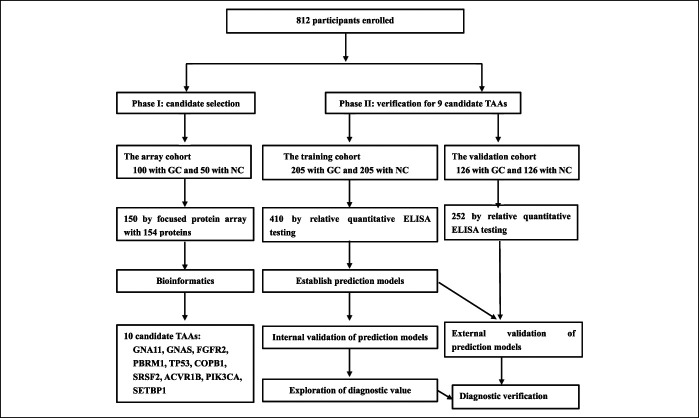
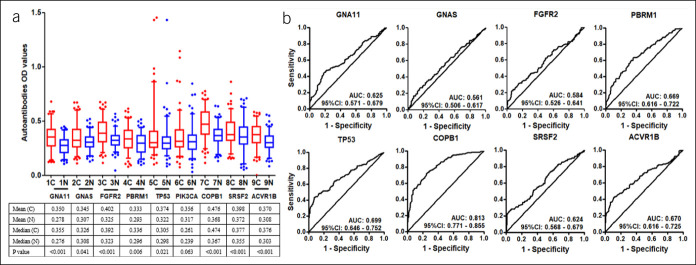
Protein arrays based on cancer driver genes were customized for screening candidate TAAs in 100 GAC sera and 50 normal control (NC) sera. Autoantibodies against candidate TAAs were assessed by enzyme-linked immunosorbent assay in both training group (205 GAC sera and 205 NC sera) and independent validation group (126 GAC sera and 126 NC sera). Moreover, the immunodiagnostic models were respectively established and validated in the training group and validation group.
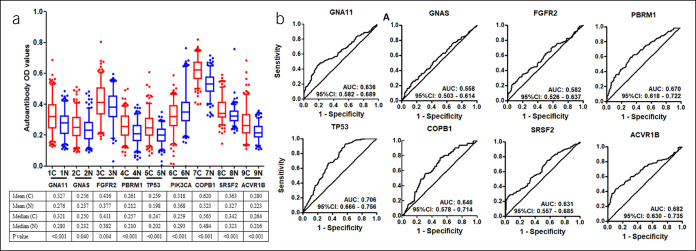
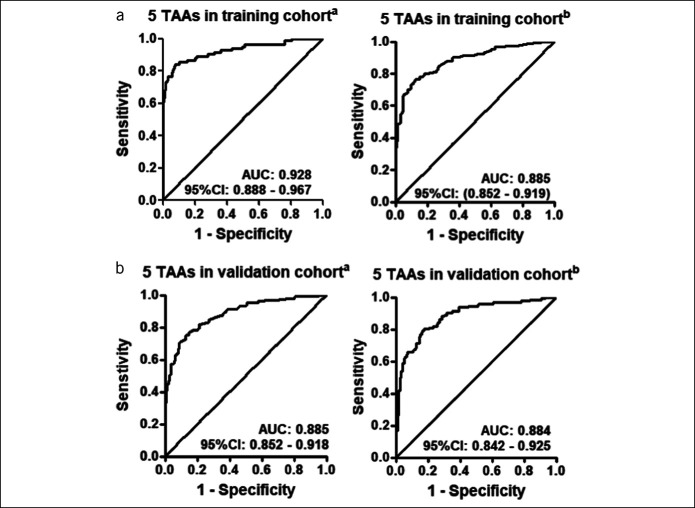
A panel with 5 autoantibodies including anti-TP53, anti-COPB1, anti-GNAS, anti-serine/arginine-rich splicing factor 2, and anti-SMARCB1 was selected by the Fisher linear discriminant analysis model with an areas under receiver operating characteristic curve (AUC) of 0.928 (95% confidence interval [CI]: 0.888-0.967) in the training cohort and an AUC of 0.885 (95% CI: 0.852-0.918) in the validation cohort. Besides, the panel with 5 autoantibodies including anti-TP53, anti-COPB1, anti-GNAS, anti-PBRM1, and anti-ACVR1B which were selected by the binary logistic regression model showed an AUC of 0.885 (95% CI: 0.852-0.919) in the training cohort and 0.884 (95% CI: 0.842-0.925) in the validation cohort.
Two panels which were selected in this study could boost the detection of anti-TAA autoantibodies in sera as biomarkers for the detection of GAC.
先前的研究表明,癌症患者体内针对肿瘤相关抗原(TAA)的自身抗体可用作癌症检测的敏感免疫诊断生物标志物。这些 TAA 大多参与肿瘤发生途径。具有内含子突变的癌症驱动基因可以促进肿瘤发生。本研究旨在鉴定血清中癌症驱动基因编码的 TAA 所对应的自身抗体,作为胃腺癌(GAC)潜在的免疫诊断生物标志物。
根据癌症驱动基因定制蛋白芯片,用于筛选 100 例 GAC 血清和 50 例正常对照(NC)血清中的候选 TAA。采用酶联免疫吸附试验检测候选 TAA 的自身抗体,分别在训练组(205 例 GAC 血清和 205 例 NC 血清)和独立验证组(126 例 GAC 血清和 126 例 NC 血清)中进行评估。此外,在训练组和验证组中分别建立和验证免疫诊断模型。
采用 Fisher 线性判别分析模型筛选出 5 种自身抗体(抗 TP53、抗 COPB1、抗 GNAS、抗丝氨酸/精氨酸丰富剪接因子 2 和抗 SMARCB1)组成的panel,在训练队列中的曲线下面积(AUC)为 0.928(95%置信区间[CI]:0.888-0.967),在验证队列中的 AUC 为 0.885(95% CI:0.852-0.918)。此外,采用二项逻辑回归模型筛选出的 5 种自身抗体(抗 TP53、抗 COPB1、抗 GNAS、抗 PBRM1 和抗 ACVR1B)组成的 panel,在训练队列中的 AUC 为 0.885(95% CI:0.852-0.919),在验证队列中的 AUC 为 0.884(95% CI:0.842-0.925)。
本研究中筛选出的两个panel 可提高血清中抗 TAA 自身抗体作为 GAC 检测生物标志物的检测率。